
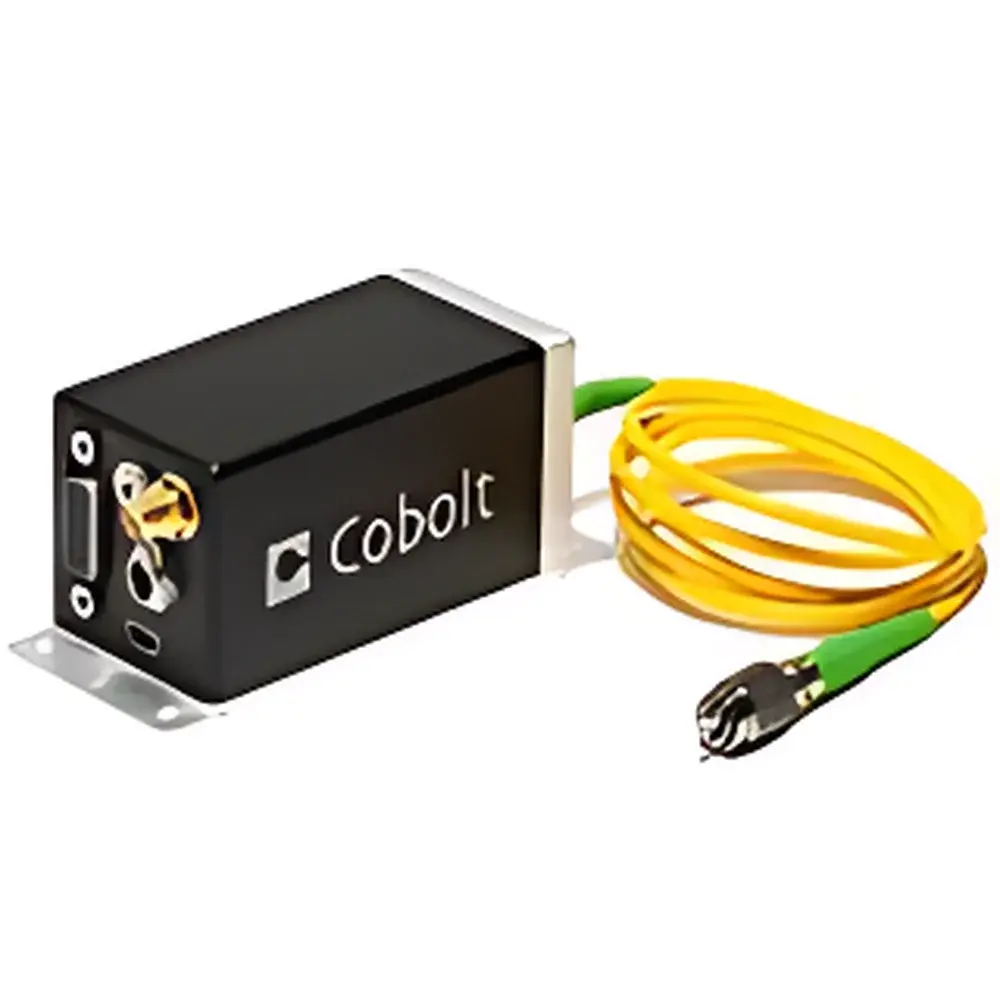
Cobolt THCure Fiber-Pigtailed Diode Laser Module
| Brand | Cobolt |
|---|---|
| Origin | Sweden |
| Model | Cobolt THCure Series |
| Wavelength | 640 nm / 660 nm |
| Output Power (Fiber-Coupled) | ≤75 mW |
| Spatial Mode | TEM₀₀, M² = 1.1 |
| Mode Field Diameter (MFD) | 4.5 µm |
| Spectral Linewidth (FWHM) | <1.2 nm |
| Polarization Ratio | >100:1 |
| Relative Intensity Noise (RIN, 250 Hz–2 MHz) | <0.2% (rms) |
| Power Stability (8 h) | <0.5% |
| Modulation | Digital (DC–150 MHz), Analog (DC–2 MHz), Remote ON/OFF (DC–500 kHz) |
| Rise/Fall Times | <2.5 ns (digital), <200 ns (analog), <500 ns (ON/OFF) |
| Operating Baseplate Temperature | ≤50 °C |
| Total Power Consumption | <10 W |
| Fiber Type | 1 m single-mode or polarization-maintaining fiber with 3 mm jacketing |
| Numerical Aperture | 0.09 |
| Output Connector | FC/APC (non-collimated) |
| Communication Interface | RS-232 and USB |
| Warranty | 12 months |
Overview
The Cobolt THCure Fiber-Pigtailed Diode Laser Module is an engineered solution for applications demanding high spectral purity, exceptional beam quality, and long-term power stability in a compact, fiber-coupled format. Leveraging Cobolt’s proprietary THCure (Thermal High-stability Curing) technology, the laser diode chip is permanently bonded to the optical fiber using a thermally optimized, low-stress curing process—eliminating mechanical micro-misalignment drift and ensuring robust performance under thermal cycling and vibration. Unlike standard pigtailed modules relying on epoxy-based alignment, the THCure architecture delivers intrinsic mechanical and thermal stability, making it suitable for integration into demanding OEM instrumentation—including confocal microscopy, flow cytometry, Raman spectroscopy, and quantum optics platforms—where reproducibility across environmental variations is non-negotiable.
Key Features
- TEM₀₀ spatial mode with M² ≤ 1.1 and mode field diameter of 4.5 µm—optimized for efficient coupling into single-mode fibers and high-resolution optical systems.
- Narrow spectral linewidth (100:1), enabling interference-sensitive applications such as heterodyne detection and coherent excitation.
- Ultra-low relative intensity noise (<0.2% rms, 250 Hz–2 MHz) and excellent short- and long-term power stability (<0.5% over 8 hours), critical for quantitative fluorescence measurements and lock-in detection schemes.
- Multi-domain modulation capability: digital modulation up to 150 MHz with >10⁴ extinction ratio and sub-2.5 ns switching; analog modulation up to 2 MHz; and remote TTL-compatible ON/OFF control up to 500 kHz.
- Low thermal load design: maximum baseplate temperature limited to 50 °C with total system power consumption <10 W—facilitating air-cooled integration in space-constrained enclosures.
- Standard configuration includes 1 m SMF-28 or PM fiber with 3 mm jacketing and FC/APC connector; custom lengths, fiber types (e.g., HI1060, Panda PM), and termination options (e.g., FC/PC, SC/APC, free-space collimation) are supported per OEM requirements.
Sample Compatibility & Compliance
The module is designed for integration into Class 3B laser systems compliant with IEC 60825-1:2014 and FDA 21 CFR Part 1040.10/1040.11. When paired with Cobolt’s optional CDRH-compliant control box (key-switch enabled), the system meets U.S. regulatory requirements for clinical and industrial laser products. All units undergo factory calibration and verification against traceable NIST standards for output power, wavelength, and polarization characteristics. The device operates within ISO 14644-1 Class 8 cleanroom-compatible environments and conforms to RoHS 2015/863/EU and REACH (EC 1907/2006) material restrictions. No special sample preparation is required—the laser emits directly through the fiber output and interfaces seamlessly with standard optomechanical mounts, fiber couplers, and spectrometers.
Software & Data Management
Laser operation is managed via bidirectional RS-232 or USB 2.0 interface using Cobolt’s standardized ASCII command protocol. Host software (Windows/Linux/macOS) provides real-time monitoring of output power, temperature, modulation status, and fault diagnostics—including over-temperature shutdown, current limit alerts, and interlock state reporting. Firmware supports full audit trail logging (timestamped parameter changes, error events) compatible with GLP/GMP workflows requiring 21 CFR Part 11-compliant electronic records when deployed with validated third-party data acquisition platforms. Configuration files (.cfg) can be saved, version-controlled, and loaded across multiple units to ensure consistent setup in multi-instrument laboratories or production lines.
Applications
- Confocal and super-resolution fluorescence microscopy—where stable 640/660 nm excitation enables precise Cy5/Cy5.5 and Alexa Fluor 647 labeling quantification.
- OEM integration in portable Raman spectrometers—leveraging narrow linewidth and low noise for improved signal-to-background ratio in fingerprint region analysis.
- Quantum optics experiments requiring high-extinction-ratio, digitally gated excitation of NV centers or trapped ions.
- Industrial machine vision systems performing high-speed barcode or defect inspection using visible-wavelength structured illumination.
- Calibration sources for photodetector linearity testing and spectrometer wavelength validation.
- Flow cytometry instrument development—supporting dual-laser excitation architectures with synchronized digital gating.
FAQ
What fiber types are supported in the standard configuration?
Standard delivery includes 1 m length of SMF-28 (single-mode) or Panda-type PM fiber with 3 mm PVC or Hytrel jacketing. Custom fibers—including HI1060, 780HP, or specialty PM fibers—are available upon request.
Is analog modulation compatible with external function generators?
Yes—the analog modulation input accepts ±5 V differential signals with 50 Ω impedance matching and supports DC-coupled operation up to 2 MHz bandwidth. Full modulation depth linearity is verified across the entire range.
Can the laser operate without the optional control box?
Yes—the module supports OEM auto-start mode (Model suffix “-200”) with internal default settings. The CDRH control box (suffix “-100”) is only required for regulatory compliance in user-accessible instruments.
What is the typical warm-up time to achieve specified power stability?
Power stabilizes to within ±0.5% of final value within 15 minutes after cold start at ambient temperature (23 °C). Thermal equilibrium is accelerated by integrated TEC control and low thermal mass packaging.
Are firmware updates provided post-purchase?
Yes—Cobolt releases firmware revisions quarterly via secure download portal. Updates include enhanced diagnostics, new modulation profiles, and compatibility patches for emerging host OS versions.



