
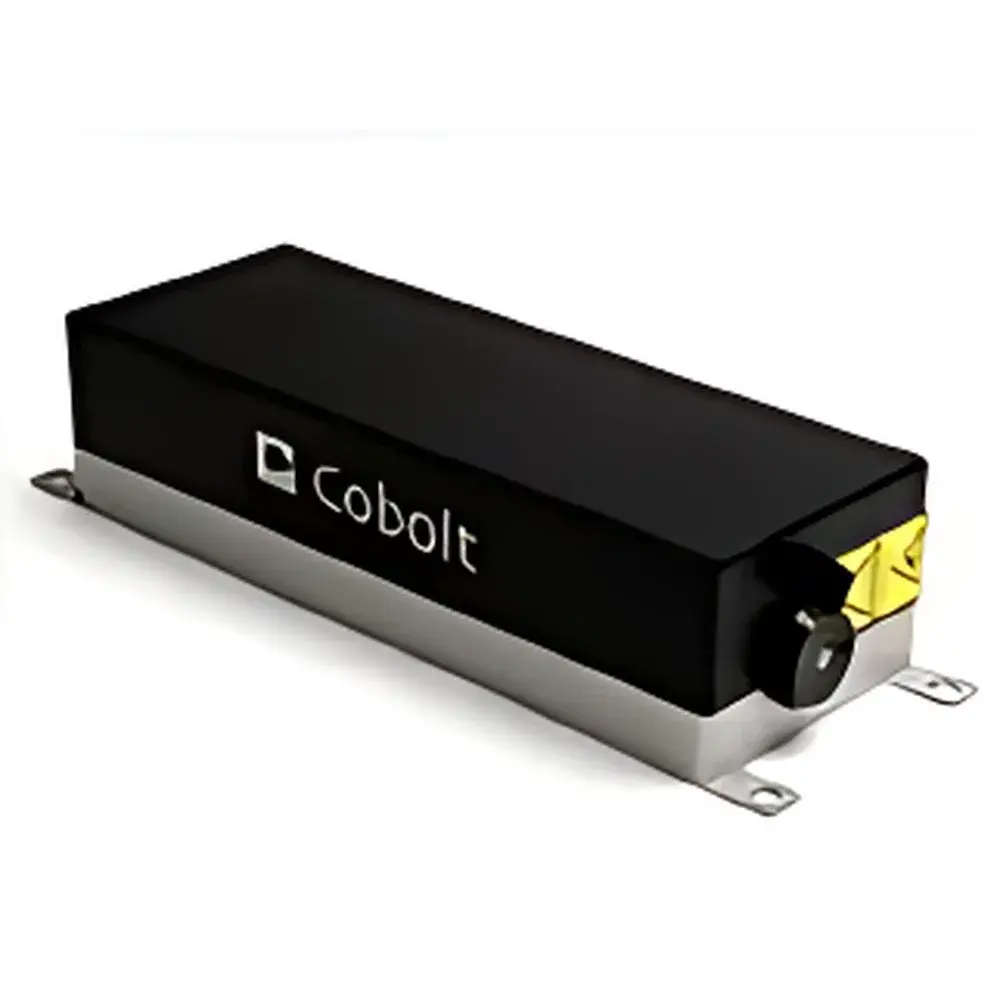
Cobolt Dual-Wavelength Laser System (Model DLC Series)
| Brand | Cobolt |
|---|---|
| Origin | Sweden |
| Model | DLC Series |
| Wavelength Range | 457–594 nm |
| Output Power Options | 25–300 mW per line |
| Spectral Linewidth | <1 MHz (<0.01 pm) |
| Spatial Mode | TEM₀₀, M² < 1.1 |
| Beam Diameter (aperture) | 700 µm |
| Beam Divergence (full angle) | <1.2 mrad |
| Beam Overlap | <250 µrad |
| Long-Term Power Stability (8 h) | <±3% (at ±3°C ambient) |
| Beam Pointing Stability | <25 µrad/°C |
| Polarization Ratio | >100:1 (linear) |
| Total Power Consumption | <70 W (typ. <30 W) |
| Operating Temperature | 10–40 °C |
| Heat Sink Thermal Resistance | 0.5 K/W |
| Dual Combiner Dimensions | 190 × 65 × 46 mm |
| Controller Dimensions | 190 × 72 × 28 mm |
| Communication Interface | RS-232 or USB |
| CDRH Compliance | Integrated key-switch |
| Warranty | 12 months (24 months on laser heads) |
Overview
The Cobolt Dual-Wavelength Laser System (DLC Series) is a permanently aligned, OEM-optimized optical source engineered for precision multi-color excitation in advanced life science and analytical instrumentation. Based on proprietary solid-state frequency-doubled diode-pumped lasers, the system integrates two independently selected single-longitudinal-mode (SLM) laser lines—spanning 457 nm to 594 nm—into a collinear, spatially and temporally stable output beam. Unlike mechanically coupled or fiber-mixed solutions, the DLC employs monolithic beam-combining optics with sub-250 µrad angular alignment tolerance, ensuring diffraction-limited overlap (<0.5 µm lateral displacement at 1 m) critical for confocal microscopy, flow cytometry, and multi-channel fluorescence resonance energy transfer (FRET) assays. The system replaces legacy gas-based sources—including argon-ion (488 nm, 514 nm) and krypton-ion (568 nm, 594 nm) lasers—with superior power stability, reduced thermal drift, and zero warm-up delay. All lasers operate in continuous-wave (CW) mode with intrinsic SLM operation verified by heterodyne linewidth measurements (<1 MHz), enabling high-fidelity interferometric applications and narrowband spectroscopic pumping.
Key Features
- Permanently aligned dual-wavelength output with guaranteed beam overlap <250 µrad and pointing stability <25 µrad/°C across 10–40 °C ambient range
- TEM₀₀ spatial profile with M² < 1.1 and beam divergence <1.2 mrad (full angle), optimized for high-NA objective coupling
- Independent power selection per wavelength: 25–300 mW options across seven discrete wavelengths (457, 473, 491, 515, 532, 561, 594 nm)
- Integrated thermal management architecture featuring 0.5 K/W heat sink thermal resistance and low typical power draw (<30 W)
- Compliant with IEC 60825-1:2014 Class 3B laser safety requirements; includes CDRH-certified key-switch interlock and emission indicator
- Dual communication interface support: RS-232 (models ending -300/-400) and USB 2.0 (models ending -700/-800) with ASCII command protocol for OEM integration
- Extended warranty coverage: 24 months on laser diode modules, 12 months on full system—including controller and combiner optics
Sample Compatibility & Compliance
The DLC Series is designed for seamless integration into regulated analytical platforms requiring traceable performance and audit-ready operation. Its optical architecture supports direct free-space coupling into commercial confocal microscopes (e.g., Zeiss LSM, Nikon A1R), flow cytometers (BD FACSAria, Beckman CytoFLEX), and DNA sequencers (Illumina NovaSeq, PacBio Revio). All models meet ISO 13406-2 for laser beam quality classification and comply with FDA 21 CFR Part 11 when operated with validated firmware and timestamped logging enabled via RS-232/USB. The system’s long-term power stability (<±3% over 8 hours at constant ambient) satisfies GLP/GMP environmental monitoring thresholds for QC laboratories. Optional mounting blocks enable permanent SMF-28 or PM1550 fiber coupling with <0.3 dB insertion loss, supporting integration into fiber-based Raman or OCT systems requiring polarization-maintained excitation.
Software & Data Management
Cobolt provides a cross-platform SDK (Windows/Linux/macOS) supporting both command-line and API-driven control via serial or USB. The driver stack implements full state reporting—including real-time temperature readback from thermistors embedded in each laser head, current monitoring, and interlock status—and enables synchronized on/off sequencing of both wavelengths with <10 µs jitter. Logging functions record all setpoints and measured parameters with millisecond timestamps, generating CSV-compatible audit trails compliant with FDA 21 CFR Part 11 Annex 11 requirements when deployed with electronic signature validation. Firmware updates are delivered via signed binary packages with SHA-256 verification. No cloud dependency or telemetry is enabled by default; all data remains local unless explicitly configured by the end user.
Applications
- Multi-parameter flow cytometry requiring simultaneous 488 nm + 561 nm excitation for tandem dye discrimination (e.g., PE-Cy7, APC-Cy7)
- Confocal and super-resolution microscopy (STED, STORM) where co-aligned 532 nm + 594 nm beams enable dual-depletion or multi-color activation
- Next-generation DNA sequencing platforms relying on precise 457 nm + 515 nm excitation for reversible terminator chemistry
- Fluorescence correlation spectroscopy (FCS) and fluorescence lifetime imaging (FLIM) demanding sub-MHz linewidth and shot-noise-limited intensity stability
- Calibration-grade reference sources for spectrometer wavelength validation and photodetector quantum efficiency mapping
- Optical trapping setups utilizing dual-wavelength gradient forces for independent manipulation of heterogeneous particle populations
FAQ
Can the two wavelengths be modulated independently?
Yes—each channel supports TTL-compatible analog modulation (0–5 V) with bandwidth up to 500 kHz, enabling gated excitation or intensity ramping without cross-talk.
Is fiber coupling available as a factory option?
Yes—custom SMF-28 or PM1550 pigtailing is offered with FC/APC or SMA905 connectors; insertion loss and polarization extinction ratio are documented per unit.
What is the minimum time required between wavelength switching?
No switching delay—the two lasers operate simultaneously and continuously; output is always present once enabled.
Does the system support external triggering for synchronization with detectors?
Yes—both lasers accept TTL start/stop triggers with <50 ns jitter relative to internal clock, and provide sync output pulses for camera or DAQ timing alignment.
Are calibration certificates provided with shipment?
Each unit ships with a NIST-traceable power calibration certificate (at 25 °C, 50% power setting) and beam parameter report (M², divergence, pointing stability).



