
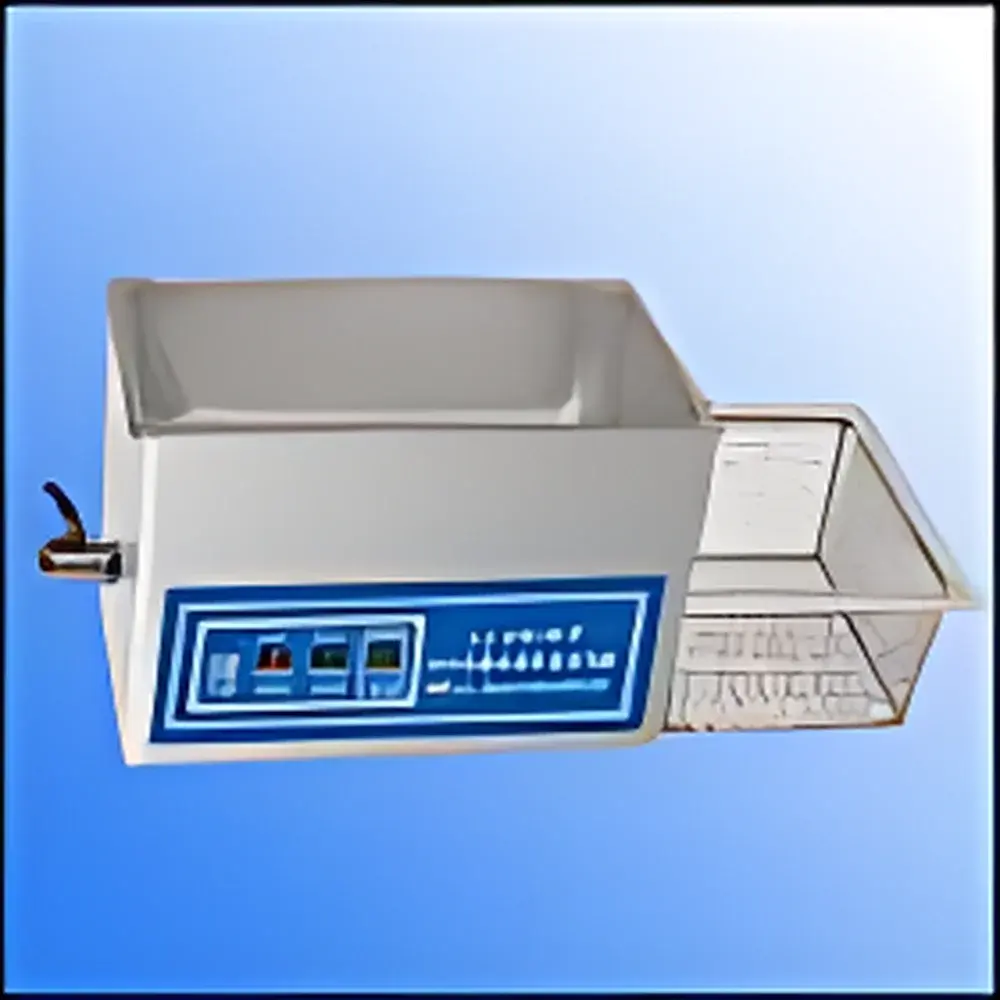
SHUMEI KQ-100B Benchtop Ultrasonic Cleaner
| Brand | SHUMEI |
|---|---|
| Origin | Jiangsu, China |
| Model | KQ-100B |
| Type | General-purpose ultrasonic cleaner |
| Capacity | 4 L |
| Ultrasonic Frequency | 40 kHz |
| Ultrasonic Power Output | 100 W (adjustable from 40–100%) |
| Heating Range | Ambient to 80 °C |
| Heating Power | 800 W |
| Timer Range | 1–20 min |
| Tank Dimensions (L×W×H) | 300 × 150 × 100 mm |
| External Dimensions (L×W×H) | 320 × 174 × 260 mm |
Overview
The SHUMEI KQ-100B Benchtop Ultrasonic Cleaner is an integrated, compact laboratory-grade cleaning system engineered for precision cleaning, degassing, emulsification, homogenization, extraction, and cell disruption in low-to-medium throughput environments. It operates on the principle of ultrasonic cavitation: high-frequency sound waves (40 kHz) generate microscopic vacuum bubbles in the cleaning solution, which rapidly collapse to produce localized shockwaves and microstreaming—mechanically dislodging contaminants from surfaces without abrasion or chemical aggression. Designed for reliability in academic labs, QC/QA facilities, and R&D settings, the KQ-100B features a monolithic construction where the ultrasonic transducer assembly is directly bonded to the stainless steel tank base, ensuring efficient energy transfer and long-term acoustic stability. Its 4-liter capacity accommodates standard beakers, vials, pipette tips, optical components, printed circuit boards, and small mechanical parts—making it suitable for routine instrument maintenance, sample preparation prior to spectroscopic or chromatographic analysis, and pre-sterilization cleaning steps compliant with ISO 13485 and ASTM D2601.
Key Features
- Integrated 40 kHz ultrasonic generator with adjustable power output (40–100% of 100 W nominal), enabling process optimization for delicate vs. heavily soiled samples.
- Independent digital temperature control (ambient to 80 °C) supported by an 800 W heating element, facilitating thermally assisted cleaning protocols—critical for removing waxy, viscous, or polymer-based residues.
- Precise programmable timer (1–20 minutes) with automatic shutdown, ensuring repeatability across cleaning cycles and minimizing operator variability.
- 304 stainless steel inner tank (300 × 150 × 100 mm) formed via deep-drawn stamping for structural integrity and corrosion resistance against aqueous and mild solvent-based cleaning solutions.
- Included stainless steel wire mesh basket for secure sample placement and uniform exposure to cavitation fields; compatible with common labware up to Ø120 mm diameter.
- Manual drain valve located at the tank base enables rapid, residue-free solution exchange—essential for multi-step cleaning sequences or solvent rinsing workflows.
Sample Compatibility & Compliance
The KQ-100B is validated for use with glass, quartz, stainless steel, titanium, silicon wafers, and most rigid polymers (e.g., PTFE, polypropylene). It is not recommended for soft elastomers, adhesives, or unsealed electronic assemblies unless validated per internal SOPs. While the unit itself does not carry CE or UL certification, its design adheres to general safety principles outlined in IEC 61010-1 for laboratory electrical equipment. Users performing regulated work (e.g., pharmaceutical cleaning validation per USP or ISO 15883-1 for washer-disinfectors) must establish in-house performance qualification protocols—including cavitation intensity mapping, temperature uniformity testing, and residue recovery studies—to meet GLP/GMP documentation requirements.
Software & Data Management
The KQ-100B operates via a front-panel membrane keypad with LED display—no external software, drivers, or PC connectivity are required. All operational parameters (time, temperature, power level) are retained after power cycling. Though lacking digital audit trail functionality, the device supports manual logbook recording aligned with FDA 21 CFR Part 11 Annex 11 expectations when paired with controlled documentation practices. For laboratories requiring automated data capture, integration with external environmental monitoring systems (via optional relay outputs, not included) can be implemented through third-party PLC interfaces.
Applications
- Cleaning of HPLC columns, GC injectors, and spectrophotometer cuvettes prior to calibration.
- Degassing of solvents (e.g., mobile phases, buffer solutions) to prevent pump cavitation and baseline drift.
- Cell lysis of bacterial cultures and tissue homogenates for protein extraction (when combined with appropriate lysis buffers).
- Removal of polishing compounds from optical lenses and semiconductor substrates.
- Pre-cleaning of surgical instruments and dental tools in non-sterile preparatory workflows.
- Supporting ASTM E1970 (standard guide for ultrasonic cleaning verification) through standardized test soil challenges.
FAQ
Is the KQ-100B suitable for cleaning delicate MEMS devices or microfluidic chips?
Yes—with reduced power (40–60%) and short durations (1–3 min), provided the devices are mounted in a suspended basket and immersed in low-surface-tension, deaerated water or IPA/water mixtures.
Can this unit be used with flammable solvents such as acetone or ethanol?
No. The KQ-100B lacks explosion-proof certification and internal spark suppression. Only aqueous or flashpoint >60 °C solutions should be used.
Does the unit include a built-in degassing mode?
Not as a dedicated function—but degassing efficacy is achieved by running the unit at 40–60% power for 5–10 min at ambient temperature without heating.
What maintenance is required for long-term reliability?
Monthly inspection of the tank seal integrity, quarterly descaling of the heater element using 5% citric acid solution, and annual verification of transducer impedance using a multimeter (expected range: 12–18 Ω).



