
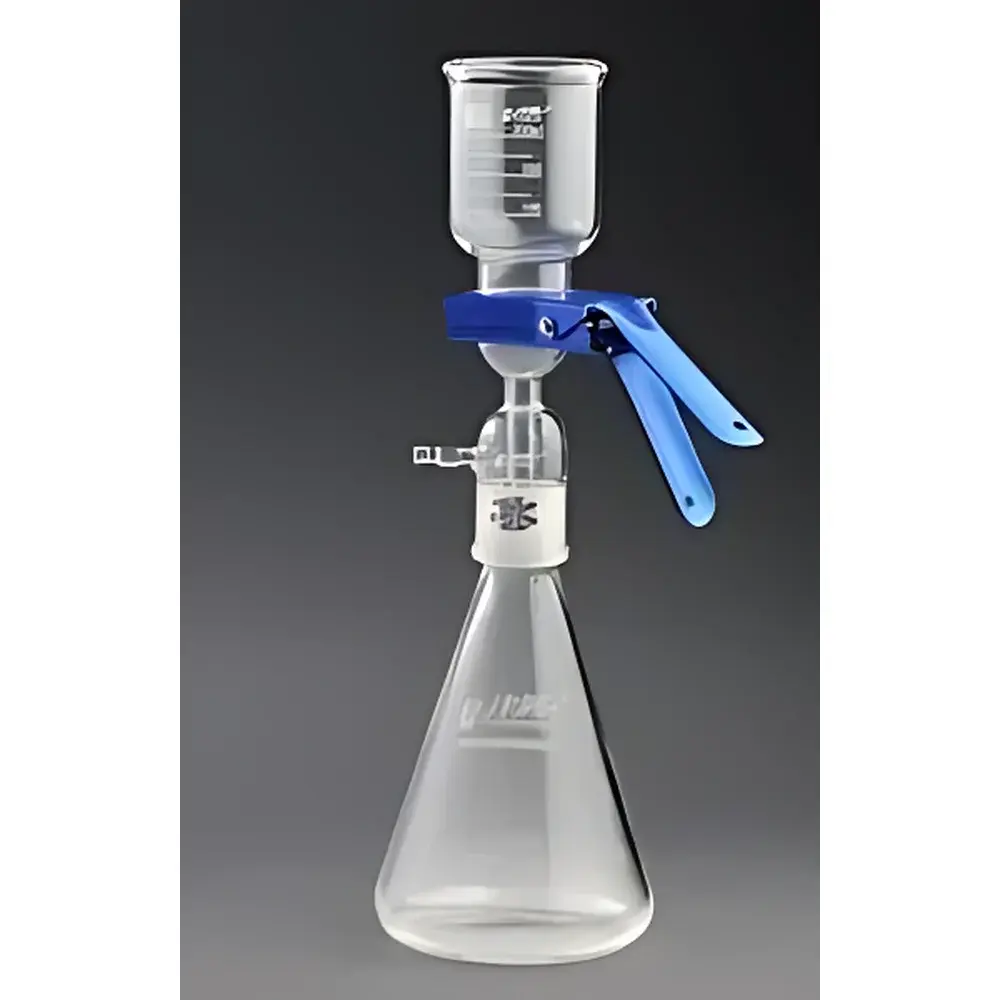
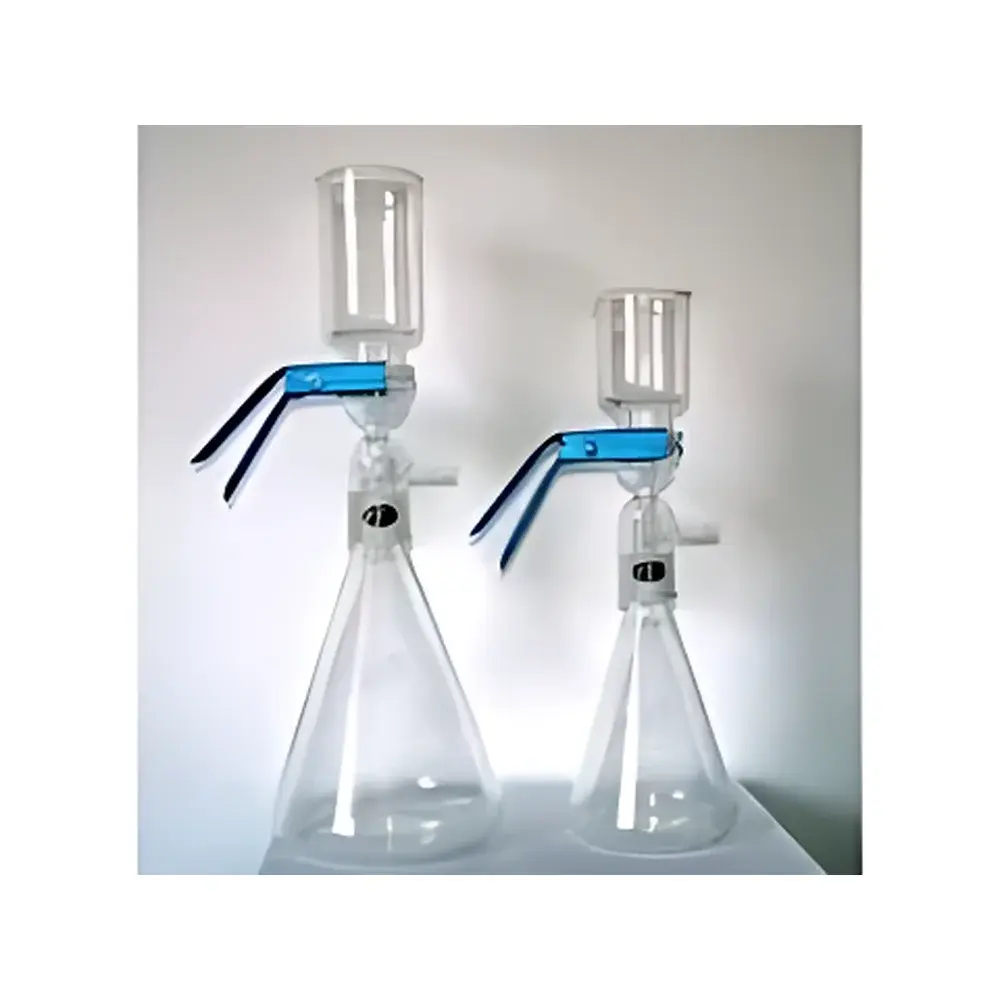
JINTENG T-50 (1L) Solvent Filtration Assembly for HPLC Mobile Phase Preparation
| Brand | JINTENG |
|---|---|
| Origin | Tianjin, China |
| Model | T-50 (1L) |
| Filter Cup Capacity | 300 mL |
| Receiving Bottle Capacity | 1000 mL |
| Filter Head Diameter | 50 mm |
| Pore Size | 10 µm |
| Filter Head Material | High-Borosilicate Glass |
| Receiving Bottle Material | High-Borosilicate Glass |
| Filter Membrane Support | Removable PTFE Frit |
| Connection Type | Standard Ground-Glass Joint (ISO 2768-fine tolerance) |
| Sterilization Compatibility | Autoclavable at 121 °C, 20 min |
| Clamp Material | Anodized Aluminum Alloy |
| Compatible Membrane Diameters | φ47 mm or φ50 mm |
| Chemical Resistance | Full compatibility with aqueous, organic (e.g., acetonitrile, methanol), and corrosive solvents (e.g., dilute HCl, NaOH, TFA) |
Overview
The JINTENG T-50 (1L) Solvent Filtration Assembly is an engineered vacuum-driven filtration system designed specifically for the preparation and purification of HPLC mobile phases in regulated analytical laboratories. It operates on the principle of gravity-assisted vacuum filtration, where differential pressure across a supported membrane drives solvent flow while retaining particulate contaminants, undissolved salts, and microaggregates. Unlike syringe filters or inline filter cartridges, this assembly enables batch-scale pre-filtration of up to 1 L of solvent—minimizing repeated handling, reducing exposure risk, and improving reproducibility in chromatographic method development and routine QC workflows. Its construction adheres to ISO/IEC 17025-aligned design principles for laboratory equipment, with dimensional conformity to DIN 12252 and ASTM D1193 Type I–IV water purity support requirements.
Key Features
- High-borosilicate glass components (filter cup, funnel head, and receiving bottle) ensure optical clarity, thermal stability up to 500 °C, and resistance to thermal shock during autoclaving.
- Standard taper ground-glass joints (29/32 or 45/50, depending on configuration) provide leak-tight, repeatable sealing without lubricants—critical for volatile organic solvent handling and long-duration filtration.
- Removable PTFE frit (10 µm nominal pore size) offers inert support for hydrophilic, hydrophobic, and low-protein-binding membranes; compatible with nylon, PVDF, PTFE, and mixed cellulose ester (MCE) formats.
- Anodized aluminum alloy clamp delivers consistent clamping force (>12 N·m torque retention), eliminating deformation under vacuum (rated for ≤ −0.095 MPa absolute pressure) and ensuring mechanical integrity over >10,000 operational cycles.
- Integrated air vent with hydrophobic PTFE membrane prevents backstreaming during vacuum release and supports passive degassing—reducing dissolved oxygen and microbubble formation in mobile phases prior to HPLC pump priming.
Sample Compatibility & Compliance
The T-50 system accommodates aqueous buffers (e.g., phosphate, acetate), polar organics (methanol, acetonitrile, THF), and aggressive reagents including 0.1 M HCl, 0.1 M NaOH, and 0.1% trifluoroacetic acid (TFA). All wetted surfaces comply with USP Class VI biocompatibility testing criteria. The ground-glass interface meets ISO 3585 specifications for borosilicate glass 3.3, and the overall assembly supports GLP/GMP documentation workflows through traceable component marking (batch-coded glassware) and compatibility with audit-ready lab notebooks. It is routinely deployed in environments requiring adherence to ICH Q5A (viral clearance validation support), ASTM E2652 (liquid particle counting), and USP (total organic carbon—TOC—sample prep).
Software & Data Management
While the T-50 is a manual, non-electronic filtration device, its design integrates seamlessly into digital lab ecosystems. Each unit ships with a unique serial identifier engraved on the receiving bottle base, enabling direct linkage to electronic lab notebook (ELN) entries via barcode scanning. The standardized dimensions and material certifications allow automated import into inventory management systems (e.g., LabVantage, STARLIMS) and quality management software (QMS) for calibration tracking and preventive maintenance scheduling. Documentation packages include full material declarations (RoHS, REACH), CoA for glass composition, and autoclave validation reports—supporting FDA 21 CFR Part 11 compliance when paired with validated ELN platforms.
Applications
- HPLC and UHPLC mobile phase preparation—including gradient-compatible solvent mixing and filtration prior to online degassing.
- Pre-filtration of sample diluents and standard stock solutions in pharmaceutical assay development (ICH Q2(R2)).
- Removal of silica particulates from aged buffer stocks or precipitated additives (e.g., EDTA, sodium azide).
- Supporting LC-MS method robustness by minimizing column fouling and ion source contamination.
- Research-grade filtration in proteomics workflows where low extractables (<0.5 µg/cm² per USP ) are required for membrane selection.
FAQ
Can the T-50 assembly be sterilized using ethylene oxide (EtO)?
Yes—high-borosilicate glass and anodized aluminum are EtO-compatible; however, PTFE frits must be validated separately per ISO 11135 due to potential sorption effects.
Is the 10 µm PTFE frit suitable for sterile filtration?
No—this frit serves only as a mechanical support; sterile filtration requires ≤0.22 µm membrane filters placed above it.
What vacuum level is recommended for optimal flow rate without membrane rupture?
Maintain vacuum between −0.07 and −0.09 MPa (absolute); higher differentials may compromise low-pressure-rated membranes such as regenerated cellulose.
Are replacement parts available for individual components?
Yes—glass filter cups, receiving bottles, PTFE frits, and aluminum clamps are stocked as spare parts with full dimensional and material certification.
Does the system meet ISO 8573-1 Class 2 requirements for compressed air purity when used with vacuum pumps?
The assembly itself does not regulate air quality; users must implement ISO 8573-1-compliant vacuum filtration or oil-free diaphragm pumps upstream to ensure solvent integrity.
Related Products





