
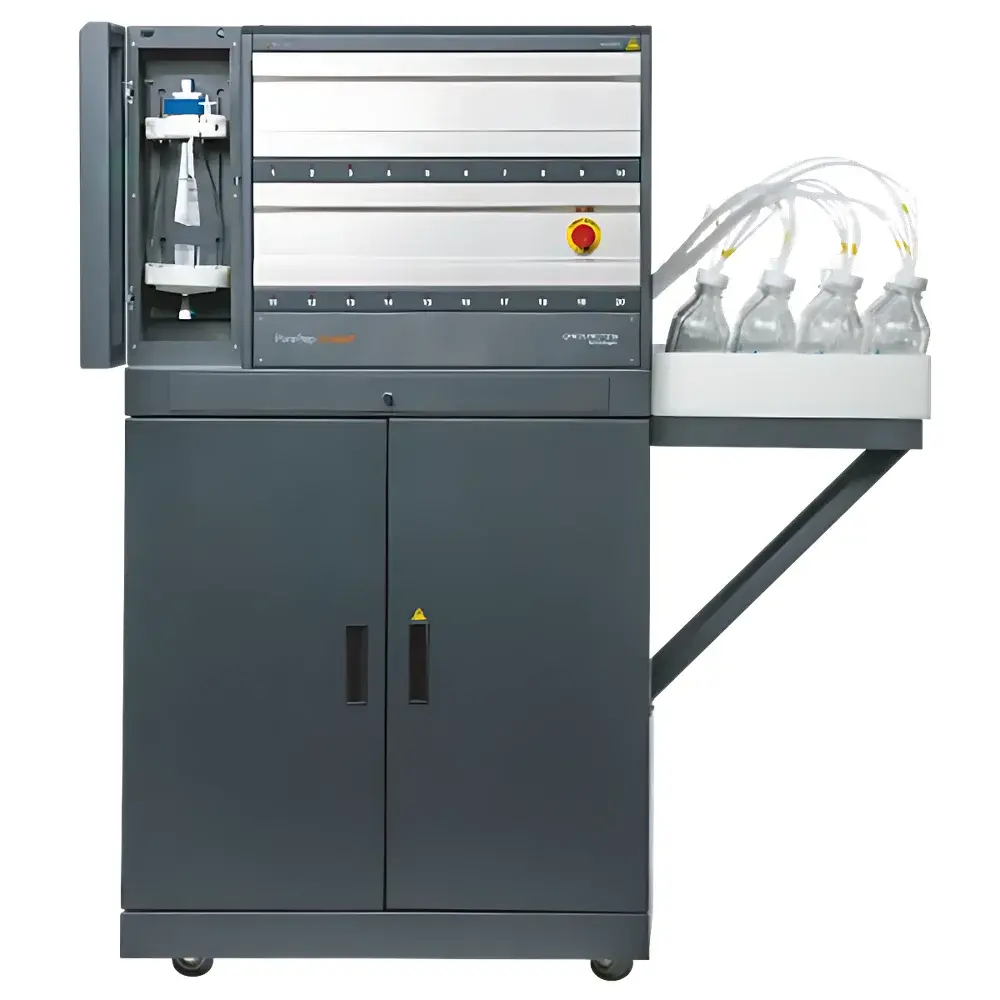
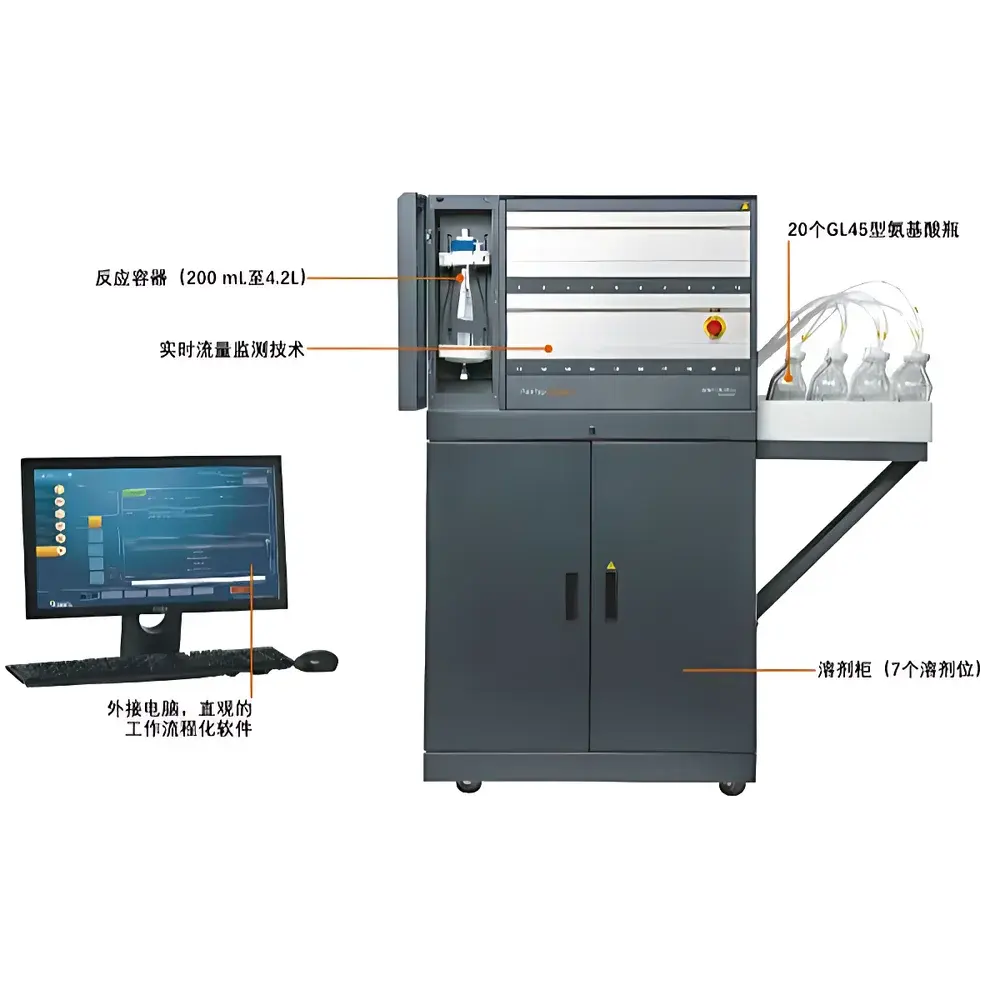
PurePep® Sonata®+ Automated Peptide Synthesizer
| Brand | Hanking |
|---|---|
| Origin | Imported |
| Manufacturer Type | Authorized Distributor |
| Model | PurePep® Sonata®+ |
| Amino Acid Delivery | Fully Automated |
| Reagent Delivery | Fully Automated |
| Synthesis Scale | 1–200 mmol |
| Reactor Quantity | 1 |
| Reactor Volume Options | 200 mL, 500 mL, 1.2 L, 2 L, 3.2 L, 4.2 L |
| Regulatory Compliance | 21 CFR Part 11, GLP/GMP-ready |
| Flow Monitoring Technology | Acoustic-based real-time flow measurement (<5% error across viscosity range) |
| Mixing Modes | N₂ bubbling, variable-speed oscillation, recirculation |
| Solvent Ports | 7 |
| Reagent Ports | 20 |
| Waste Ports | 2 (separable streams) |
| Collection Port | 1 (optional) |
| Valve System | Chemically inert PurePep® Pathway manifold with Single-Shot pre-activation architecture |
| IQ/OQ Support | Available via certified field engineers |
Overview
The PurePep® Sonata®+ is a fully automated, single-channel pilot-scale peptide synthesizer engineered for reproducible, scalable solid-phase peptide synthesis (SPPS) under cGMP-aligned conditions. It operates on the Fmoc/tBu strategy and integrates precision fluidic control, chemically inert fluid pathways, and real-time acoustic flow monitoring to ensure consistent coupling efficiency, minimal epimerization, and high crude purity—critical for preclinical and clinical-stage peptide manufacturing. Designed specifically for contract research organizations (CROs), contract development and manufacturing organizations (CDMOs), and pharmaceutical R&D labs, the Sonata®+ bridges the gap between benchtop synthesis and GMP production by supporting synthesis scales from 1 mmol to 200 mmol in a single reactor configuration. Its modular architecture accommodates reactor volumes ranging from 200 mL to 4.2 L, enabling method translation across development phases without re-optimization.
Key Features
- Acoustic Real-Time Flow Monitoring: Proprietary bidirectional acoustic sensing technology continuously measures solvent and reagent flow rates independent of viscosity. Calibration is required only once per fluid type, maintaining accuracy within ±5% across dynamic flow changes—eliminating drift-related errors common in pressure- or volume-based delivery systems.
- PurePep® Pathway Valve Block: A chemically inert, low-dead-volume manifold system with integrated three-port flow modules enables true Single-Shot pre-activation. This architecture physically isolates amino acid activation from coupling steps, preventing cross-contamination between residues and ensuring batch-to-batch consistency in both short and long peptides (up to 100+ residues).
- Multi-Mode Reactor Agitation: Three orthogonal mixing modalities—programmable N₂ sparging, variable-frequency mechanical oscillation, and closed-loop recirculation—can be deployed individually or in sequence. Each mode is optimized for specific reaction stages (e.g., deprotection, coupling, washing), improving resin solvation and reagent diffusion while minimizing shear-induced aggregation.
- High-Fidelity Fluid Handling: Chemically resistant PTFE-lined recirculation pump and primary solvent pump deliver >400 mL/min throughput with minimal maintenance. Seven solvent and twenty reagent ports support complex protocols involving multiple activators, scavengers, and orthogonal protecting groups—fully configurable via software.
- Dual-Waste & Optional Collection Architecture: Two dedicated waste outlets allow segregation of acidic cleavage streams from neutral wash fractions, reducing hazardous waste disposal costs. An additional collection port supports on-line product capture (e.g., cleaved peptide in TFA cocktail) or recovery of expensive reagents such as HATU or PyBOP.
Sample Compatibility & Compliance
The PurePep® Sonata®+ is validated for use with standard SPPS resins (e.g., Wang, Rink amide MBHA), Fmoc-protected amino acids (including sterically hindered and post-translationally modified variants), and common coupling reagents (DIC/HOAt, HBTU/DIEA). All wetted surfaces—including tubing, valves, and reactor liners—are constructed from fluoropolymer and inert stainless steel compliant with USP Class VI requirements. The instrument meets ISO 13485 design controls and supports full 21 CFR Part 11 compliance through electronic signatures, audit trails, role-based access control, and immutable data archiving. Installation Qualification (IQ) and Operational Qualification (OQ) documentation packages are provided by certified field service engineers, aligning with ICH Q5, Q7, and FDA Process Validation Guidance.
Software & Data Management
The embedded graphical user interface (GUI) features drag-and-drop method builder functionality, preloaded SOP templates for common peptide classes (e.g., cyclic, disulfide-rich, phosphorylated), and direct FASTA/PEP sequence import with automatic side-chain protection mapping. Users can queue multiple synthesis protocols while an active run is underway—enabling unattended overnight operation and sequential batch processing. All method parameters, sensor logs, flow profiles, and alarm events are timestamped and stored in encrypted SQLite databases with SHA-256 hashing. Data export adheres to ASTM E2500-13 standards and supports CSV, PDF, and XML formats for integration into LIMS or electronic lab notebooks (ELN). Audit trail records include operator ID, timestamp, parameter change, and reason code—fully traceable for regulatory inspections.
Applications
- Preclinical peptide API synthesis (1–50 mmol scale) for pharmacokinetic and toxicology studies
- GMP-compliant manufacturing of clinical trial materials (Phase I–III), including GLP toxicology lots
- Development of difficult sequences (e.g., hydrophobic stretches, β-sheet formers, aggregation-prone motifs)
- Process optimization and robustness testing for commercial-scale transfer
- Synthesis of peptide conjugates (e.g., PEGylated, lipidated, fluorescently labeled derivatives)
- Support for novel chemistry platforms including pseudoproline dipeptides and backbone modifications
FAQ
Is the PurePep® Sonata®+ compatible with both Fmoc and Boc chemistries?
Yes—the instrument supports Fmoc/tBu and Boc/Bzl strategies via configurable reagent sets, acid-labile resin handling, and programmable deprotection cycles. Dedicated hardware modules for HF cleavage are available as optional accessories.
Can reactor volume be changed without recalibrating the entire system?
Yes—each reactor size (200 mL to 4.2 L) has a factory-characterized flow profile. Switching reactors requires only selection of the corresponding calibration file; no manual recalibration is needed.
Does the system support remote monitoring and intervention?
Yes—via secure HTTPS-enabled web interface, users can monitor real-time flow rates, temperature, pressure, and step progress from any authorized workstation. Critical alarms trigger email/SMS notifications per configurable escalation matrix.
What validation documentation is included with the system?
Standard delivery includes Factory Acceptance Test (FAT) report, User Requirement Specification (URS) traceability matrix, IQ/OQ protocols and executed reports, and a Certificate of Conformance per ISO 9001:2015.
How is maintenance scheduled and tracked?
The software includes a preventive maintenance scheduler with automated reminders based on runtime hours and cycle counts. Service history, part replacements, and calibration logs are archived with full version control and digital signature verification.




