
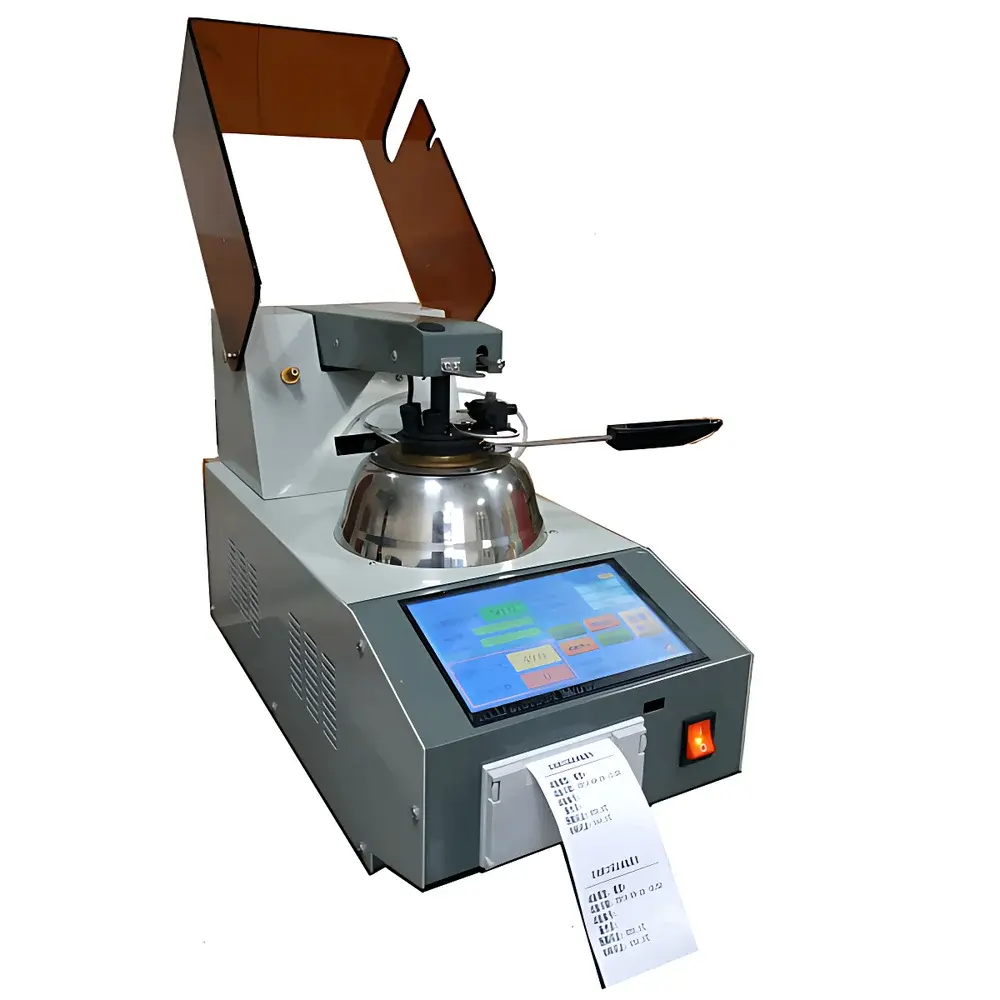
Xufeng XF-93S Pensky-Martens Closed-Cup Flash Point Tester with Dual Ignition (Gas & Electronic)
| Brand | Xufeng |
|---|---|
| Origin | Shanghai, China |
| Model | XF-93S |
| Detection Method | Closed-Cup |
| Operation Mode | Fully Automatic |
| Temperature Range | 40 °C to 360 °C |
| Ignition Modes | Electric Spark Ignition & External Fuel-Gas Ignition |
| Repeatability | Compliant with ASTM D93 and GB/T 261 test protocols |
| Applicable Standards | GB/T 261–2008, ASTM D93 |
Overview
The Xufeng XF-93S Pensky-Martens Closed-Cup Flash Point Tester is a fully automated analytical instrument engineered for precise determination of the flash point of petroleum products, lubricants, solvents, and other flammable liquids using the standardized Pensky-Martens closed-cup method. Based on the principle of controlled heating and sequential ignition—where a test specimen is heated at a defined rate in a sealed cup and exposed to an ignition source at prescribed temperature intervals—the XF-93S detects the lowest temperature at which vapors above the sample ignite momentarily when exposed to flame or electric spark. This thermodynamic threshold is critical for hazard classification, transportation safety (UN TDG, ADR, IMDG), storage compliance, and quality control in refining, petrochemical, and polymer manufacturing facilities. The instrument supports dual ignition configurations: gas-fueled (requiring external propane/butane supply) and electronic spark (integrated high-voltage pulse generator), enabling operational flexibility across laboratory environments with varying infrastructure constraints.
Key Features
- Fully automated test execution—from initial temperature ramping to final flash point reporting—with single-button initiation via intuitive touchscreen interface.
- Dual-standard compliance: preconfigured test modes for ASTM D93 (Method A/B/C) and GB/T 261–2008, including dedicated routines for initial screening, stepwise detection, and expected flash point search.
- Precision temperature control: stainless-steel heating block with PID regulation, ±0.1 °C stability over 40–360 °C operating range; real-time monitoring via calibrated Pt100 sensor.
- Intelligent ignition system: selectable electric spark (XF-93SE variant) or externally supplied fuel-gas flame (XF-93S), both synchronized with thermal ramping per standard-defined intervals.
- Robust hardware architecture: all critical components—including thermal controller, ignition module, and detection thermocouple—sourced from internationally certified suppliers for long-term reliability.
- Self-diagnostic capability with on-screen fault codes, audible alerts, and automatic test suspension upon anomaly detection (e.g., sensor drift, ignition failure, cup misalignment).
- RS-232C serial interface compliant with SCPI command set for integration into LIMS or centralized QC networks; optional Ethernet module available for TCP/IP-based remote supervision.
- Integrated thermal printer (dot-matrix) for immediate hardcopy output of test reports, including date/time stamp, operator ID, standard reference, raw temperature data, and pass/fail status.
Sample Compatibility & Compliance
The XF-93S accommodates standard ASTM/ISO-compliant Pensky-Martens closed cups (55–65 mL capacity) and accepts samples with viscosities up to 150 mm²/s at 40 °C. It is validated for use with distillate fuels (diesel, kerosene), base oils, hydraulic fluids, biodiesel blends, and halogenated solvents. All operational parameters—including heating rate, stir speed, ignition timing, and temperature increment steps—are programmatically locked to match the procedural requirements of ASTM D93 (Annex A1–A3) and GB/T 261–2008. Instrument design adheres to IEC 61010-1 safety standards for electrical equipment used in measurement, control, and laboratory applications. Full traceability is supported through audit-ready test logs, including user authentication, environmental pressure compensation (barometric correction), and firmware version tracking—enabling alignment with GLP and ISO/IEC 17025 laboratory accreditation frameworks.
Software & Data Management
The embedded firmware implements deterministic real-time scheduling to ensure strict adherence to standard-defined time–temperature profiles. Test data—including ramp history, ignition events, detected flash temperatures, and ambient pressure—is timestamped and stored in non-volatile memory (≥1,000 test records). Export options include ASCII text files via USB port or RS-232 transmission for downstream analysis in Excel or statistical process control (SPC) platforms. Optional PC software (Xufeng FlashLink™) provides graphical trend analysis, batch report generation, and configurable PDF certificate templates compliant with ISO 17025 clause 7.8.2. All electronic records maintain immutable timestamps and operator identifiers, satisfying FDA 21 CFR Part 11 requirements for electronic signatures and audit trails when deployed in regulated GMP environments.
Applications
- Quality assurance laboratories verifying flash point conformity for ASTM D975 (diesel fuel), ASTM D3699 (kerosene), and ISO 8217 (marine fuels).
- Refinery process control units monitoring intermediate cuts during distillation to prevent off-spec blending.
- Research and development teams evaluating thermal stability of bio-based lubricants and synthetic esters under accelerated aging conditions.
- Hazard communication departments preparing Safety Data Sheets (SDS) in accordance with GHS classification criteria (Category 1–4 flammables).
- Third-party testing organizations performing accredited flash point determinations for certification bodies (e.g., SGS, TÜV, BV).
FAQ
What is the difference between XF-93S and XF-93SE models?
The XF-93S requires an external fuel-gas supply (propane or butane) for flame-based ignition, while the XF-93SE uses a solid-state electronic spark igniter—eliminating dependency on compressed gas cylinders.
Does the instrument support pressure compensation?
Yes. Barometric pressure input (in kPa or mmHg) is manually entered prior to testing and automatically applied to flash point calculation per ASTM D93 Annex A2.
Can multiple test methods be run sequentially without manual reconfiguration?
Yes. Up to five user-defined test profiles—including custom ramp rates, ignition intervals, and endpoint logic—can be saved and recalled directly from the touchscreen interface.
Is calibration verification traceable to national standards?
The instrument supports verification using NIST-traceable reference materials (e.g., n-decane, cyclohexane) and includes built-in calibration check routines per ASTM D6417 guidelines.
What maintenance is required for long-term accuracy?
Routine cleaning of the test cup, ignition electrode/spark gap, and thermal sensor surface is recommended after every 50 tests; annual verification of temperature sensor linearity and ignition energy output is advised.





