
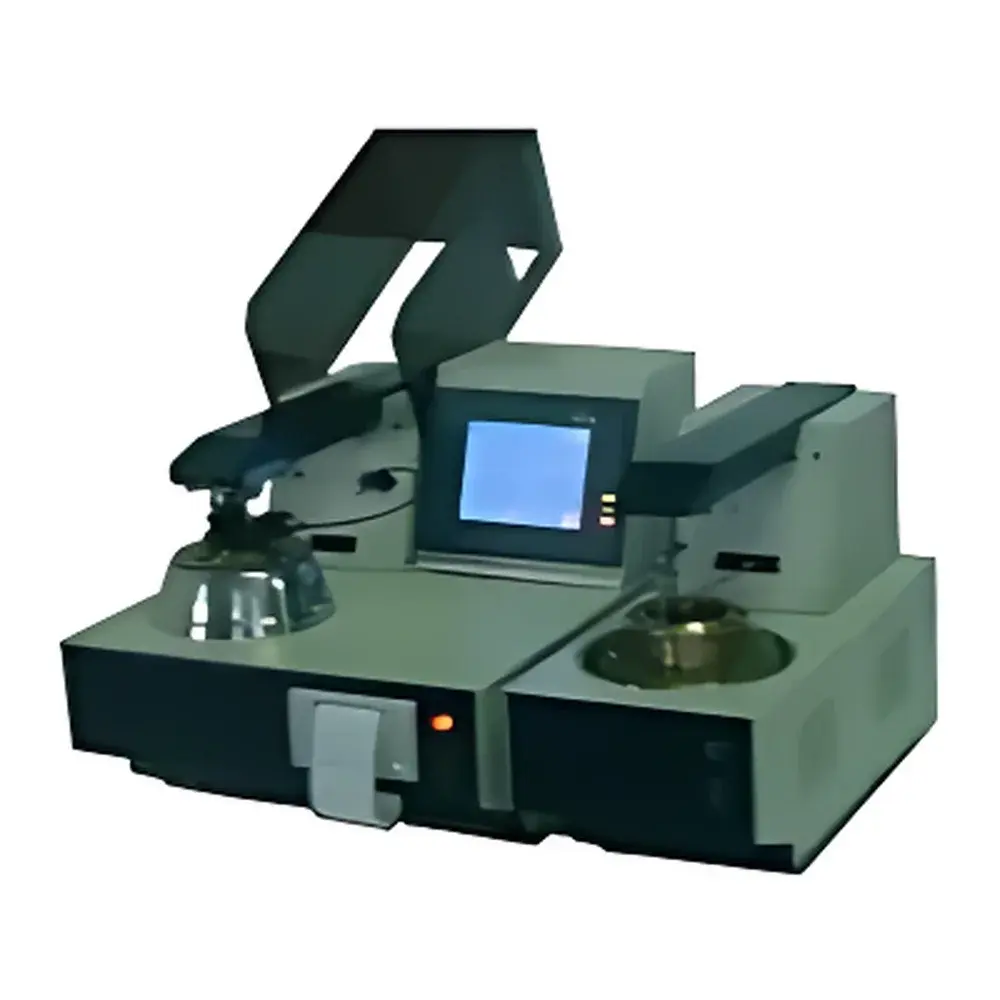
Xufeng XF-9293 Dual-Cup Automatic Flash Point Tester (Closed-Cup & Open-Cup)
| Brand | Xufeng |
|---|---|
| Origin | Shanghai, China |
| Model | XF-9293 |
| Testing Method | Closed-Cup & Open-Cup |
| Temperature Control Accuracy | ±0.1 °C |
| Operating Temperature Ranges | Closed-Cup (0–300 °C), Open-Cup (0–400 °C), Tag Closed-Cup (0–95 °C, optional Peltier cooling) |
| Detection Methods | Flame Ionization (Open-Cup), High-Sensitivity Thermocouple (Closed-Cup) |
| Compliance Standards | ASTM D56, ASTM D92, ASTM D93, GB/T 261, GB/T 3536, GB/T 21929, SH/T 0733, GB/T 267 |
Overview
The Xufeng XF-9293 Dual-Cup Automatic Flash Point Tester is an integrated, benchtop analytical instrument engineered for precise and repeatable determination of flash point and fire point across multiple standardized test methods—including closed-cup (Tag, Pensky-Martens), open-cup (Cleveland), and specialized variants—within a single platform. It operates on the fundamental principle of controlled heating and automated ignition detection: for open-cup tests, flame ionization sensing detects the transient combustion event at the vapor-air interface; for closed-cup methods, high-sensitivity thermocouples monitor rapid temperature transients indicative of flash ignition under confined vapor conditions. Designed for laboratories requiring multi-method compliance without hardware reconfiguration, the XF-9293 supports concurrent dual-sample testing—enabling cross-method validation, inter-laboratory comparison, or statistical averaging per ASTM E29 and ISO/IEC 17025 guidelines. Its architecture meets the thermal stability, repeatability, and safety requirements essential for quality control in petroleum refining, aviation fuel certification, lubricant formulation, and regulatory submissions to agencies including the U.S. EPA, DOT, and China’s CNCA.
Key Features
- Dual independent heating furnaces with full stainless-steel construction, enabling simultaneous execution of two distinct test protocols (e.g., ASTM D93 and ASTM D92) without interruption or manual intervention.
- Precision temperature control across three operational ranges: 0–300 °C (closed-cup), 0–400 °C (open-cup), and 0–95 °C (Tag closed-cup), all maintained within ±0.1 °C using PID-regulated heating elements and calibrated Pt100 sensors.
- Configurable ignition systems: user-selectable electronic spark ignition (no external gas required) or traditional gas-fired pilot flame (propane or butane compatible), with automatic flame monitoring and fail-safe shutoff.
- Integrated thermal and electrical self-diagnostic system that continuously monitors furnace integrity, sensor continuity, ignition status, and cup seal integrity—triggering real-time visual alerts and halting operation upon anomaly detection.
- Large backlit LCD interface with intuitive menu navigation, real-time graphical display of temperature ramp profiles, expected flash point prediction, and live status indicators for each active test channel.
- Built-in dot-matrix printer for immediate hardcopy output of test parameters, raw temperature data, detected flash point, fire point (where applicable), atmospheric pressure correction, and pass/fail compliance flags.
- RS-232C serial port compliant with ANSI/TIA/EIA-232-F standards, supporting bidirectional communication with LIMS or centralized QA/QC software for audit-trail generation per FDA 21 CFR Part 11 requirements.
Sample Compatibility & Compliance
The XF-9293 accommodates standard test cups conforming to ASTM E1871 (Pensky-Martens), ASTM E1872 (Cleveland), and ISO 3679 (Tag) geometries. It accepts liquid hydrocarbon samples ranging from low-volatility base oils to highly volatile naphthas and jet fuels (Jet A-1, JP-8), provided viscosity remains below 150 cSt at test temperature. Sample volume requirements align with method-specific norms: 70 mL for Cleveland open-cup, 50–75 mL for Pensky-Martens, and 10–12 mL for Tag closed-cup. The instrument is fully compliant with international regulatory frameworks: ASTM D56 (Tag), ASTM D92 (Cleveland), ASTM D93 (Pensky-Martens), GB/T 261 (Chinese adaptation of ASTM D93), GB/T 3536 (Chinese Cleveland equivalent), GB/T 21929 (Tag variant), SH/T 0733 (Chinese Tag specification), and GB/T 267 (traditional open-cup). All calibration procedures follow NIST-traceable reference materials (e.g., NIST SRM 2721a), and routine verification adheres to ISO/IEC 17025 clause 7.7 on equipment validation.
Software & Data Management
While the XF-9293 operates autonomously via embedded firmware, its RS-232C interface enables seamless integration into laboratory informatics ecosystems. Raw data streams include timestamped temperature readings (1 Hz resolution), detected flash point (°C), atmospheric pressure input (kPa), test method ID, cup identification, operator code, and diagnostic logs. When connected to validated third-party software (e.g., LabWare LIMS or Thermo Fisher SampleManager), the system supports electronic signatures, role-based access control, and immutable audit trails meeting GLP and GMP documentation requirements. Local storage retains up to 100 test records per method configuration, each containing full procedural metadata—including ramp rate, ignition timing, and deviation from expected onset—as required for internal quality audits and regulatory inspections.
Applications
- Refinery QC labs performing routine flash point verification on crude fractions, distillates, and finished fuels per ASTM D93 and GB/T 261.
- Aviation maintenance facilities certifying Jet A-1 and JP-5 fuel compliance with DEF STAN 91-91 and MIL-DTL-83133E specifications.
- Power generation utilities assessing insulating oil degradation per IEC 60156 and ASTM D92.
- Chemical distributors validating SDS-reported flash points for OSHA HCS and CLP Regulation (EC) No 1272/2008 classification.
- Contract testing laboratories supporting ISO/IEC 17025 accreditation with documented method equivalence between ASTM and GB standards.
- R&D departments conducting comparative volatility screening of bio-based lubricants, synthetic esters, and hydrogenated vegetable oils.
FAQ
Does the XF-9293 support both ASTM and Chinese national standards simultaneously?
Yes—the instrument’s firmware embeds parameter sets for ASTM D56, D92, D93, GB/T 261, GB/T 3536, GB/T 21929, and SH/T 0733. Users select the applicable standard prior to test initiation; no hardware modification is required.
Is external gas supply mandatory for operation?
No—electronic spark ignition is standard. Gas-fired ignition (propane/butane) is optional and requires external cylinder connection with pressure regulator (0.02–0.05 MPa).
How is atmospheric pressure compensated during testing?
The instrument accepts manual barometric pressure input (in kPa or mmHg); flash point results are automatically corrected per ASTM E1233 and GB/T 261 Annex B algorithms.
Can test data be exported in CSV or XML format?
Direct export is not supported onboard, but ASCII-formatted serial output (delimited by tabs or commas) is available via RS-232C and can be parsed by common data acquisition software.
What maintenance intervals are recommended for long-term reliability?
Daily: cleaning of test cups and ignition electrodes. Quarterly: verification of thermocouple calibration against NIST-traceable reference fluids. Annually: full electrical safety inspection and firmware update per Xufeng technical bulletin XT-2023-04.





