
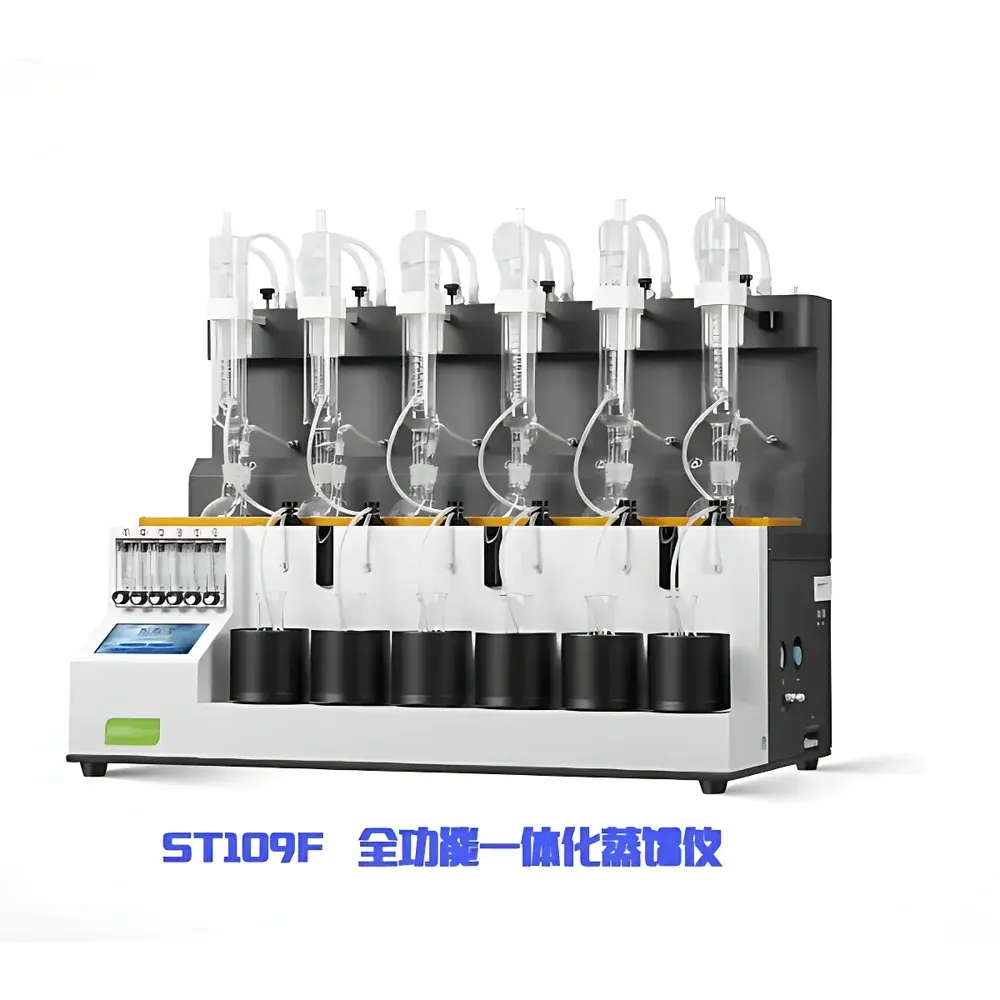
SENTE ST109F Integrated Distillation System
| Brand | SENTE |
|---|---|
| Origin | Shandong, China |
| Manufacturer Type | Direct Manufacturer |
| Instrument Type | Quartz Glass Distillation Apparatus |
| Model | ST109F |
| Heating Method | Far-Infrared Ceramic + Steam Heating |
| Cooling Method | External High-Efficiency Chiller |
| Ramp-Up Time | ≤10 min |
| Distillation Endpoint Detection | Capacitive Contact Sensor or Mass Sensor (Selectable) |
| Heating Positions | 6-channel Independent Control |
| Power Supply | 220 V / 50 Hz |
| Total Power | 6000 W |
| Heating Power per Channel | 500 W |
| Distillate Mass Range | 1–1000 g (Gravimetric Mode) |
| Dimensions (W×D×H) | 1020 × 550 × 740 mm |
| Nitrogen Flow Rate | 0.1–2.0 L/min |
Overview
The SENTE ST109F Integrated Distillation System is an engineered solution for standardized, reproducible, and fully automated distillation in analytical laboratories. Designed around dual-mode thermal input—far-infrared ceramic heating and steam heating—the system enables precise control of thermal energy delivery across six independent channels, minimizing thermal gradient effects and ensuring uniform sample treatment. It operates on fundamental principles of fractional and steam distillation, optimized for volatile analyte recovery under controlled pressure and temperature conditions. The system is purpose-built for compliance-driven applications in environmental monitoring (e.g., ammonia nitrogen, cyanide, phenols), food safety testing (e.g., SO₂, ethanol, formaldehyde, N-nitrosamines), and pharmaceutical quality control (e.g., residual sulfur dioxide in herbal extracts). Its architecture supports both conventional distillation and steam distillation protocols, with integrated endpoint detection eliminating operator-dependent judgment errors.
Key Features
- Six-channel independent heating control (0–500 W per channel), with dry-run protection and real-time power modulation to maintain consistent boiling kinetics.
- Dual heating mode selection: far-infrared ceramic heating for rapid, contactless energy transfer; steam heating for gentle, uniform thermal input—ideal for thermally labile analytes.
- Intelligent acid addition module with programmable dosing, tubing rinsing, and calibration verification—critical for standardized SO₂ determination per GB 5009.34-2022 and USP .
- Six independent nitrogen flow channels (0.1–2.0 L/min), integrated with steam and acid delivery lines via a unified leak-minimized manifold design.
- Automated air-tightness self-check: sequential pressure validation across all six distillation paths prior to operation, generating pass/fail logs traceable to GLP audit requirements.
- Endpoint detection via dual-sensor architecture—capacitive contact sensing for liquid-level-based termination or high-precision mass sensor (±0.01 g) for gravimetric endpoint control.
- 7-inch industrial-grade capacitive touchscreen with five preloaded method templates: SO₂ Method I/II/III (GB 5009.34), steam distillation, micro-boiling mode, and seal integrity test—each with editable, user-locked parameter sets.
- Modular condensation system featuring quick-release joints, auto siphon-back of cooling water, and compatibility with Liebig, coiled, and reflux condensers—including reverse-flush capability to prevent biofilm accumulation.
Sample Compatibility & Compliance
The ST109F accommodates standard 250 mL and 500 mL round-bottom flasks, Kjeldahl digestion tubes, and custom vessels (100–500 mL capacity) when used with the optional ice-bath module (0–5 °C, auto-refill). It meets mechanical and operational requirements referenced in multiple national and industry standards, including but not limited to: ASTM D129 (sulfur in petroleum), ISO 5815-1:2018 (ammonia nitrogen in water), USP (residual solvents), and Chinese national standards HJ 537-2009, HJ 484-2009, HJ 503-2009, GB 5009.34-2022, GB 5009.225-2023, and GB 5009.26-2023. All electronic controls comply with IEC 61000-4 electromagnetic compatibility directives. Data acquisition supports 21 CFR Part 11–compliant audit trails when paired with validated laboratory information management systems (LIMS).
Software & Data Management
The embedded firmware records time-stamped metadata for every run—including setpoints, actual power output, nitrogen flow rates, endpoint triggers, and mass gain curves—stored locally on internal flash memory (≥10,000 cycle retention). Export options include CSV and PDF reports with digital signatures. Optional USB or Ethernet connectivity enables integration with third-party LIMS platforms. Firmware updates are performed via secure OTA protocol with SHA-256 signature verification. User access levels (Operator, Supervisor, Administrator) enforce role-based parameter restrictions aligned with ISO/IEC 17025 documentation control requirements.
Applications
The ST109F delivers validated performance in regulated workflows requiring high inter-laboratory reproducibility. Typical use cases include: ammonia nitrogen quantification in wastewater per HJ 537-2009; cyanide recovery from soil matrices per HJ 745-2015; steam distillation of N-nitrosamines from cured meats per GB 5009.26-2023; ethanol concentration measurement in alcoholic beverages per GB 5009.225-2023; and sulfur dioxide liberation from dried fruits and traditional Chinese medicinal herbs per GB 5009.34-2022. Its modular design also supports method development for emerging analytes requiring low-temperature, oxygen-sensitive, or nitrogen-purged distillation environments.
FAQ
Does the ST109F support GLP-compliant data archiving?
Yes—audit trails, user login logs, method version history, and raw sensor outputs are retained with tamper-evident timestamps and exportable in FDA-acceptable formats.
Can the system be validated per IQ/OQ/PQ protocols?
Yes—SENTE provides documented validation templates aligned with ISO/IEC 17025 and GMP Annex 15, including temperature uniformity mapping, endpoint repeatability testing, and nitrogen flow linearity verification.
Is external chiller integration mandatory?
Yes—the system requires continuous coolant circulation at ≤10 °C; SENTE recommends chillers with ≥3 kW cooling capacity and corrosion-resistant stainless-steel coils.
What maintenance intervals are recommended?
Quarterly inspection of sealing gaskets, biannual calibration of mass sensors (using NIST-traceable weights), and annual verification of nitrogen flow meters against primary standards.
Are consumables such as condenser tubes covered under warranty?
No—quartz glass components, silicone tubing, and sensor elements are classified as wear parts and excluded from the 24-month limited warranty covering structural and electronic subsystems.



