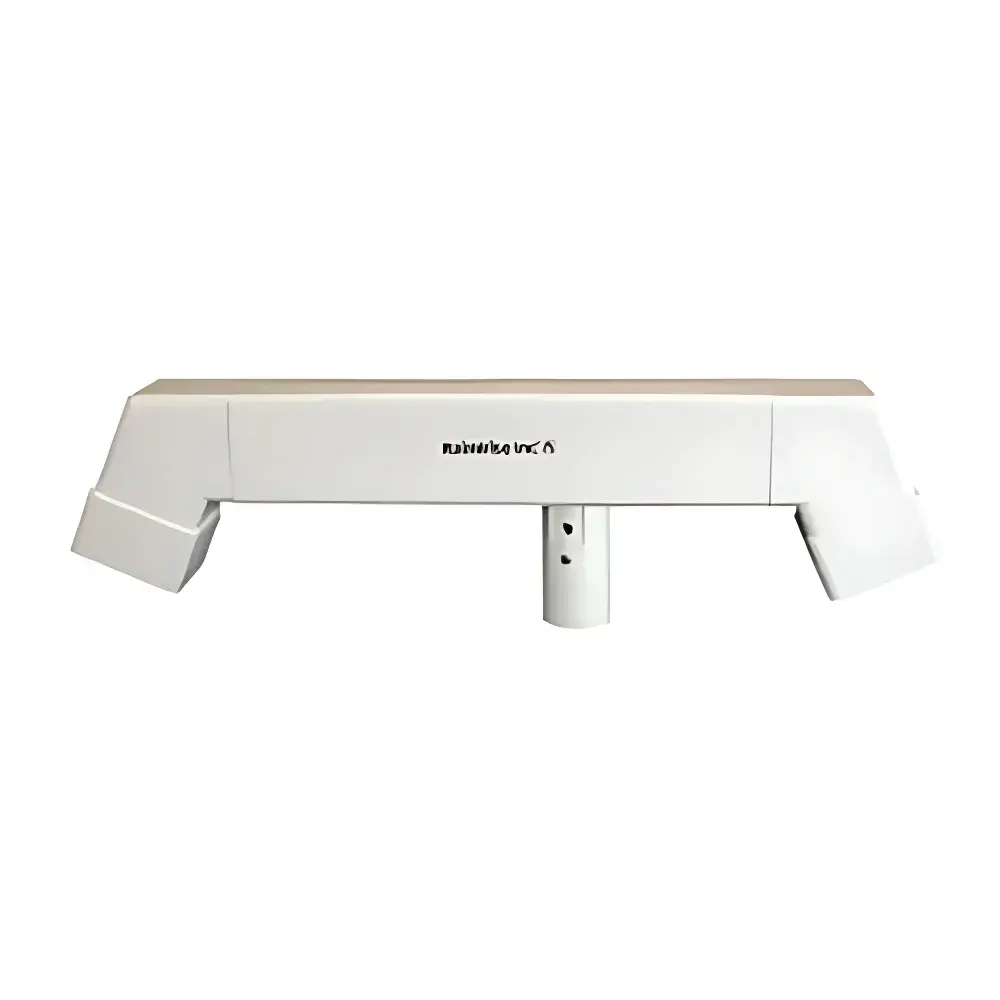
RainWise TWD Wet-Bulb/Dry-Bulb Temperature Sensor
| Brand | RainWise |
|---|---|
| Origin | USA |
| Model | TWD |
| Temperature Range | 0–50 °C |
| Accuracy | ±0.15 °C |
| Resolution | 0.10 °C |
| Sensor Type | Precision Thermistor |
Overview
The RainWise TWD Wet-Bulb/Dry-Bulb Temperature Sensor is a dual-element, precision environmental monitoring instrument engineered for simultaneous measurement of dry-bulb and wet-bulb temperatures in meteorological, agricultural, HVAC, and controlled-environment laboratory applications. Based on the psychrometric principle—where relative humidity and dew point are derived from the temperature differential between a ventilated dry sensor and an evaporatively cooled wet sensor—the TWD delivers high reproducibility in ambient air characterization. Its compact, weather-resistant housing enables outdoor deployment, while its thermistor-based sensing architecture ensures stable, low-drift thermal response across its operational range of 0 to 50 °C. Designed and assembled in the United States, the TWD complies with NIST-traceable calibration practices and supports integration into larger environmental data acquisition systems via standard analog voltage or current outputs (e.g., 0–5 VDC or 4–20 mA, configurable per OEM specification).
Key Features
- Dual-sensor architecture: Independent, matched thermistors for dry-bulb and wet-bulb measurements—minimizing cross-talk and thermal lag.
- High-accuracy thermistor elements: Calibrated to ±0.15 °C at 25 °C, with linearity maintained across the full 0–50 °C range; resolution of 0.10 °C supports fine-grained humidity gradient analysis.
- Robust environmental enclosure: IP65-rated housing with UV-stabilized polycarbonate body and stainless-steel mounting hardware for long-term outdoor exposure.
- Active wet-bulb design: Integrated wick system with capillary-driven water reservoir ensures consistent evaporation surface without external pump or manual refilling.
- Low-power operation: Compatible with battery- or solar-powered remote stations; typical current draw < 3 mA at 12 VDC.
- Field-serviceable construction: Replaceable wick assembly and accessible sensor terminals simplify maintenance in unattended installations.
Sample Compatibility & Compliance
The TWD is optimized for use in ambient atmospheric air under natural or forced ventilation conditions. It is not intended for immersion, high-velocity wind tunnels (>15 m/s), or corrosive or particulate-laden environments without optional filtration or shielding. The sensor meets IEC 60751 Class B tolerance equivalency for resistance temperature devices and conforms to ASTM E337–22 (“Standard Test Method for Measuring Humidity with a Psychrometer”) for psychrometric performance validation. Calibration certificates include NIST-traceable reference data and are supplied with each unit. For regulated environments—including USDA-APHIS field trials, EPA ambient monitoring networks, or GLP-compliant greenhouse studies—the TWD supports audit-ready documentation when paired with compliant data loggers featuring time-stamped, tamper-evident storage.
Software & Data Management
While the TWD itself is an analog transducer, it is routinely interfaced with industry-standard data acquisition platforms including Campbell Scientific CR-series loggers, Onset HOBO UX120 systems, and RainWise’s own MK-III weather station controllers. Output signals are linearized and converted to psychrometric variables (relative humidity, dew point, vapor pressure deficit) using embedded algorithms compliant with the WMO Guide to Meteorological Instruments and Methods of Observation (CIMO Guide, Chapter 4). When integrated into FDA 21 CFR Part 11–compliant infrastructure, the sensor’s traceable calibration history and immutable timestamped readings support electronic record integrity. Firmware-upgradable host systems can apply real-time offset corrections based on site-specific barometric pressure or elevation inputs—enhancing accuracy in high-altitude deployments.
Applications
- Meteorological networks: Core component in ASOS (Automated Surface Observing Systems) and mesonet nodes for real-time humidity profiling.
- Agricultural microclimate monitoring: Used in orchard frost prediction models, irrigation scheduling tools, and post-harvest storage condition verification.
- Controlled-environment agriculture (CEA): Integration into vertical farm climate control loops to maintain optimal VPD (vapor pressure deficit) for leaf transpiration management.
- Building commissioning and HVAC diagnostics: Quantifying latent load contributions and validating desiccant wheel or cooling coil performance.
- Educational laboratories: Teaching psychrometrics, heat transfer fundamentals, and sensor calibration methodology in undergraduate engineering curricula.
FAQ
Does the TWD require periodic recalibration?
Yes—annual recalibration is recommended for applications requiring traceable uncertainty budgets; RainWise offers factory recalibration services with NIST-traceable certification.
Can the wet-bulb wick be replaced in the field?
Yes—the wick assembly is user-replaceable using standard tools; replacement kits (part #TWD-WICK-KIT) are available directly from authorized distributors.
Is the sensor compatible with Modbus or SDI-12 protocols?
No—the TWD provides analog output only; digital communication requires an external signal conditioner or smart logger with analog input and built-in psychrometric calculation firmware.
What is the maximum cable length for maintaining signal integrity?
For 0–5 VDC output, maximum recommended length is 30 meters with shielded twisted-pair cable; for 4–20 mA, up to 300 meters is supported under standard industrial noise conditions.
Does RainWise provide installation guidance for aspirated vs. naturally ventilated configurations?
Yes—detailed mounting guidelines, including aspirator fan selection (e.g., 100 L/min minimum flow) and radiation shielding recommendations, are included in the TWD Installation & Maintenance Manual (Rev. D, 2023).