
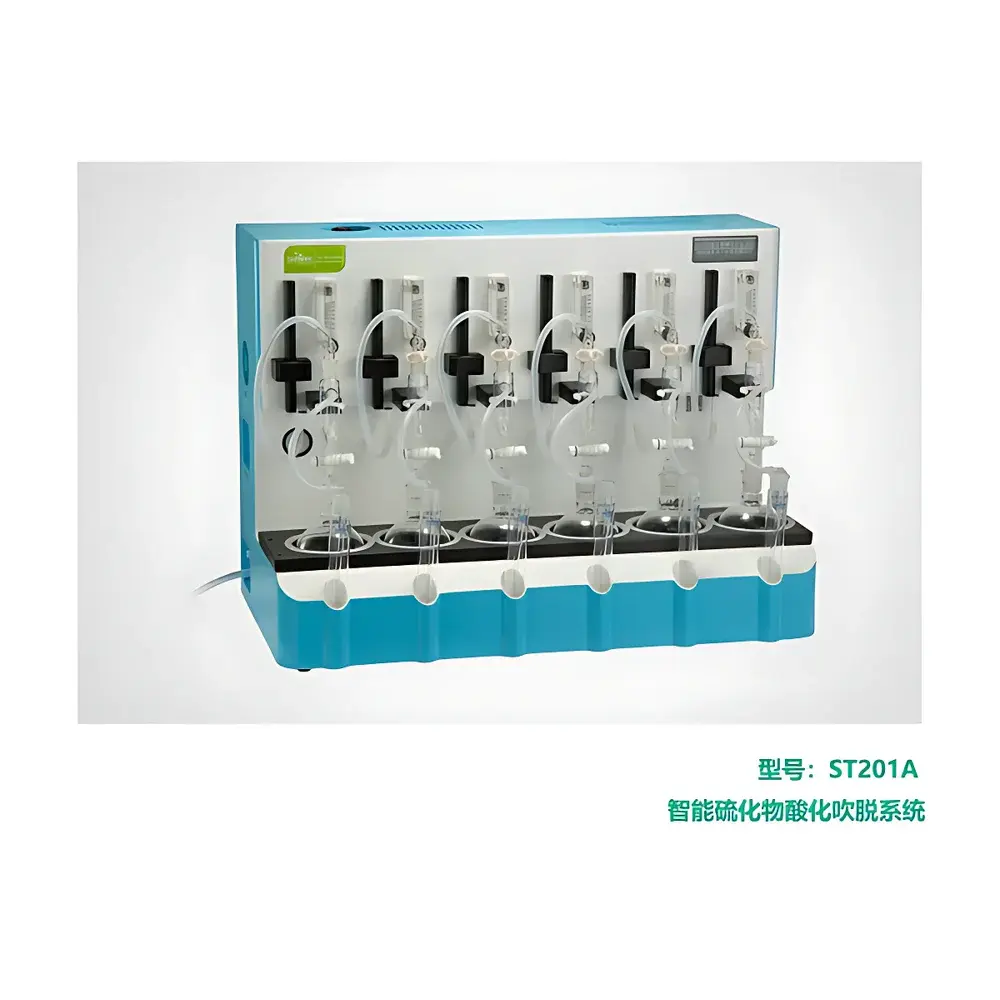
SENTE ST201A1 Sulfide Acidification and Purge System for Water and Soil Analysis (Compliant with HJ 1226-2021, HJ/T 60-2000, HJ 833-2017)
| Brand | SENTE |
|---|---|
| Origin | Shandong, China |
| Manufacturer Type | Direct Manufacturer |
| Product Category | Domestic |
| Model | ST201A1 |
| Instrument Type | Laboratory Benchtop System |
| Gas Flow Control | 6-channel linked rotameter (60–600 mL/min per channel, individually adjustable) |
| Heating Method | Constant-Temperature Water Bath |
| Temperature Range | 0–99 °C |
| Temperature Accuracy | ±1 °C (PID-controlled) |
| Power Rating | 2000 W |
| Safety Features | Leakage current protection |
| Automation Functions | Automatic acid addition, timed nitrogen purge, auto-fill/auto-drain water bath, real-time monitoring via integrated LCD touchscreen |
Overview
The SENTE ST201A1 Sulfide Acidification and Purge System is a laboratory-grade benchtop instrument engineered for precise, reproducible pre-treatment of aqueous and solid environmental samples prior to sulfide quantification. It implements the standardized acidification-purge-absorption principle—where sulfide species (S²⁻, HS⁻, H₂S) are liberated under acidic conditions, purged from the matrix using high-purity nitrogen gas, and trapped in an alkaline absorbent solution (e.g., zinc acetate or NaOH). This methodology aligns with internationally recognized analytical frameworks and is explicitly validated for compliance with Chinese national standards HJ 1226-2021 (Methylene Blue Spectrophotometry for Water), HJ/T 60-2000 (Iodometric Titration), and HJ 833-2017 (for soil matrices). The system’s design prioritizes method fidelity, operator safety, and inter-laboratory comparability—critical requirements for accredited environmental testing laboratories operating under ISO/IEC 17025 or GLP conditions.
Key Features
- Six independent sample channels with synchronized yet individually adjustable nitrogen flow control (60–600 mL/min per channel), enabled by a calibrated linked rotameter bank for uniform mass transfer kinetics across all positions.
- Integrated PID-controlled constant-temperature water bath (0–99 °C, ±1 °C stability) ensuring consistent reaction kinetics during acidification and purge phases—minimizing volatility-related bias in sulfide recovery.
- Automated reagent delivery: programmable vertical acid injection mechanism enables precise, contamination-free addition of phosphoric or hydrochloric acid directly into sample vessels, eliminating manual pipetting variability.
- Full-system automation via a built-in industrial-grade LCD touchscreen interface: users configure acid addition timing, purge duration (0–999 min), heating setpoint, and water bath fill/drain cycles—all stored with timestamped method files.
- Intelligent water management: level sensors trigger audible/visual alerts upon low-water condition; optional auto-refill function maintains bath volume without operator intervention.
- 2000 W heating capacity with integrated earth-leakage circuit breaker (ELCB), conforming to IEC 61000-4 electromagnetic compatibility and Class I electrical safety requirements for laboratory environments.
Sample Compatibility & Compliance
The ST201A1 accommodates standard 100–500 mL borosilicate glass reaction vessels and supports both liquid (surface water, groundwater, wastewater, leachates) and solid-phase matrices (soil, sediment, sludge) following appropriate homogenization and suspension protocols per HJ 833-2017. Its modular gas pathway employs chemically inert PTFE and borosilicate components to prevent sulfide adsorption or catalytic oxidation. All operational parameters—including temperature logs, gas flow calibration records, acid addition timestamps, and purge durations—are traceable and exportable, supporting audit readiness for regulatory submissions under EPA Method 376.1, ISO 16302:2014 (Water Quality — Determination of Sulfide), and China’s CNAS-CL01:2018 accreditation criteria. The system does not include an integrated spectrophotometer; it serves exclusively as a sample preparation module compatible with downstream UV-Vis analysis platforms.
Software & Data Management
The embedded firmware provides non-volatile storage for ≥100 method templates, each retaining full parameter sets (temperature ramp profiles, acid volume, purge time, flow rate per channel). All run-time events—including start/stop times, temperature deviations >±0.5 °C, flow interruptions, and water-level anomalies—are logged with ISO 8601 timestamps. Data export is supported via USB 2.0 to CSV format for integration with LIMS or statistical analysis tools (e.g., JMP, Minitab). While the system does not implement FDA 21 CFR Part 11-compliant electronic signatures or audit trails out-of-the-box, its deterministic operation and immutable event logging meet foundational ALCOA+ (Attributable, Legible, Contemporaneous, Original, Accurate) principles required for GLP-compliant environmental testing workflows.
Applications
- Routine monitoring of total sulfide in municipal wastewater influent/effluent per national discharge standards (e.g., GB 8978-1996).
- Regulatory compliance testing for industrial effluents (petrochemical, pulp & paper, tannery sectors) where sulfide poses corrosion or toxicity risks.
- Ecological risk assessment of sediments and porewater in freshwater and estuarine systems.
- Method validation studies comparing recovery efficiency across different acid types, purge durations, and absorbent solutions.
- Training platforms in university environmental chemistry labs due to intuitive interface and transparent process visualization.
FAQ
Does the ST201A1 include an integrated spectrophotometer or detection module?
No. It is a dedicated sample preparation system designed exclusively for acidification, nitrogen purging, and absorbent trapping—intended for use with standalone UV-Vis spectrophotometers or titrators.
What nitrogen purity is recommended for optimal recovery?
≥99.998% (Grade 5.0) nitrogen is advised to minimize interference from oxygen or moisture that may oxidize H₂S during transport.
Can the system handle viscous or suspended samples without clogging?
Yes—sample vessels accept up to 20% (w/v) suspended solids; however, filtration or centrifugation prior to acidification is recommended for samples with high particulate load to ensure consistent gas–liquid mass transfer.
Is third-party calibration certification available?
Calibration certificates for rotameters and temperature sensors (traceable to NIM, China) can be provided upon request at additional cost; on-site verification services are supported through SENTE’s authorized regional partners.
What maintenance intervals are recommended for long-term reliability?
Rotameter calibration every 12 months; water bath descaling every 3 months in hard-water regions; visual inspection of PTFE tubing and O-rings before each batch run.







