
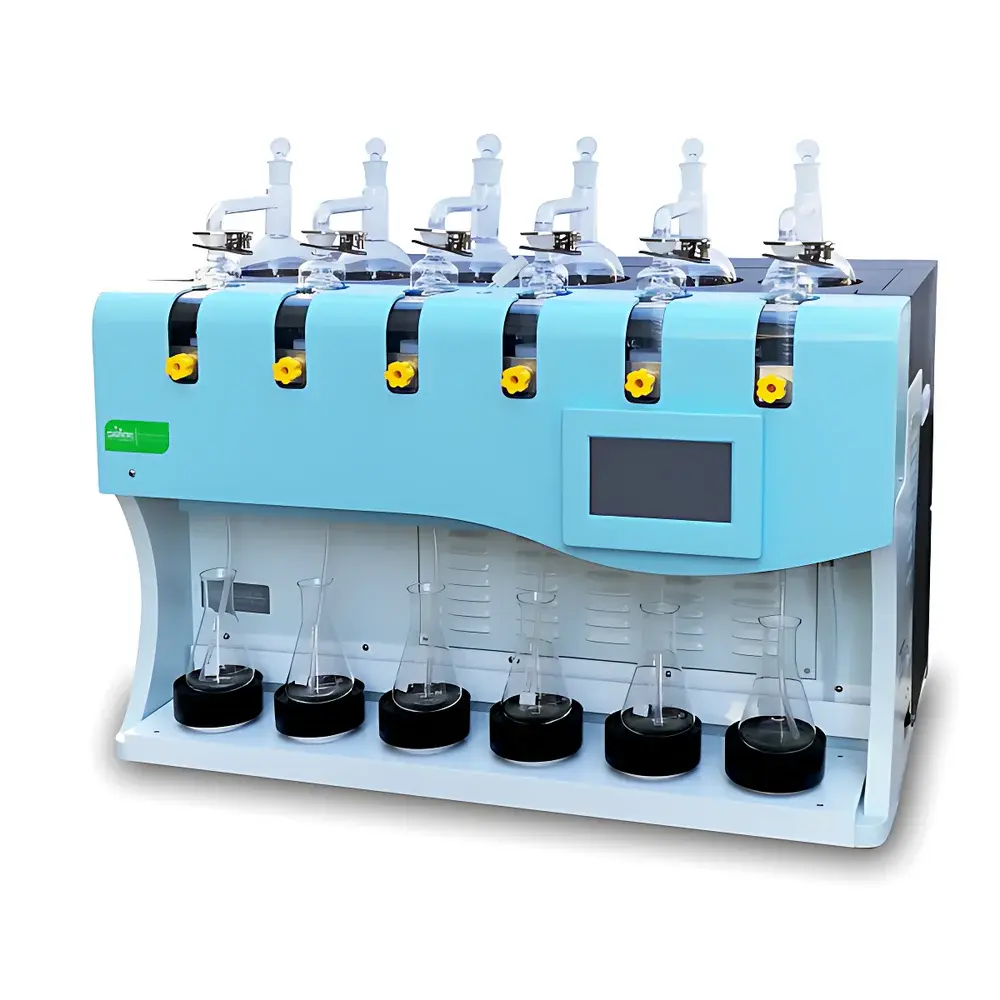
SENTE STRW206 Automated Intelligent Sub-boiling Distillation Apparatus
| Brand | SENTE |
|---|---|
| Origin | Shandong, China |
| Manufacturer Type | Direct Manufacturer |
| Country of Origin | China |
| Model | STRW206 |
| Instrument Type | Sub-boiling Distillation Apparatus |
| Compliance Standards | HJ 503–2009, HJ 484–2009, HJ 537–2009, HJ 745–2015, Q/0102JST002–2015 |
Overview
The SENTE STRW206 Automated Intelligent Sub-boiling Distillation Apparatus is an integrated, laboratory-grade distillation system engineered for precision, safety, and regulatory compliance in environmental and food quality testing. Unlike conventional distillation setups—where heating, vaporization, condensation, and collection operate as discrete units—the STRW206 implements a fully synchronized sub-boiling distillation process based on controlled infrared thermal input and dynamic endpoint detection. Sub-boiling operation minimizes bumping, foaming, and analyte degradation by maintaining liquid-phase temperature below the atmospheric boiling point while enabling efficient volatilization of target compounds (e.g., phenols, cyanides, ammonia nitrogen, SO₂, formaldehyde, and ethanol). This principle is critical for preserving labile species and achieving high recovery rates required by HJ 503–2009, HJ 537–2009, and other Chinese EPA-equivalent methods.
Key Features
- Independent per-position control: Six-channel modular design with individual timer and volume setpoints (1–500 mL) for simultaneous yet non-interfering distillations.
- Integrated cooling architecture: Built-in refrigerated water reservoir with imported compressor and dual-mode air-assisted heat dissipation—eliminates dependency on external chillers or tap-water circulation.
- Far-infrared ceramic heating elements: Chemically inert, acid- and alkali-resistant surface; precise thermal coupling with round-bottom flasks; energy efficiency up to 35% higher than conventional resistive heaters.
- Intelligent endpoint management: Real-time distillate volume monitoring via gravimetric or optical sensor feedback, triggering automatic power cutoff and anti-suckback valve activation upon completion.
- Full-glass condensation path: Concealed borosilicate condenser with seamless all-glass jointing to round-bottom flasks—ensures minimal hold-up volume, no metal contamination, and adherence to classical distillation thermodynamics.
- Enhanced electrical safety: CE-certified residual-current circuit breaker (RCCB), reinforced insulation, and grounded chassis compliant with IEC 61010-1 for Class II laboratory equipment.
- Human-centered interface: 7-inch capacitive touch LCD with multilingual OS support (English default), intuitive workflow navigation, and parameter lockout for GLP environments.
Sample Compatibility & Compliance
The STRW206 is validated for aqueous matrices including surface water, wastewater, drinking water, soil leachates, and food digests. It meets method-specific requirements for volatile phenol (4-aminoantipyrine spectrophotometry), total and free cyanide (titrimetric and colorimetric), ammonia nitrogen (distillation–acid titration), and SO₂ (modified pararosaniline method). Its design aligns with Good Laboratory Practice (GLP) principles—including audit-ready operation logs, user-access level controls, and non-volatile memory retention—and supports traceability under ISO/IEC 17025-accredited testing workflows. All wetted components comply with USP Class VI and FDA 21 CFR Part 11 data integrity guidelines when paired with optional LIMS integration modules.
Software & Data Management
Embedded firmware records timestamped event logs—including start/stop times, heating ramp profiles, cooling status, volume targets, and fault codes—for each distillation run. Data export is supported via USB 2.0 (CSV format) or optional Ethernet/Wi-Fi module (TCP/IP protocol). The system allows configuration of electronic signatures, user-defined report templates, and password-protected method libraries. Audit trail functionality satisfies regulatory expectations for data permanence, change tracking, and operator accountability—particularly relevant for CNAS-accredited labs and third-party environmental testing providers operating under HJ series standards.
Applications
Primary use cases include: (1) Environmental analysis—determination of phenolic compounds, cyanide species, and ammonia nitrogen in municipal effluents and natural waters per HJ 503, HJ 484, and HJ 537; (2) Food safety testing—quantification of sulfur dioxide residues in dried fruits and wines, formaldehyde adulteration screening in aquatic products, and alcohol content verification in fermented beverages; (3) Soil and sediment characterization—cyanide extraction from contaminated sites following HJ 745; (4) Method development laboratories requiring reproducible low-temperature volatilization for compound isolation prior to GC, IC, or UV-Vis analysis.
FAQ
What distinguishes sub-boiling distillation from conventional boiling distillation?
Sub-boiling operates below the solvent’s atmospheric boiling point using controlled infrared energy, reducing thermal stress on analytes and minimizing co-distillation of non-volatiles—critical for accurate phenol and cyanide recovery.
Is external cooling water required?
No. The STRW206 incorporates a self-contained refrigeration unit with compressor-based cooling and auxiliary air heat exchange—no tap water or chiller connection needed.
Can the system be validated for ISO/IEC 17025 compliance?
Yes. With its electronic logbook, user access control, and tamper-evident data storage, it supports full validation documentation including IQ/OQ/PQ protocols.
What flask configurations are supported?
Standard 500 mL round-bottom flasks (GB/T 12807); included six-position custom rack accommodates standard neck geometry and ensures stable thermal contact with heating modules.
How is over-distillation prevented?
A dual safeguard system combines real-time distillate volume feedback with mechanical anti-siphon valves that close automatically upon reaching the preset endpoint—preventing overflow and sample loss.



