
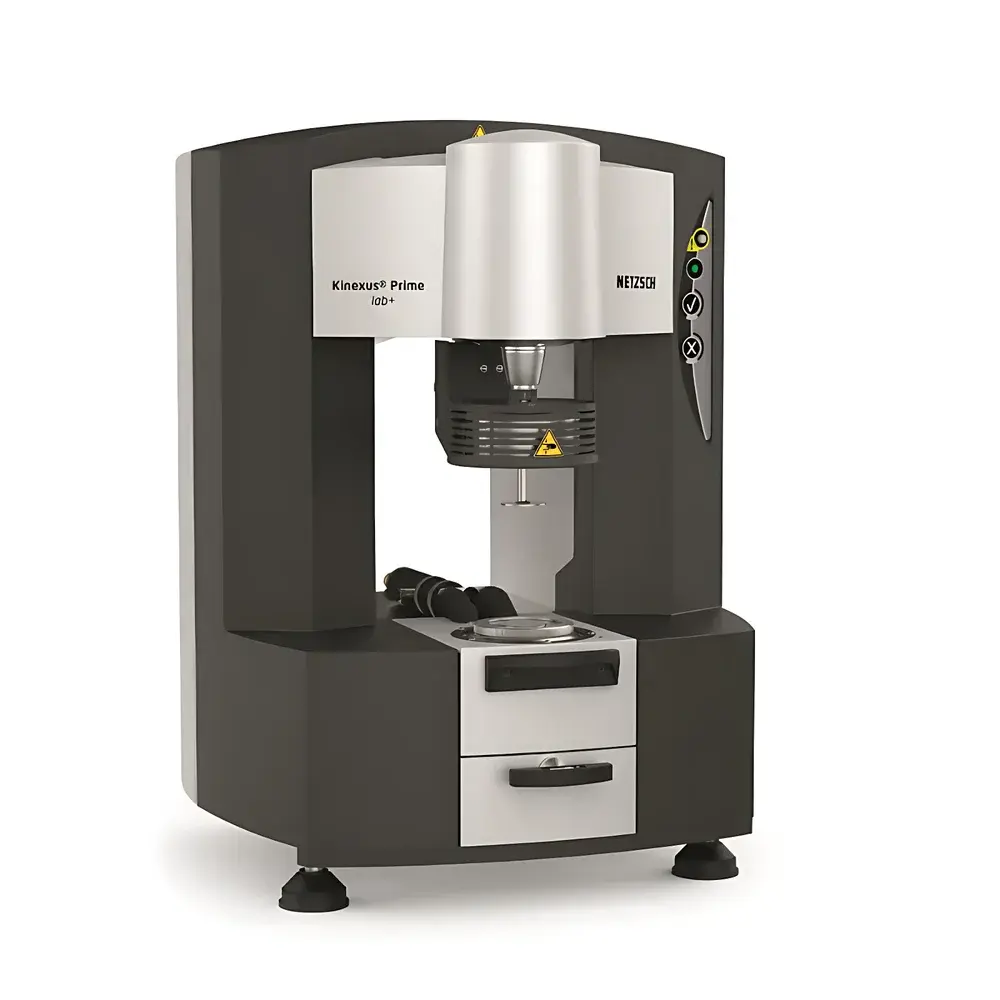
Netzsch Kinexus lab+ Advanced Rotational Rheometer
| Brand | Netzsch |
|---|---|
| Origin | Germany |
| Model | Kinexus lab+ |
| Instrument Type | Rotational Rheometer |
| Sample State | Liquid |
| Bearing Type | Air Bearing |
| Minimum Angular Velocity | 10 nrad/s |
| Maximum Angular Velocity | 325 rad/s |
| Frequency Range | 1 µHz – 150 Hz |
| Maximum Torque | 200 mNm |
| Torque Resolution | 0.1 nNm |
| Normal Force Range | 0.001 N – 50 N |
| Normal Force Response Time | 10 ms |
| Vertical Travel Speed | 0.1 µm/s – 35 mm/s |
| Vertical Travel Distance | 230 mm |
| Gap Resolution | 0.1 µm |
| Motor Inertia | 12 µN·m·s² |
| Torque Range (Steady-State) | 0.01 µNm – 200 mNm |
| Torque Range (Oscillatory) | 0.005 µNm – 200 mNm |
| Fixture Identification | RFID-enabled Smart Recognition |
| Environmental Control Unit | Plug-and-Play with Auto-Detection |
Overview
The Netzsch Kinexus lab+ Advanced Rotational Rheometer is a high-precision, modular rheological testing platform engineered for rigorous characterization of complex fluids and soft solids under controlled mechanical and thermal conditions. Based on the Couette and cone-plate geometries, it operates on the fundamental principle of controlled-strain and controlled-stress rotational rheology—measuring shear stress, shear rate, storage modulus (G′), loss modulus (G″), and complex viscosity (η*) across wide dynamic ranges. Designed in Selb, Germany, the system integrates an ultra-low-inertia motor (<12 µN·m·s²) coupled with a high-resolution optical encoder (angular resolution down to 10 nrad/s) and an active air-bearing suspension system. This architecture ensures exceptional torque sensitivity (down to 0.005 µNm in oscillatory mode), minimal mechanical drift, and high reproducibility—critical for detecting subtle structural transitions in polymer melts, dispersions, emulsions, and food matrices. Its modular design supports seamless integration with environmental control units, solvent trapping accessories, and in-line process monitoring interfaces, making it suitable for both R&D laboratories and quality assurance environments operating under GLP or GMP frameworks.
Key Features
- Ultra-low-inertia air-bearing motor system with real-time angular position feedback via high-resolution optical encoders
- Intelligent normal force control with 10 ms response time and sub-micron gap resolution (0.1 µm) over 230 mm vertical travel range
- RFID-enabled smart fixture recognition: automatic loading of geometry-specific calibration data, correction factors, and historical validation records
- Plug-and-play environmental control units with auto-detection and parameter synchronization—compatible with Peltier, liquid-circulated, and convection oven modules
- Integrated real-time data acquisition for simultaneous recording of torque, normal force, gap, temperature, and rotational kinematics
- Comprehensive software architecture supporting both SOP-driven workflows and fully customizable experimental protocols—including multi-step amplitude sweeps, frequency sweeps, time sweeps, and LAOS (Large Amplitude Oscillatory Shear)
Sample Compatibility & Compliance
The Kinexus lab+ accommodates liquid-state samples including polymer melts, thermoplastic solutions, colloidal suspensions, latex emulsions, coatings, inks, pharmaceutical gels, and dairy-based systems. Its broad torque range (0.005 µNm–200 mNm) and extended frequency spectrum (1 µHz–150 Hz) enable characterization from highly viscous melts (>10⁶ Pa·s) to low-viscosity Newtonian fluids ( G″). The system complies with ISO 6721 (Plastics — Determination of dynamic mechanical properties), ASTM D4440 (Standard Test Method for Rheological Properties of Polymer Melts), and USP (Rheological Measurements). Data integrity features include full audit trails, electronic signatures, and configurable user access levels aligned with FDA 21 CFR Part 11 requirements for regulated environments.
Software & Data Management
The Kinexus software suite provides a unified interface for instrument control, method development, real-time visualization, and post-processing. It supports hierarchical method templates, batch processing of multiple samples, and automated report generation compliant with LIMS integration standards. All raw measurement data—including time-stamped torque, strain, temperature, and gap values—are stored in open-format HDF5 files, ensuring long-term archival stability and third-party analysis compatibility. Built-in statistical tools facilitate inter-laboratory comparison studies, while export modules support ASTM E1447-compliant data exchange formats. Software validation documentation (IQ/OQ/PQ protocols) is available upon request for regulated users.
Applications
- Molecular weight and molecular weight distribution estimation of synthetic polymers via master curve construction and time-temperature superposition
- Processing window definition for extrusion, injection molding, and fiber spinning through melt elasticity and extensional viscosity modeling
- Stability assessment of colloidal formulations (e.g., paints, cosmetics) using yield stress mapping and thixotropic loop analysis
- Texture and mouthfeel prediction in food products (e.g., yogurts, sauces) via small- and large-strain oscillatory tests
- Quality control of incoming raw materials and in-process intermediates against predefined rheological specifications
- Accelerated aging studies under thermal cycling conditions to evaluate structural degradation kinetics
FAQ
What types of sample geometries are supported?
Standard configurations include cone-plate, parallel-plate, and concentric cylinder (Couette) geometries; custom geometries (e.g., vane, serrated, or sand-blasted surfaces) can be integrated via RFID-enabled recognition.
Is the system compatible with ISO/IEC 17025-accredited laboratories?
Yes—the Kinexus lab+ supports full traceability, uncertainty quantification per ISO/IEC Guide 98-3, and calibration certificate management integrated into the software audit trail.
Can the instrument perform extensional rheology measurements?
While primarily a rotational rheometer, it supports filament stretching rheometry (FSR) and capillary breakup extensional rheometry (CaBER) when coupled with optional extensional modules and third-party accessories.
How is temperature control validated during testing?
Each environmental unit includes independent Pt100 sensor feedback, with temperature uniformity verified per ASTM E220 and documented in system qualification reports.
Does the software support multi-user environments with role-based permissions?
Yes—administrator, operator, and viewer roles can be assigned with granular control over method editing, data export, and system configuration changes.



