
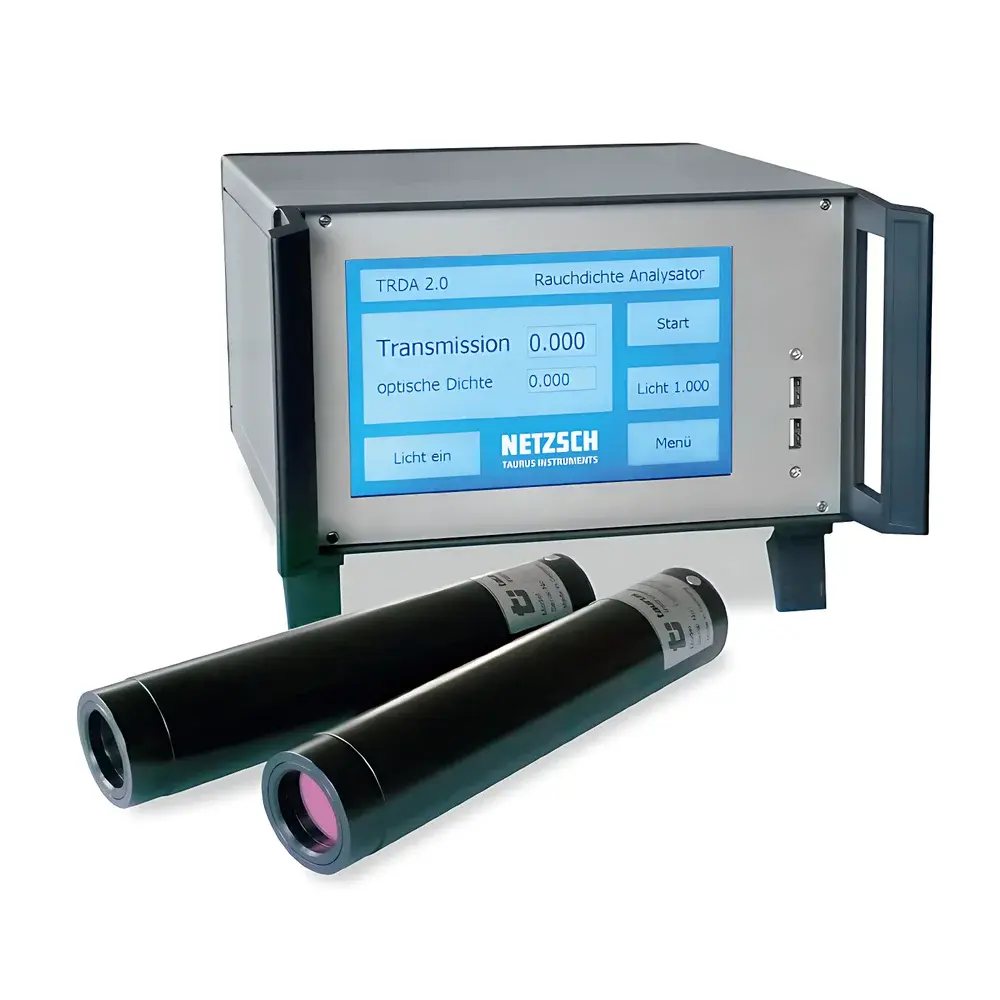
Netzsch TRDA Optical Smoke Density Measurement System
| Brand | Netzsch |
|---|---|
| Origin | Germany |
| Model | TRDA Optical Smoke Density Measurement System |
| Light Source | 10 W halogen lamp, color temperature 2900 K |
| Beam Diameter | 22–500 mm |
| Photometric Linearity | < ±1.5% |
| Compliance | DIN 50055 |
| Control Interface | USB & RS232 |
| Integrated Computing | Single-board computer with Windows OS, TRDA software, high-resolution color touchscreen |
| Accessories Support | Compatibility with single-burner and bundled-cable fire testing configurations |
| Software Licensing | TRDA software — exclusive licensed implementation |
Overview
The Netzsch TRDA Optical Smoke Density Measurement System is a precision-engineered instrument designed for quantitative assessment of optical smoke density generated during controlled combustion of solid materials. It operates on the principle of transmitted light attenuation—measuring the reduction in luminous flux as smoke particles scatter and absorb visible radiation across a defined optical path. This photometric methodology aligns with the fundamental physical basis of smoke obscuration, enabling direct correlation to human visibility impairment under fire conditions. The system is engineered for laboratory-based fire safety evaluation in accordance with DIN 50055, a German standard widely referenced in European fire test protocols for polymeric materials, building components, and cable insulation. Its robust optical architecture—including a stabilized 10 W halogen source (2900 K color temperature), collimating optics, and calibrated photodetector—ensures repeatable, traceable measurements essential for regulatory compliance and material qualification.
Key Features
- Integrated single-board computer running Windows OS, eliminating dependency on external PCs for standalone operation
- Proprietary TRDA software—exclusively licensed by Netzsch—with intuitive graphical interface and real-time optical density (Ds) calculation per DIN 50055
- High-resolution color touchscreen display enabling direct parameter configuration, live signal visualization, and on-device data review
- Optical path flexibility: adjustable beam diameter from 22 mm to 500 mm, accommodating diverse specimen geometries and chamber configurations
- Dual communication interfaces (USB and RS232) supporting bidirectional data exchange, remote calibration verification, and integration into larger fire test automation frameworks
- Modular hardware design allowing seamless coupling with standardized fire test platforms—including single-flame burner setups (e.g., ISO 5659-2 compliant) and bundled-cable vertical tray configurations (IEC 60332-3)
Sample Compatibility & Compliance
The TRDA system supports testing of rigid and flexible polymer specimens, composite panels, insulation foams, electrical cable jackets, and architectural finish materials. Specimen dimensions are constrained only by the optical path geometry and upstream fire exposure apparatus—not by the TRDA unit itself. All measurement outputs comply with the photometric requirements of DIN 50055, which defines optical density (Ds) as Ds = –log10(T), where T is the fractional transmittance of incident light through the smoke layer. The system’s < ±1.5% linearity across its operational dynamic range ensures conformity with the repeatability thresholds specified in EN ISO 5659-2 Annex A and ASTM E662 for smoke density index derivation. While not certified to UL 723 or NFPA 255 directly, its optical metrology chain is fully compatible with those standards’ measurement clauses when integrated into appropriately configured test chambers.
Software & Data Management
TRDA software provides full lifecycle data handling—from real-time acquisition and baseline correction to post-test reporting in PDF and CSV formats. Each measurement session includes automatic timestamping, environmental metadata logging (ambient temperature/humidity if externally interfaced), and audit-trail generation compliant with GLP principles. The software implements configurable alarm thresholds for Ds overshoot and photometric drift detection, triggering operator alerts during extended tests. Exported datasets retain full traceability: raw photodiode voltage, calculated transmittance, and derived Ds values at user-defined time intervals (default: 1 s). For regulated environments, optional 21 CFR Part 11 add-ons support electronic signatures, role-based access control, and immutable record archiving—enabling use in GMP-aligned R&D laboratories and third-party certification bodies.
Applications
- Development and qualification of low-smoke, zero-halogen (LSZH) cable compounds for rail and mass transit infrastructure
- Comparative smoke yield analysis of flame-retardant additives in thermoplastics and thermosets
- Fire performance benchmarking of façade cladding systems under radiant heat exposure
- Validation of smoke suppression efficacy in intumescent coatings and firestop sealants
- Supporting documentation for CE marking under Construction Products Regulation (CPR) Annex ZA, particularly for Euroclass B-s1,d0 and C-s2,d0 classifications
- Academic research on soot formation kinetics and particle size distribution effects on visible light extinction
FAQ
Does the TRDA system require periodic recalibration?
Yes—annual photometric recalibration against NIST-traceable neutral density filters is recommended to maintain compliance with DIN 50055 linearity specifications.
Can TRDA software export data to LIMS or ELN platforms?
Yes—CSV exports include structured headers and metadata fields compatible with most laboratory information management systems; API integration is available under custom licensing.
Is the halogen light source replaceable in the field?
Yes—the 10 W halogen lamp is a user-serviceable component with documented replacement procedure and alignment protocol included in the technical manual.
What is the minimum detectable optical density increment?
The system achieves a resolution of 0.01 Ds units over its full 0–4.0 Ds measurement range, sufficient to resolve early-stage smoke development in low-yield materials.
Does Netzsch provide installation qualification (IQ) and operational qualification (OQ) documentation?
Yes—factory-verified IQ/OQ protocols, including photometric verification reports and software validation summaries, are supplied with each system upon request.



