
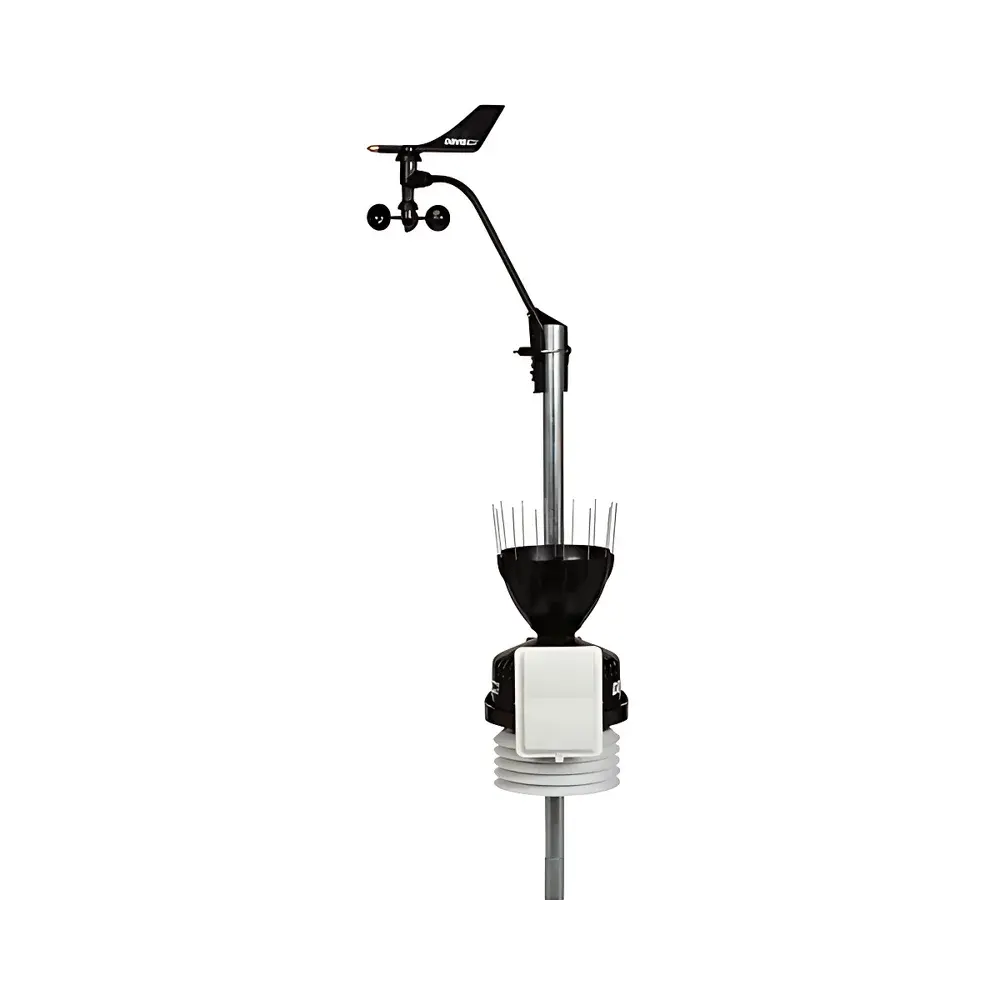
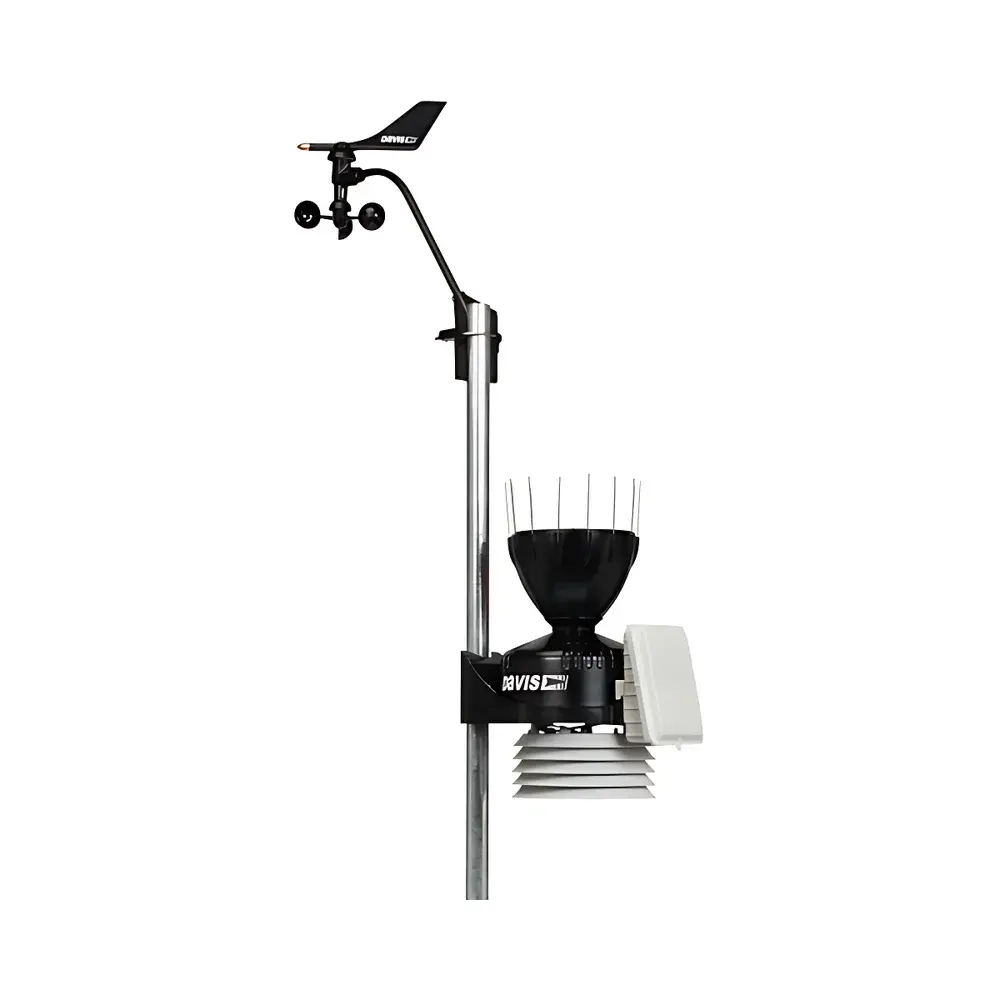
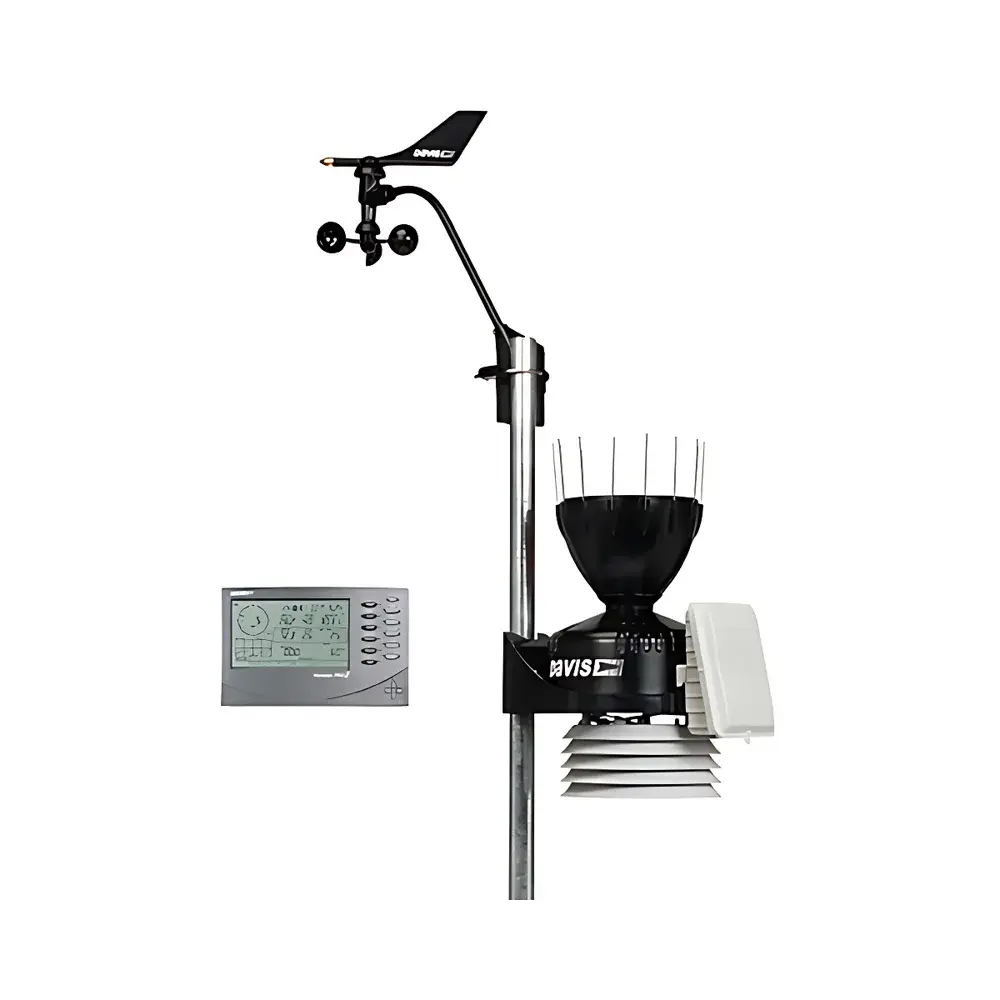
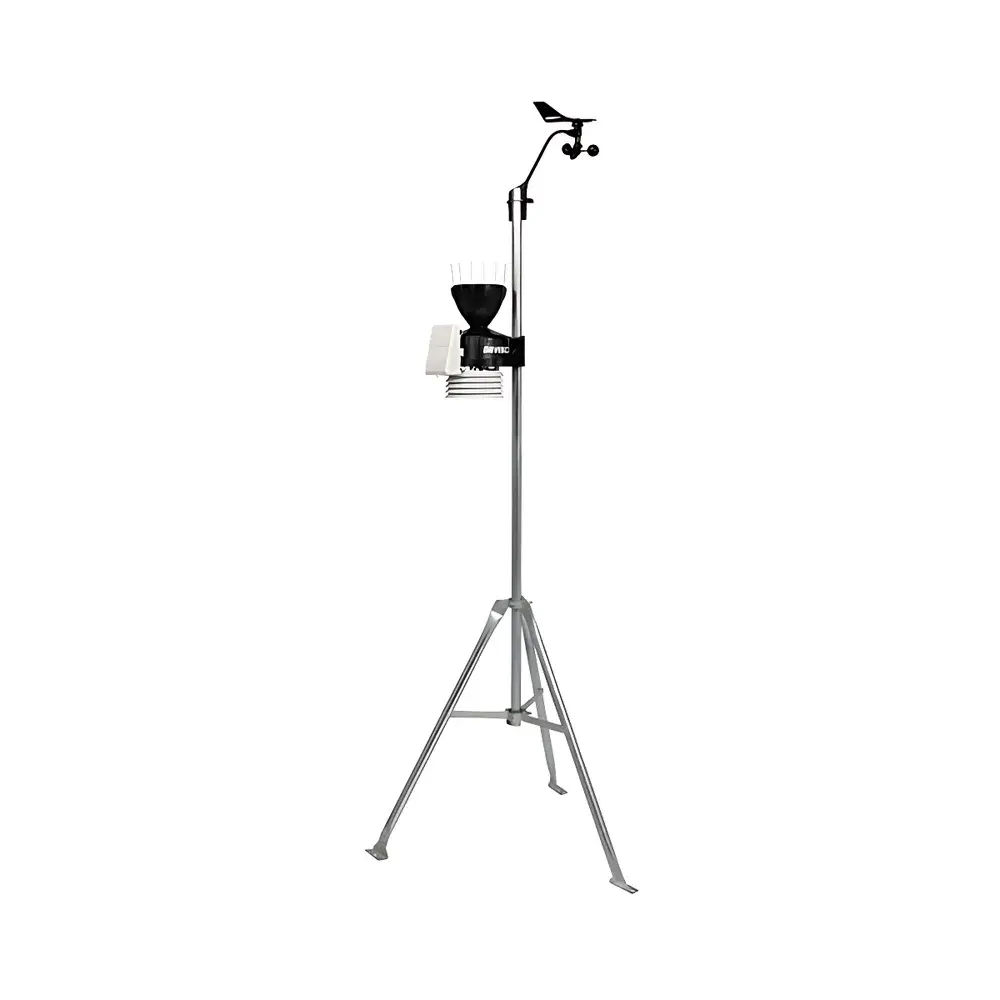
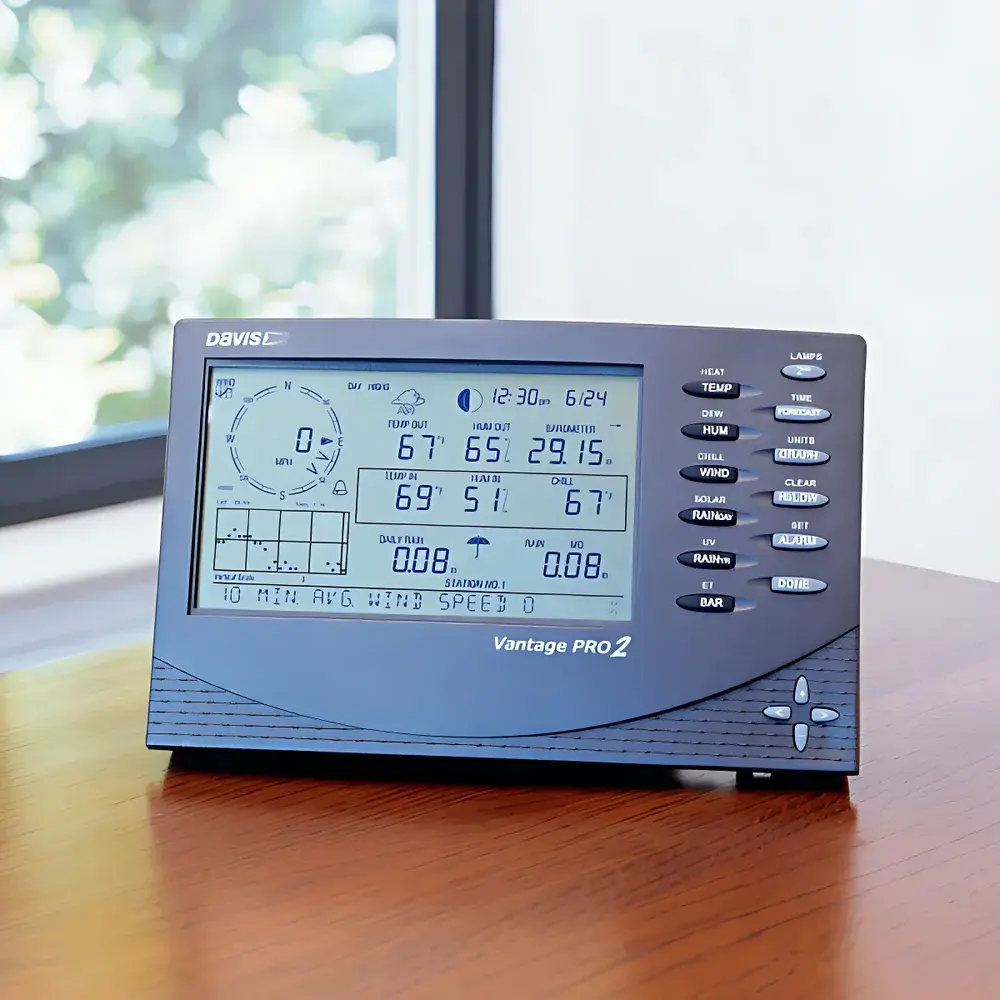
Davis Vantage Pro2 6152C Wired Standard Weather Station
| Brand | Davis (USA) |
|---|---|
| Origin | USA |
| Model | Vantage Pro2 6152C |
| Instrument Type | Wired Integrated Weather Station |
| Power Consumption | ≤10 mA (ISS + Console, 4–6 VDC) |
| Max Cable Length | 300 m (Console), 165 m (ISS) |
| Operating Temperature | −40°C to +65°C (ISS), 0°C to +60°C (Console) |
| Wind Speed Range | 0–89 m/s |
| Wind Direction | 1–360° (±3° accuracy) |
| Temp Range (Outdoor) | −40°C to +65°C (±0.3°C) |
| Humidity | 1–100% RH (±2% accuracy) |
| Barometric Pressure | 540–1100 hPa (±1.0 hPa) |
| Rainfall Resolution | 0.2 mm (≤2000 mm), 1 mm (>2000 mm) |
| Rainfall Accuracy | ±3% or ±0.2 mm (whichever greater, ≤250 mm/h) |
| Data Logging | Flash memory (non-volatile) |
| Communication | RJ-11 wired interface |
| Compliance | Designed for NOAA-compliant reporting, GLP-aligned data integrity |
Overview
The Davis Vantage Pro2 6152C Wired Standard Weather Station is a fully integrated, field-deployable environmental monitoring system engineered for long-term, high-reliability meteorological data acquisition in unattended outdoor settings. Built upon the proven Vantage Pro2 platform, this wired configuration eliminates radio interference and latency concerns inherent in wireless systems—making it especially suitable for installations near RF-sensitive infrastructure, within shielded enclosures, or in regulatory environments requiring deterministic data transmission timing. The station employs a modular sensor suite (Integrated Sensor Suite, ISS) that simultaneously measures wind speed (cup anemometer with magnetic reed switch), wind direction (vane with precision potentiometer), ambient temperature and relative humidity (silicon diode and thin-film capacitive elements), barometric pressure (piezoresistive transducer), and precipitation (tipping-bucket rain gauge with 214 cm² collection area). All raw measurements are processed locally in the ISS and transmitted via shielded 4-conductor 26 AWG cable to the console, where real-time calculation of derived parameters—including wind chill, dew point, heat index, evapotranspiration (ET), sunrise/sunset times, and lunar phase—is performed using embedded firmware compliant with NOAA-defined algorithms.
Key Features
- Non-volatile Flash memory logging ensures uninterrupted data retention during power loss—no data corruption or gaps due to brownouts or battery depletion.
- Robust outdoor-rated ISS housing constructed from UV-stabilized ABS and polypropylene resists degradation under prolonged solar exposure, salt spray, and thermal cycling.
- Low-power architecture: average current draw ≤10 mA (ISS + console) enables extended operation on solar-charged battery banks or low-capacity backup systems—ideal for remote off-grid deployments.
- Lightning-hardened design includes multi-stage transient voltage suppression at both ISS and console interfaces, meeting IEC 61000-4-5 surge immunity requirements for Class III outdoor installations.
- Configurable sampling intervals (1–60 minutes) and local storage capacity support compliance with ISO 13956:2020 (meteorological data continuity) and ASTM D5096 (field instrumentation validation protocols).
- RJ-11 cabling architecture supports daisy-chaining of multiple ISS units (with optional expansion modules) and permits cable runs up to 300 meters between console and ISS—enabling flexible site layout without signal repeaters.
Sample Compatibility & Compliance
The Vantage Pro2 6152C is validated for continuous operation across diverse environmental regimes—from arctic tundra (−40°C) to desert basins (+65°C). Its sensor calibration traceability aligns with NIST-traceable reference standards used by Davis Instruments’ ISO/IEC 17025-accredited calibration laboratory. The station satisfies key regulatory prerequisites for environmental data used in air quality modeling (EPA QA/QC requirements), agricultural ET estimation (FAO-56 methodology), and hydrometeorological reporting (WMO No. 8 guidelines). While not certified as a primary reference station per WMO Class I specifications, its performance envelope meets WMO Class II operational thresholds for synoptic observation networks. Data output formats comply with NOAA’s Surface Observations (METAR/SYNOP) schema and support direct ingestion into EPA’s AirNow and USDA’s Climate Hub platforms via WeatherLink software export.
Software & Data Management
WeatherLink v6.x software (Windows/macOS) provides full local control, visualization, and archival of time-series meteorological data. It generates standardized NOAA-formatted reports (e.g., Daily Summary, Monthly Climatic Summary) with automated QC flagging for out-of-range values, sensor saturation, or missing intervals. Audit trails record all user-initiated configuration changes, firmware updates, and manual data edits—supporting GLP/GMP documentation requirements. Raw binary logs (.wlk files) are cryptographically timestamped and retain native sensor resolution prior to post-processing. For network integration, optional WeatherLink Live hardware enables secure HTTPS-based data forwarding to third-party SCADA systems, cloud dashboards (e.g., ThingSpeak, AWS IoT Core), or institutional databases—while maintaining full local storage redundancy. All exported CSV/JSON datasets include metadata headers conforming to CF Metadata Conventions (v1.8), facilitating interoperability with Python-based analysis workflows (e.g., Pandas, Xarray).
Applications
- Agricultural research stations requiring high-temporal-resolution microclimate data for irrigation scheduling and phenology modeling.
- University atmospheric science departments deploying fixed-location networks for boundary layer studies and urban heat island quantification.
- Renewable energy site assessments where wind shear profiles, turbulence intensity, and diurnal temperature gradients inform turbine placement and yield forecasting.
- Municipal public works departments maintaining stormwater management systems reliant on real-time rainfall accumulation and intensity metrics.
- Ecological monitoring programs tracking soil moisture–temperature coupling, leaf wetness duration, and evapotranspiration trends across habitat transects.
- Federal land management agencies (e.g., USFS, BLM) implementing fire weather monitoring per NFPA 921 and NWCG standards.
FAQ
What is the maximum recommended cable length between the ISS and console?
The system supports up to 300 meters of 4-conductor 26 AWG twisted-pair cable between the console and ISS when using standard power delivery; however, for optimal signal integrity and noise immunity in electrically noisy environments, Davis recommends limiting runs to 165 meters without active signal conditioning.
Does the station meet FDA 21 CFR Part 11 requirements for electronic records?
While the Vantage Pro2 6152C itself is not a regulated medical device, WeatherLink software can be configured with electronic signatures, audit trails, and role-based access controls to support Part 11 compliance in environmental monitoring applications supporting pharmaceutical manufacturing or clinical trial sites.
Can the console operate solely on battery power?
Yes—the console accepts three C-cell alkaline batteries (not included) and will operate continuously for approximately one month without external power, though flash memory write cycles and backlight usage affect longevity.
Is the tipping-bucket rain gauge heated for winter operation?
No—the standard 6152C ISS does not include a heated rain collector. For freezing-prone climates, Davis offers the optional Heated Rain Collector (model 7851) as a field-upgradable accessory.
How is barometric pressure corrected for altitude?
The console applies a standard international atmosphere (ISA) model correction based on user-entered elevation (−600 to +4570 m); for higher accuracy, users may input local sea-level pressure from nearby NWS stations to derive station pressure via inverse calculation.
Related Products







