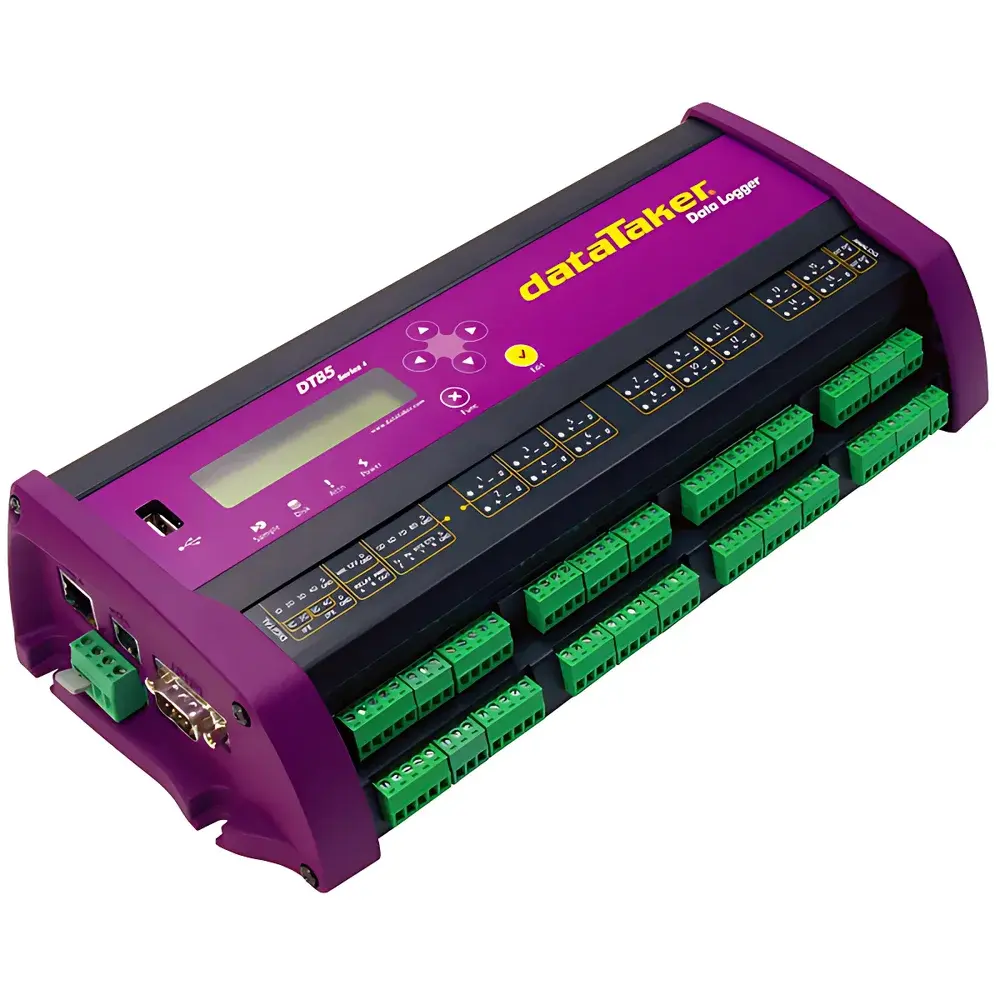
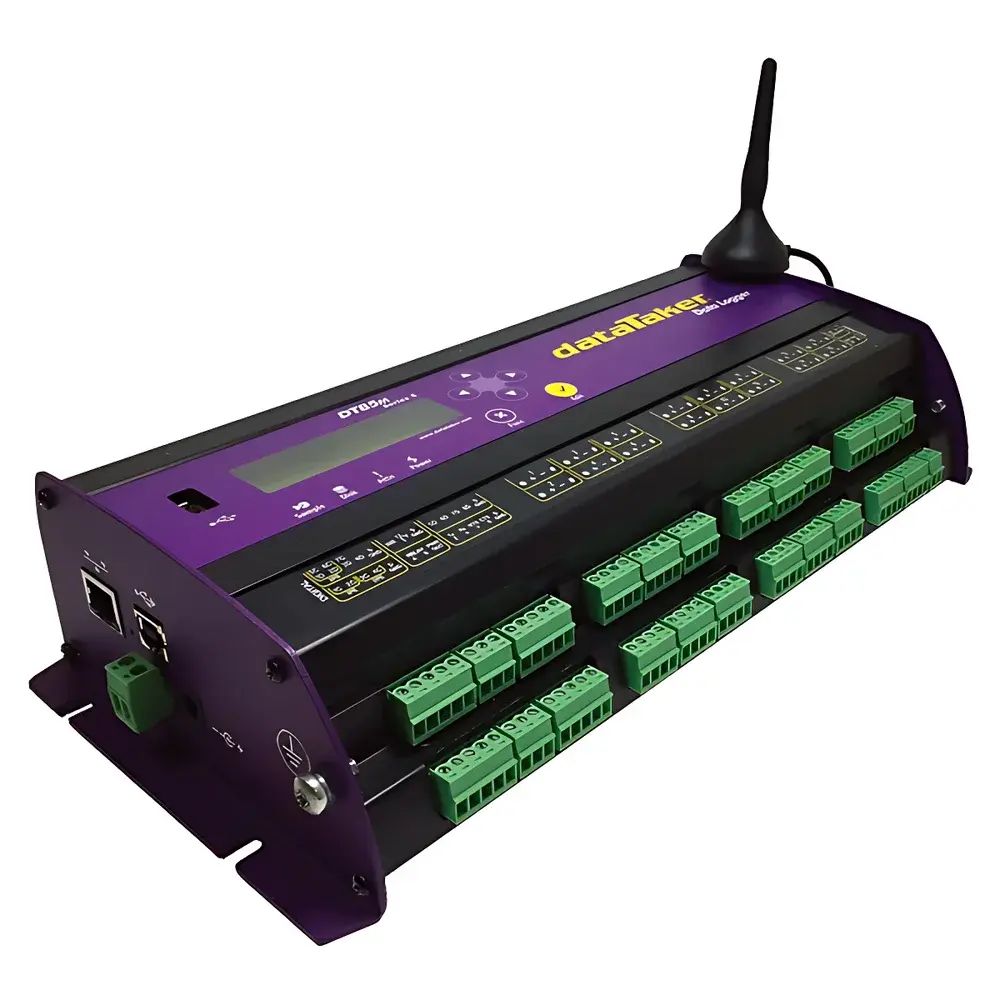
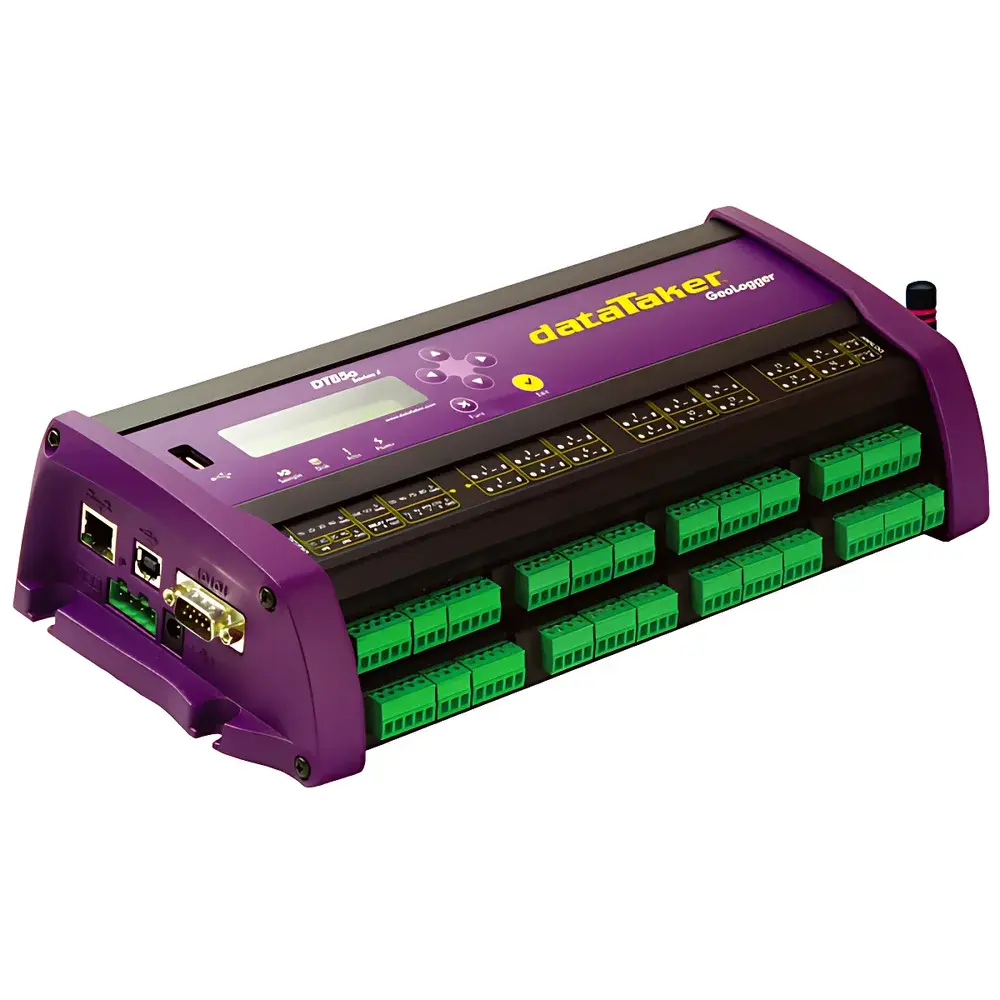
DataTaker DT85 Intelligent Data Acquisition Unit
| Brand | DataTaker |
|---|---|
| Origin | Imported |
| Model | DT85 |
| Analog Inputs | 48 single-ended / 32 differential / 16 three- or four-wire |
| Resolution | 18-bit |
| Sampling Rate | up to 40 Hz |
| Excitation Outputs | 5 V / 12 V, 150 mA max |
| Digital I/O & Counters | 32-bit, up to 100 kHz |
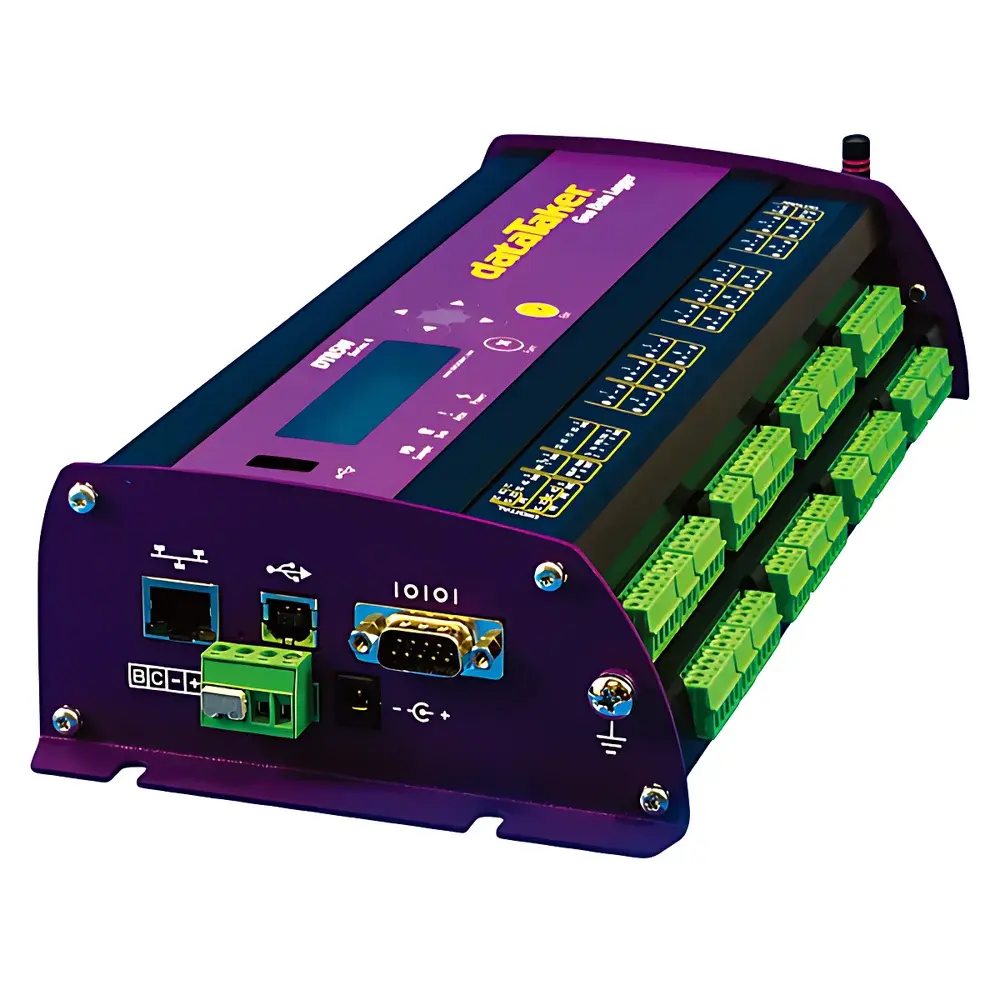
| Communication Ports | RJ45 (Ethernet), USB, RS232 (host), RS232/RS485/RS422 (multi-protocol) |
| Protocols | MODBUS RTU/TCP/IP, SDI-12, ASCII, HTTP, FTP, SMTP |
| Power Supply | 10–30 VDC |
| Operating Temperature | −40 °C to +70 °C |
| Enclosure Rating | IP54 |
| Dimensions | 300 × 137 × 65 mm |
| Weight | 2.5 kg |
| Internal Memory | 128 MB CompactFlash (upgradable to 4 GB), optional 8 GB USB storage |
| Real-Time Clock Accuracy | ±1 min/year (0–40 °C), ±4 min/year (−40–70 °C) |
Overview
The DataTaker DT85 is an industrial-grade intelligent data acquisition unit engineered for long-term, unattended monitoring in demanding environmental and infrastructure applications. Built on a deterministic real-time architecture, the DT85 acquires synchronized measurements from heterogeneous sensor types—including thermocouples, RTDs, strain gauges, 4–20 mA loops, voltage/current transducers, frequency-based sensors, digital pulse counters, and programmable serial sensors—using configurable analog input isolation, high-resolution 18-bit ADCs, and hardware-timed sampling up to 40 Hz. Its modular firmware supports simultaneous execution of measurement scheduling, alarm logic, feedback control, and automated data transmission—enabling autonomous operation without continuous host supervision. Designed for deployment across remote field sites—from hydrological monitoring stations to geotechnical instrumentation networks—the DT85 operates reliably across a certified −40 °C to +70 °C temperature range and meets IP54 ingress protection requirements for dust resistance and limited water exposure.
Key Features
- Multi-sensor interoperability: Supports over 100 sensor types via configurable analog inputs (voltage, current, resistance, bridge, thermocouple, RTD, thermistor), digital I/O, high-speed counters (32-bit, ≤100 kHz), quadrature encoders, and programmable serial sensor interfaces (SDI-12, ASCII, MODBUS RTU).
- Flexible excitation and signal conditioning: Dual programmable excitation outputs (5 V or 12 V, 150 mA max) with independent channel configuration; selectable input wiring modes (single-ended, differential, 3-wire, 4-wire) for precision resistance and bridge measurements.
- Autonomous decision-making: Onboard scripting engine enables conditional alarms, relay actuation, PID-style feedback control, and scheduled data transmission—reducing dependency on external SCADA systems.
- Ruggedized industrial enclosure: Die-cast aluminum housing with IP54-rated sealing, reinforced mounting points, and wide-voltage DC input (10–30 VDC) compatible with solar-battery hybrid power systems.
- Expandable channel capacity: Compatible with DataTaker CEM20 Channel Expansion Modules—each adding 20 universal analog/digital channels; up to five modules expand total capacity to 300 single-ended or 100 four-wire inputs.
Sample Compatibility & Compliance
The DT85 interfaces natively with sensors conforming to international measurement standards including ASTM E230 (thermocouple reference tables), IEC 60751 (RTD tolerances), and ISO 80000-8 (quantities and units for physical chemistry and engineering). Its analog input architecture complies with IEC 61000-4-5 (surge immunity) and IEC 61000-4-4 (electrical fast transient robustness). The device supports audit-ready data logging under GLP and GMP frameworks through dEX software’s timestamped, tamper-evident binary file structure and optional 21 CFR Part 11-compliant user authentication and electronic signature modules. Firmware updates are digitally signed and verified at boot, ensuring traceable system integrity for regulated deployments.
Software & Data Management
Configuration, visualization, and post-processing are performed using DataTaker’s dEX software—a Windows-based application supporting intuitive drag-and-drop channel setup, real-time waveform plotting, statistical summary generation (min/max/mean/std dev), and export to CSV, Excel, or MATLAB-compatible formats. dEX implements secure local storage management with automatic rollover, CRC-verified file integrity checks, and time-synchronized multi-device synchronization. For networked deployments, the DT85 serves raw or processed data via HTTP GET/POST, FTP push/pull, or SMTP email attachment—configurable with TLS encryption and authenticated SMTP relays. All communication logs, configuration changes, and alarm events are recorded with UTC timestamps and persistent internal storage, enabling full forensic reconstruction during QA audits.
Applications
- Environmental monitoring: Long-term tracking of groundwater level (pressure transducers), surface water quality (pH, conductivity, dissolved oxygen), meteorological parameters (wind speed, solar irradiance, barometric pressure), and air pollutant concentrations (NO₂, O₃, PM₂.₅).
- Geotechnical & structural health monitoring: Strain and displacement measurement in dams, bridges, tunnels, and retaining walls using vibrating wire sensors (DT85G/GM variants), inclinometers, piezometers, and tiltmeters.
- Industrial process validation: Thermal profiling during curing cycles, vibration analysis in rotating machinery, energy consumption logging in HVAC subsystems, and compliance verification against ISO 50001 energy management protocols.
- Research & education: Field-deployable platform for university-led climate studies, soil moisture dynamics experiments, and smart infrastructure prototyping requiring deterministic timing and low-power operation.
FAQ
Does the DT85 support MODBUS TCP/IP for integration into existing SCADA systems?
Yes—the DT85 operates as both MODBUS TCP/IP server and client, enabling bidirectional data exchange with PLCs, HMIs, and central historians without protocol translation gateways.
Can I configure alarm thresholds and relay outputs directly on the device without a PC connection?
Yes—alarms, hysteresis bands, relay activation logic, and output scaling can be fully defined and stored onboard using dEX or ASCII command sets sent via serial or Ethernet.
Is the internal RTC battery replaceable, and what is its expected service life?
The internal RTC backup battery is soldered and not user-replaceable; however, it is rated for ≥5 years under typical operating conditions (25 °C ambient, 8 hrs/day active logging).
How does the DT85 ensure data integrity during power interruption?
All measurements are written to non-volatile CompactFlash memory with atomic write operations and cyclic redundancy checksums; unsaved data in RAM is preserved by the internal 6 V / 1.2 Ah backup battery for up to 72 hours.
Are firmware updates backward-compatible with legacy dEX versions?
Firmware releases maintain full configuration file compatibility across DT80-series devices; however, new features introduced in v3.x+ require dEX v4.2 or later for configuration and visualization support.