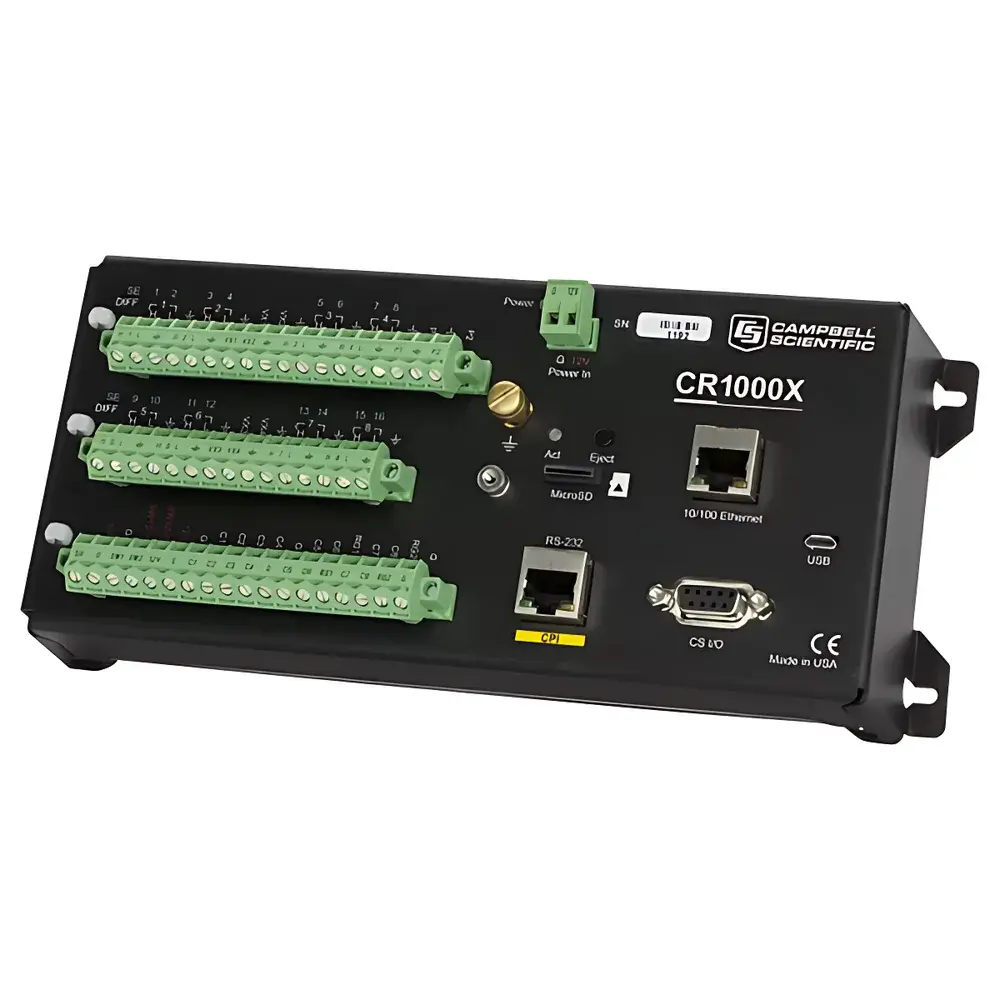
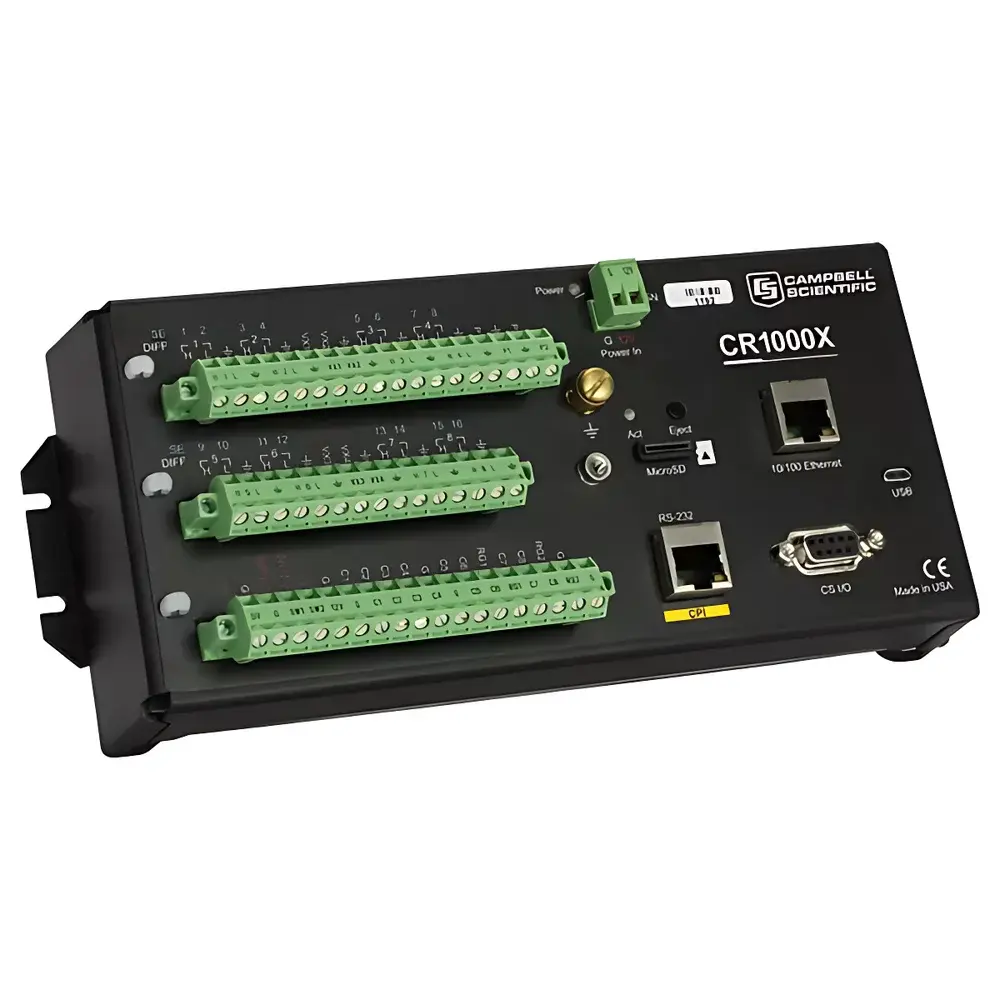
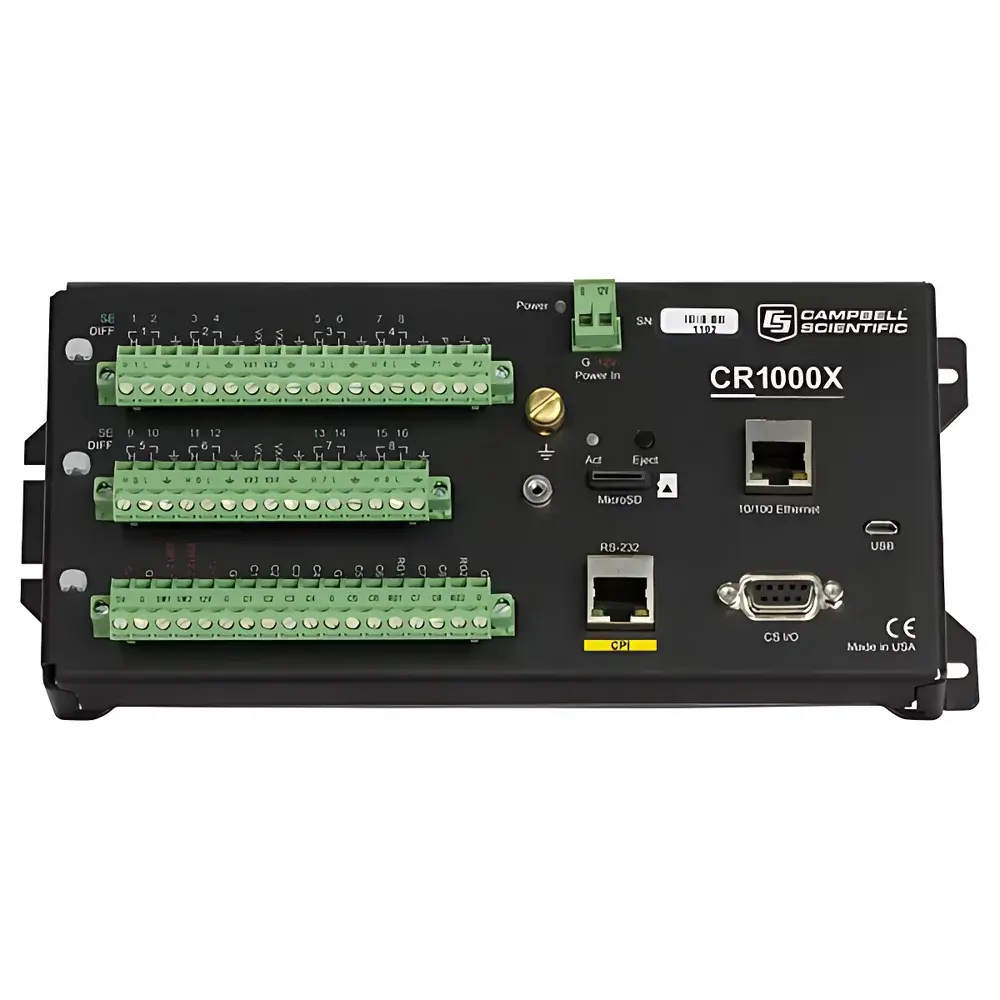
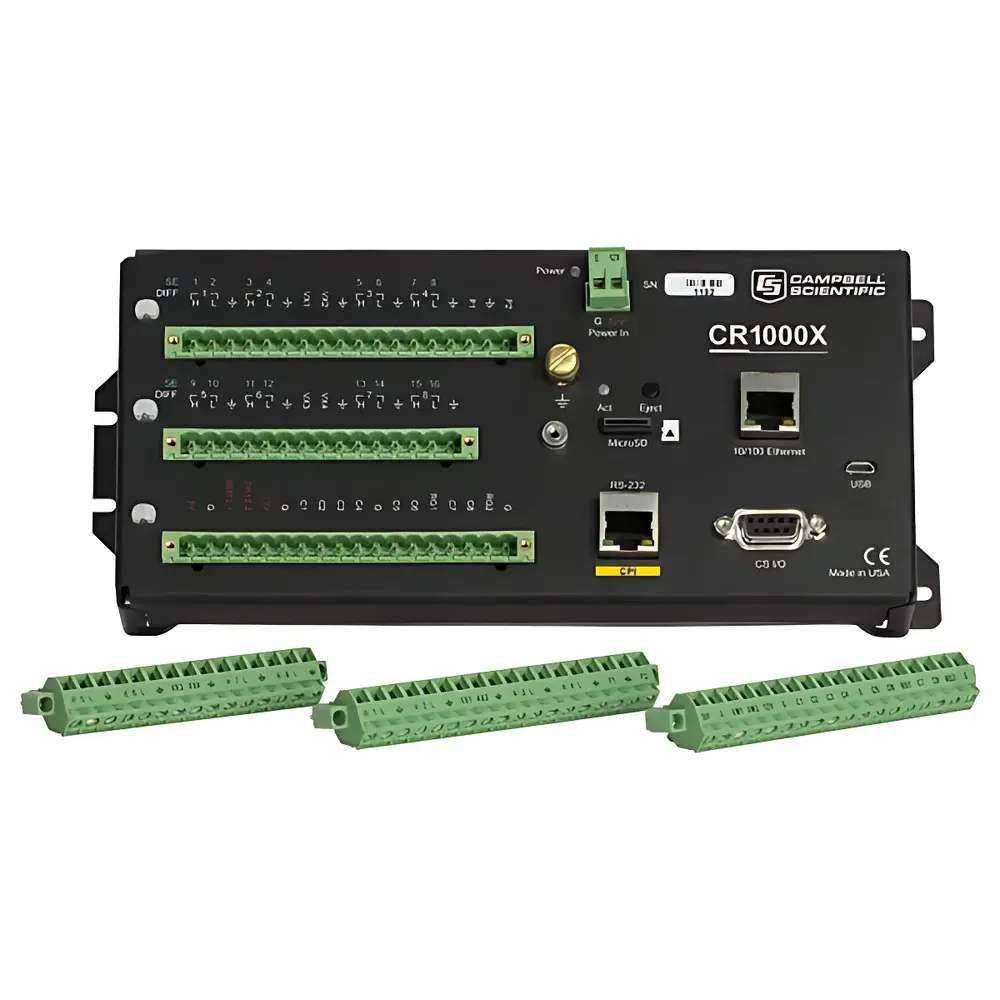
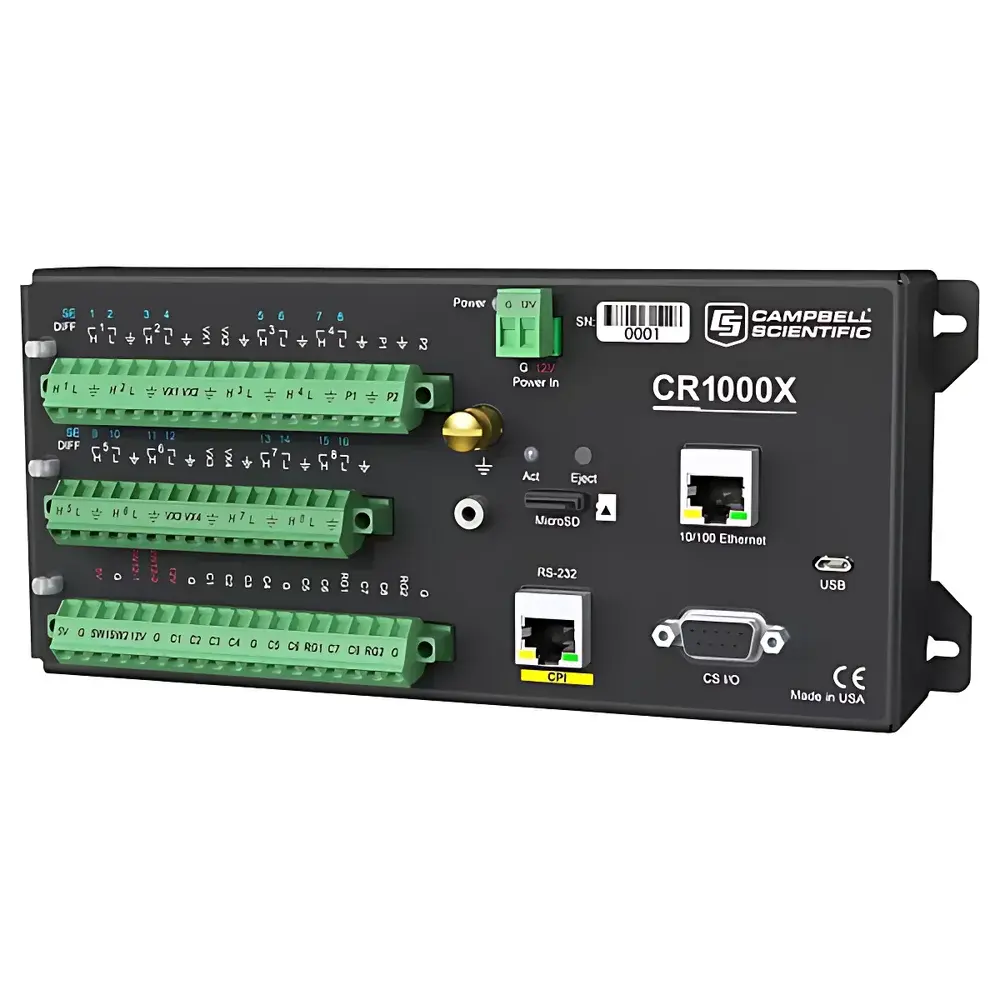
Campbell Scientific CR1000X Data Acquisition System
| Brand | Campbell Scientific |
|---|---|
| Origin | USA |
| Model | CR1000X |
| Operating Temperature Range | –40 to +70 °C (standard), –55 to +85 °C (extended) |
| Analog Inputs | 16 single-ended or 8 differential |
| ADC Resolution | 24-bit |
| Max Scan Rate | 100 Hz |
| Communication Interfaces | Ethernet, USB Micro-B, RS-232/RS-485/RS-422, CPI, SDI-12, PakBus, Modbus TCP/RTU, DNP3, MQTT, NMEA 0183, I²C, SPI |
| Real-Time Clock Accuracy | ±3 min/year (±10 µs with optional GPS synchronization) |
| Power Supply | 10–18 VDC |
| Idle Current Draw | <1 mA @ 12 VDC |
| Dimensions | 23.8 × 10.1 × 6.2 cm |
| Weight | 0.86 kg |
| Data Storage | 4 MB SRAM + 72 MB flash + microSD slot (up to 16 GB) |
Overview
The Campbell Scientific CR1000X Data Acquisition System is a high-reliability, low-power environmental monitoring platform engineered for long-term, unattended operation in remote and harsh field conditions. Built upon Campbell Scientific’s proven architecture, the CR1000X employs a deterministic real-time operating system and an embedded 32-bit ARM Cortex-M4 processor to execute measurement, control, and data logging tasks with precise timing and repeatable accuracy. Its core measurement principle relies on high-fidelity analog-to-digital conversion using a 24-bit sigma-delta ADC, enabling resolution of sub-millivolt signal variations across its 16 configurable analog input channels. Designed for deployment in meteorological networks, hydrological observatories, air quality stations, wind profiling systems, and water resource monitoring sites, the CR1000X integrates seamlessly with analog, digital, serial (SDI-12, RS-232/485), and distributed sensor ecosystems—including Campbell’s CPI-compatible CDM modules—without requiring external signal conditioning in most standard configurations.
Key Features
- Industrial-grade environmental resilience: certified operational range of –40 °C to +70 °C (standard), extendable to –55 °C to +85 °C with full specification compliance
- Dual 12 V switched power terminals and four voltage excitation outputs (VX1–VX4) supporting ±40 mA sourcing/sinking for precision sensor excitation
- Two non-isolated 0–20 mA / 4–20 mA current-input channels for direct integration of industrial process sensors
- Onboard PakBus networking stack enabling robust, self-healing mesh topologies for multi-node telemetry deployments
- Embedded web server with HTTPS, TLS 1.2, and SNMPv3 support for secure remote configuration, diagnostics, and firmware updates via standard browsers
- MicroSD card interface supporting up to 16 GB of removable storage for extended data retention and archival compliance
- USB Micro-B port for direct local programming, data retrieval, and real-time debugging without network dependency
- Comprehensive digital I/O capability: eight configurable C-series terminals supporting edge-triggered pulse counting, PWM output, UART, SPI, I²C, and SDM protocols
- Integrated real-time clock with battery-backed SRAM (4 MB) and flash memory (72 MB), plus optional GPS time synchronization to ±10 µs
Sample Compatibility & Compliance
The CR1000X supports a broad spectrum of environmental and industrial sensors—including thermistors, RTDs, strain gauges, anemometers, barometers, turbidity meters, dissolved oxygen probes, and gas analyzers—via standardized analog, pulse, frequency, and serial interfaces. Its analog input architecture accommodates both single-ended and differential configurations, minimizing common-mode noise in electrically noisy field environments. The device complies with electromagnetic compatibility requirements per FCC Part 15 Class B and CE EN 61326-1:2013 for industrial measurement equipment. Its sealed, anodized aluminum enclosure provides IP65-rated ingress protection and RF shielding via stainless-steel canister construction. For regulated applications, the CR1000X supports audit-trail-capable data logging workflows aligned with GLP and GMP principles; timestamp integrity, user-access logs, and programmable metadata tagging facilitate traceability required under FDA 21 CFR Part 11 when deployed with validated software tools such as LoggerNet or PC400.
Software & Data Management
Campbell Scientific’s ecosystem provides end-to-end data lifecycle management: LoggerNet (Windows-based) and PC400 offer centralized configuration, scheduled data collection, automated file transfer (FTP/SFTP, HTTP(S), MQTT), and alarm notification via email or SMS. All programs are written in CRBasic—a deterministic, event-driven variant of BASIC optimized for deterministic scan scheduling and conditional logic execution. The CR1000X stores raw and processed data in binary or ASCII formats, with built-in compression and rollover management. Embedded TLS 1.2 encryption secures all outbound communications, while SNMPv3 ensures authenticated device monitoring within enterprise IT infrastructure. Firmware updates are delivered over secure channels with cryptographic signature verification. Data export formats include CSV, NetCDF, and XML, ensuring interoperability with third-party analytics platforms (e.g., Python/Pandas, MATLAB, Tableau, or cloud-based IoT dashboards).
Applications
- Meteorological monitoring networks: synchronized acquisition from tipping-bucket rain gauges, ultrasonic anemometers, pyranometers, and humidity/temperature arrays
- Hydrological observatories: continuous logging of stage, flow velocity, conductivity, pH, and turbidity in rivers, reservoirs, and wastewater treatment plants
- Air quality surveillance: integration with electrochemical gas sensors (NO₂, O₃, CO), particulate matter (PM₂.₅/PM₁₀) optical counters, and meteorological co-variables
- Renewable energy site assessment: long-term wind resource characterization using cup/vane and sonic anemometry with turbulence statistics
- Geotechnical instrumentation: strain, tilt, and pore-pressure monitoring in dam safety, landslide early-warning, and structural health applications
- Smart agriculture: soil moisture, temperature, and EC profiling across wireless sensor networks using SDI-12 and LoRaWAN gateways
FAQ
What communication protocols does the CR1000X support for integration into existing SCADA or IoT platforms?
The CR1000X natively supports Modbus TCP/RTU, DNP3, MQTT, NTCIP, and NMEA 0183, enabling direct integration with industrial automation systems, cloud telemetry services, and transportation management platforms without protocol translation gateways.
Can the CR1000X operate autonomously for extended periods on battery power?
Yes. With typical 1 Hz scanning and sleep-mode optimization, average current draw drops to ~1 mA at 12 VDC—enabling multi-year operation on standard deep-cycle batteries paired with solar charging controllers.
Is the CR1000X suitable for use in explosion-hazardous areas?
The base CR1000X is not intrinsically safe or ATEX-certified. For hazardous locations, it must be installed in appropriately rated enclosures and used with approved barrier systems per IEC 60079-11 or UL 913 guidelines.
How is firmware updated, and what safeguards ensure update integrity?
Firmware is deployed via encrypted HTTPS or SFTP connections. Each update package includes SHA-256 signatures verified before installation, and rollback capability preserves prior firmware versions in flash memory.
Does the CR1000X support time-synchronized measurements across distributed nodes?
Yes. Using PakBus routing with GPS-synchronized clocks or IEEE 1588 PTP over Ethernet (with compatible switches), sub-millisecond inter-node timing alignment is achievable for phase-sensitive applications like acoustic emission or seismic array processing.