
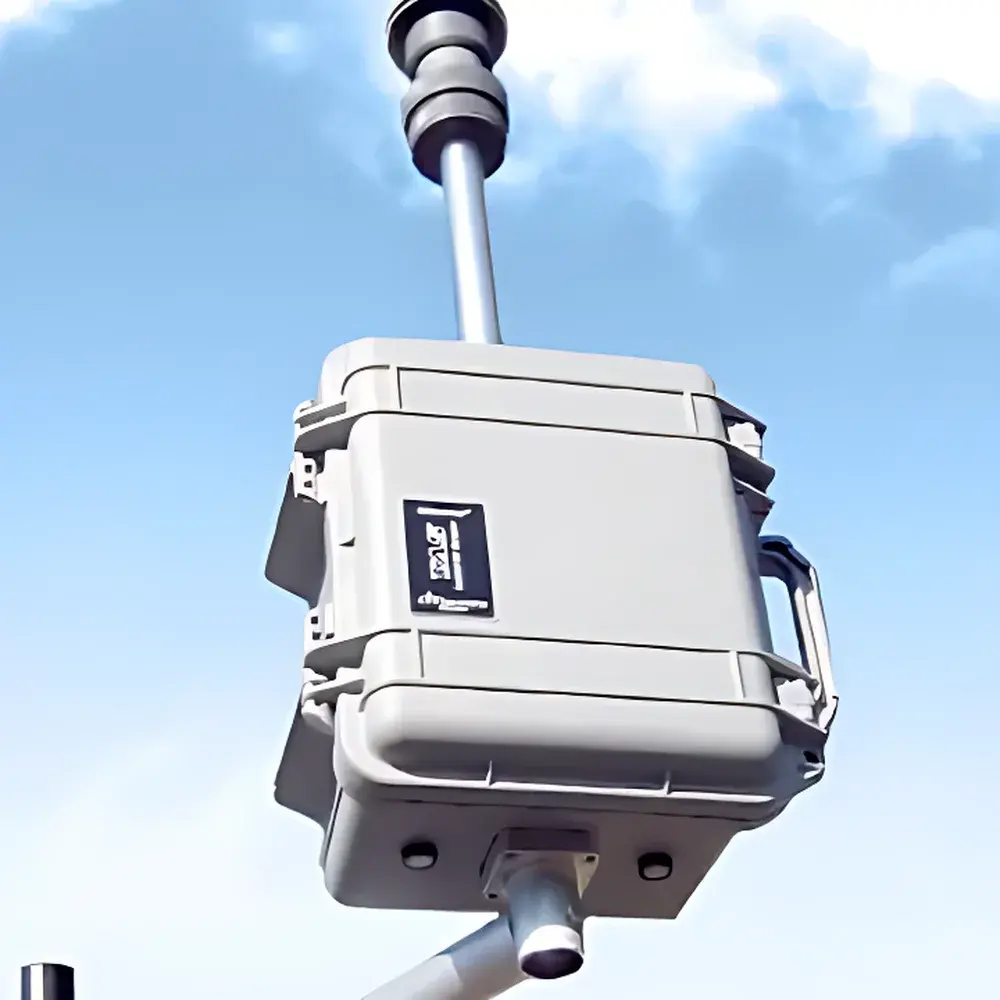
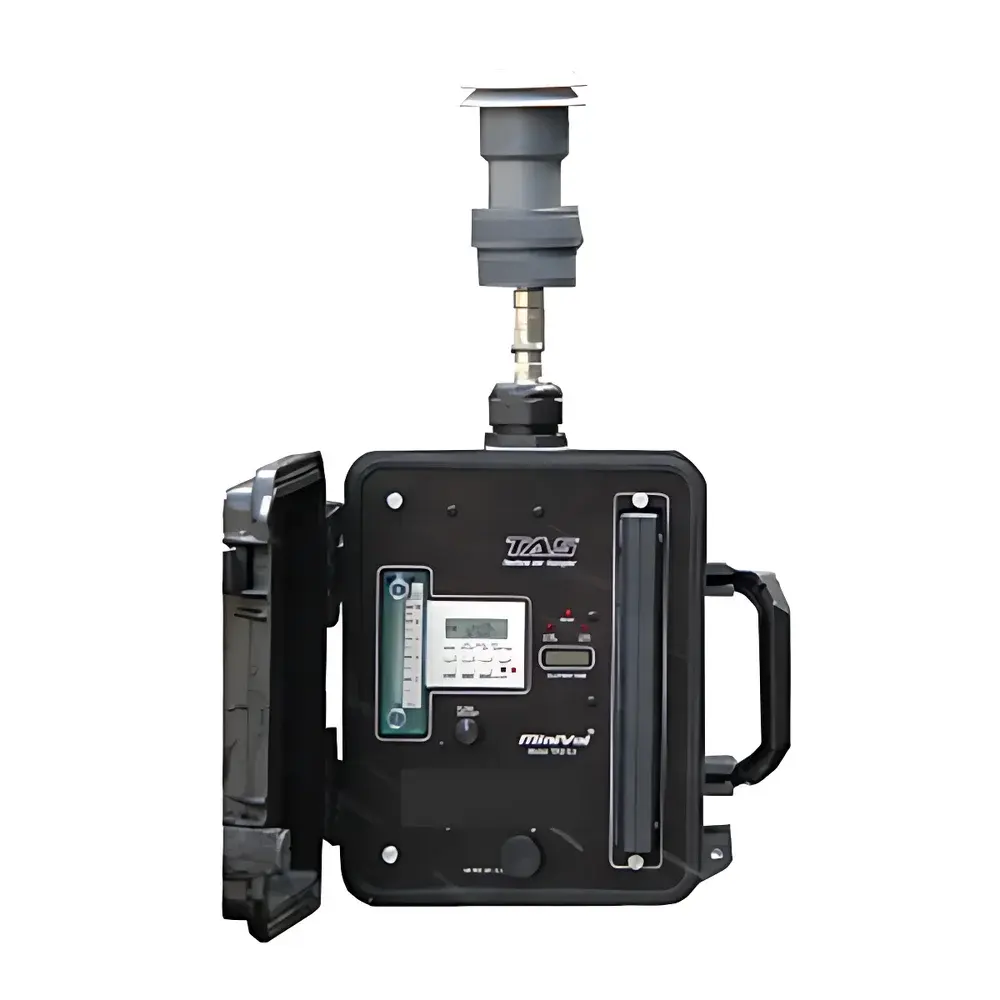
AirMetrics MiniVol Tactical Air Sampler (TAS)
| Brand | AirMetrics |
|---|---|
| Origin | USA |
| Model | MiniVol TAS |
| Flow Range | 0–10 L/min |
| Pressure Capability | >30,000 Pa |
| Flow Stability | ±5% |
| Max Flow Error | ±5% |
| Continuous Operation Time at Max Flow & Backpressure | 60 h |
| Dimensions (Sampler) | 25.4 × 30.5 × 17.8 cm |
| Weight (Fully Configured) | 4.45 kg |
| Battery | 14.8 V / 118 Wh Li-ion (≥60 h runtime, 5 h recharge) |
| Filter Format | 47 mm cassette (EPA FRM-compliant) |
| Inlet Type | EPA FRM-designated PM₁₀ or PM₂.₅ cyclonic separator |
| Power Options | AC/DC adapter (100–240 VAC, 47–63 Hz) or solar-compatible |
Overview
The AirMetrics MiniVol Tactical Air Sampler (TAS) is a portable, low-flow, filter-based particulate matter (PM) sampling instrument engineered for regulatory-grade environmental monitoring. Designed in collaboration with the U.S. Environmental Protection Agency (EPA) in the early 1990s, the MiniVol TAS implements constant-flow volumetric sampling based on precise electronic mass flow control — a methodology aligned with EPA Reference Method (FRM) and Equivalent Method (EQM) requirements for PM₁₀ and PM₂.₅ monitoring. Its operational principle relies on drawing ambient air through an EPA-certified size-selective inlet (e.g., PM₁₀ or PM₂.₅ cyclone), followed by particle collection onto a standard 47 mm quartz or Teflon filter housed in a stainless-steel cassette. The system maintains volumetric accuracy under variable atmospheric conditions and elevated backpressure — critical for long-term unattended deployment in field settings ranging from urban fence-line monitoring to remote high-altitude stations.
Key Features
- Patented dual-diaphragm pump with laminar flow shroud technology, rated for >10,000 hours of continuous operation and stable performance across temperature gradients (−20 °C to +50 °C).
- Microprocessor-controlled mass flow controller ensuring ±5% flow stability over full 0–10 L/min range, even at backpressures exceeding 30,000 Pa.
- Lightweight, field-rugged design: complete configured unit weighs only 4.45 kg; all components fit within a single wheeled transit case (total shipping weight: 16.8 kg).
- Modular inlet compatibility: supports EPA FRM-compliant PM₁₀ and PM₂.₅ cyclones, as well as total suspended particulate (TSP) configurations via optional inlets.
- Dual power architecture: operates on AC/DC input (100–240 VAC, 47–63 Hz) or integrated 14.8 V / 118 Wh lithium-ion battery (≥60 h runtime at 5 L/min; 5 h full recharge).
- EMT (Easy Maintenance Target)-designed inlet and filter housing — tool-free access for daily cleaning and rapid filter exchange without calibration drift.
- Weather-resistant PVC transport case with integrated bidirectional safety switch and IP54-rated enclosure for outdoor deployment.
Sample Compatibility & Compliance
The MiniVol TAS is validated for use with EPA FRM-approved 47 mm filter media including polytetrafluoroethylene (PTFE), quartz fiber, and cellulose ester substrates. It complies with U.S. EPA 40 CFR Part 53 for PM₂.₅ and PM₁₀ reference and equivalent methods when paired with certified size-selective inlets and calibrated flow controllers. Data generated meets GLP documentation standards and supports audit-ready reporting per ISO/IEC 17025 requirements. The system has been deployed under multiple international air quality programs, including WHO Global Air Quality Monitoring Projects and U.S. Army Environmental Command field studies — demonstrating conformance with ASTM D1357 (standard practice for sampling airborne particles) and ISO 7708 (airborne particles — definitions and particle size conventions).
Software & Data Management
The MiniVol TAS logs time-stamped flow rate, temperature, pressure, battery voltage, and cumulative sampled volume internally with non-volatile memory (10,000+ data points). Field data are retrieved via USB interface using AirMetrics’ proprietary TAS Data Manager software — a Windows-based application supporting automated QA/QC flagging, flow deviation alerts, and export to CSV or EPA AQS-compatible formats. The firmware supports NIST-traceable flow calibration certificate integration and enables secure user-level access controls. While not 21 CFR Part 11 compliant out-of-the-box, the system can be operated within validated laboratory workflows that enforce electronic signature protocols and audit trails during data review and reporting.
Applications
- Regulatory compliance monitoring: fence-line sampling at coal-fired power plants, cement kilns, and industrial facilities under NSR/PSD permitting.
- Community-scale exposure assessment: longitudinal PM₂.₅ studies in residential neighborhoods, schools, and near transportation corridors.
- Remote and off-grid monitoring: solar-powered deployments in mountainous, arctic, or island environments where grid access is unavailable.
- Indoor air quality (IAQ) characterization: source apportionment in commercial buildings, laboratories, and cleanrooms using time-integrated filter analysis (e.g., ICP-MS, XRF, gravimetry).
- Method development and validation: benchmarking new sensor technologies against reference-grade filter-based measurements.
- Emergency response: rapid deployment for post-wildfire, volcanic ash, or hazardous material release assessments.
FAQ
Is the MiniVol TAS approved by the U.S. EPA as a Reference or Equivalent Method?
Yes — when configured with EPA-certified PM₁₀ or PM₂.₅ inlets and operated within specified flow and environmental parameters, the MiniVol TAS meets the performance criteria defined in 40 CFR Part 53 for Equivalent Methods.
Can the MiniVol TAS operate continuously for 60 hours at maximum flow (10 L/min) and high backpressure?
Yes — the dual-diaphragm pump and thermal management architecture sustain ≥60 h of uninterrupted operation at 10 L/min against >30,000 Pa static pressure, verified per manufacturer’s accelerated life testing protocol.
What filter types and analytical methods are compatible with MiniVol-collected samples?
Standard 47 mm filters (quartz, PTFE, nylon, mixed cellulose ester) are supported. Collected samples are routinely analyzed via gravimetric mass determination, ion chromatography (IC), inductively coupled plasma mass spectrometry (ICP-MS), and X-ray fluorescence (XRF).
Does the MiniVol TAS support real-time telemetry or cloud-based data transmission?
No — it is a standalone, offline sampling platform. Data retrieval requires physical USB connection and post-sampling processing; no built-in cellular or LoRaWAN module is included.
Is the battery pack replaceable in the field, and are spare batteries certified for air transport?
Yes — field-replaceable Li-ion battery modules comply with IATA Packing Instruction 965 Section II and include UN38.3 test certification documentation for safe global shipment.







