
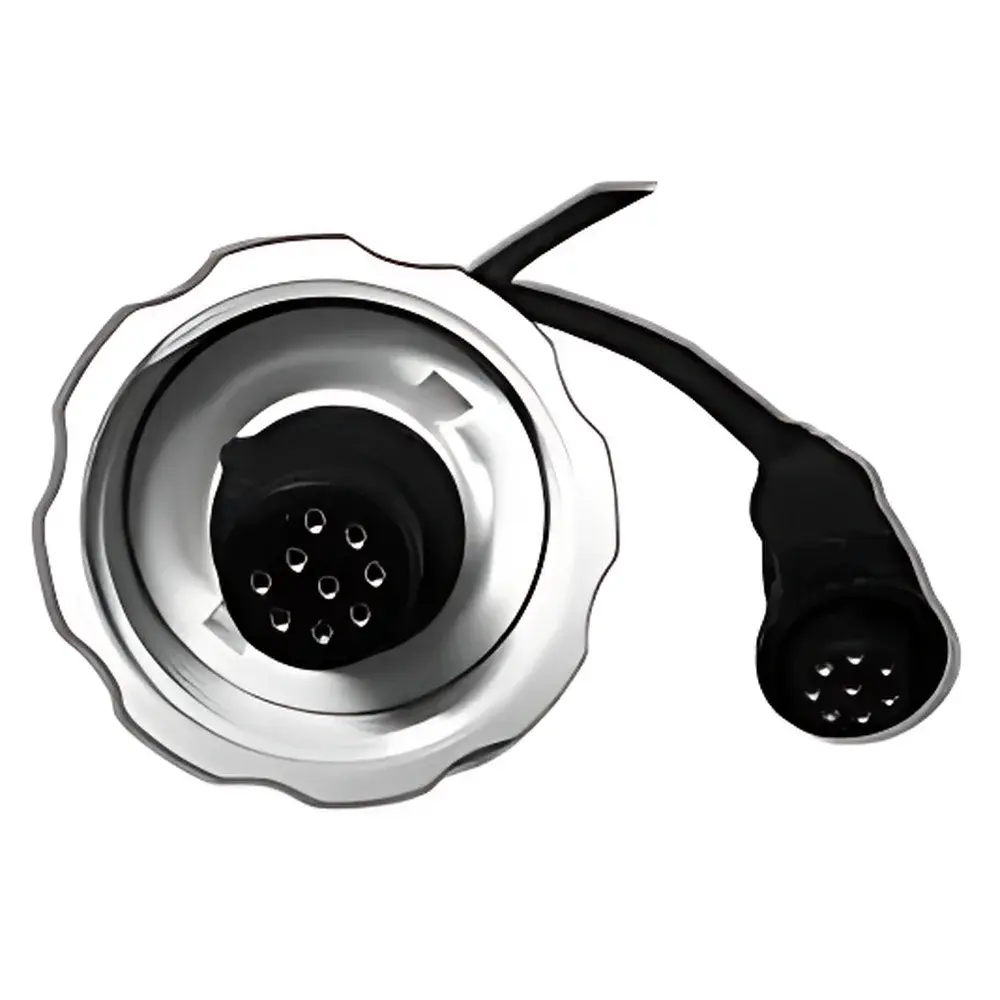
AIRMAR NMEA 0183 GPS Navigation Sensor Interface Cable
| Brand | AIRMAR |
|---|---|
| Origin | USA |
| Interface Standard | NMEA 0183 |
| Connector Type | 9-pin male (AIRMAR side) / 8-pin female (host side) |
| Customizable Termination | RS232 / RS422 / RS485 |
| Available Lengths | 10 m |
Overview
The AIRMAR NMEA 0183 GPS Navigation Sensor Interface Cable is a purpose-engineered signal transmission solution designed exclusively for integration with AIRMAR’s marine-grade navigation and environmental sensors—including GPS heading sensors, ultrasonic weather stations, and dual-antenna attitude reference systems. Built to comply with the NMEA 0183 v3.01 and v4.10 electrical specifications, this cable ensures reliable, low-noise serial data transfer at standard baud rates (4800, 38400, and up to 115200 bps where supported by host hardware). Its shielded twisted-pair construction minimizes electromagnetic interference (EMI) in electrically noisy marine environments, while the precisely terminated impedance-matched conductors preserve signal integrity over extended runs—critical for maintaining GNSS position accuracy, heading stability, and time-synchronized sensor fusion.
Key Features
- Factory-assembled AIRMAR 9-pin D-sub male connector (pinout compliant with AIRMAR’s official pin assignment for GPS/heading sensors)
- Pre-terminated 8-pin female Micro-Circular (MIL-DTL-38999 Series III compatible) connector for direct interfacing with AIRMAR USB-to-NMEA interface modules (e.g., USB100, USB200)
- Field-configurable distal end: The 8-pin connector may be cleanly removed per manufacturer guidelines, enabling user-defined termination to RS232 (TIA/EIA-232-F), RS422 (TIA/EIA-422-B), or RS485 (TIA/EIA-485-A) physical layers using industry-standard wiring practices
- High-flex, UV-stabilized polyurethane jacket rated for continuous marine exposure (-30°C to +70°C operating range)
- Braid-and-foil dual shielding (≥95% coverage) with drain wire for optimal EMI/RFI suppression
- Available in five calibrated lengths—10 m, 15 m, 25 m, 35 m, and 45 m—to accommodate bridge console routing, mast-mounted sensor deployments, and distributed display architectures without signal degradation
Sample Compatibility & Compliance
This cable is validated for use with AIRMAR’s full suite of NMEA 0183–output navigation sensors, including but not limited to the PB200, WeatherStation™ WS200, and H2183 series GPS compasses. It supports all mandatory NMEA 0183 sentence types required for marine navigation: GGA, RMC, VTG, HDT, HDG, ROT, and proprietary AIRMAR extensions such as MWD (wind data) and VHW (water speed). The cable meets UL 1581 (vertical tray flame test), RoHS 3 (2015/863/EU), and REACH (EC 1907/2006) material compliance requirements. While not a standalone certified device, it is integral to systems conforming to IEC 61162-1 (NMEA 0183) and IEC 61162-450 (Ethernet-based NMEA 2000 gateway interoperability) frameworks.
Software & Data Management
No embedded firmware or driver software is included, as the cable operates at the physical and data-link layers only. When connected via an AIRMAR USB adapter, it appears as a standard CDC ACM (Communication Device Class Abstract Control Model) COM port under Windows, macOS, and Linux, enabling seamless integration with chartplotters (Raymarine, Garmin, Furuno), vessel management systems (VMS), and third-party applications such as OpenCPN, MaxSea TimeZero, and custom Python/Node.js NMEA parsers. Full ASCII sentence logging, timestamping, and checksum validation are preserved end-to-end. For audit-trail requirements in commercial or regulatory contexts (e.g., SOLAS Chapter V compliance), the cable supports integration into systems implementing IEC 61162-450-compliant data recorders with GLP-aligned metadata tagging and 21 CFR Part 11–compatible electronic signatures when paired with appropriate host software.
Applications
- Bridge integration of AIRMAR GPS heading sensors into integrated navigation systems (INS) and electronic chart display and information systems (ECDIS)
- Connecting ultrasonic weather stations to onboard meteorological data loggers and real-time dashboard displays
- Deploying remote GNSS antennas on masts or radar arches while preserving sub-degree heading resolution and time-to-first-fix (TTFF) performance
- Supporting redundant NMEA data paths in Class-approved vessels requiring dual-sensor input validation per IMO MSC.1/Circ.1593
- Research vessel instrumentation networks where synchronized timestamps across ADCP, CTD, and GNSS payloads depend on stable serial latency (<1.2 ms typical propagation delay)
FAQ
Is this cable compatible with NMEA 2000 networks?
No. This is a dedicated NMEA 0183 point-to-point serial interface cable. NMEA 2000 requires CAN bus–based cabling (DeviceNet-style micro-circular connectors and termination resistors); conversion requires an active gateway.
Can I use this cable with non-AIRMAR sensors that output NMEA 0183?
Only if those sensors use identical pinout, voltage levels, and handshake protocols as AIRMAR devices. Pin compatibility does not guarantee functional interoperability—always verify datasheet-level electrical and protocol conformance.
What is the maximum recommended distance for RS422 operation after modifying the 8-pin end?
Per TIA/EIA-422-B, the practical limit is 1200 meters at 100 kbps; however, due to the cable’s characteristic impedance (120 Ω ±10%) and shielding quality, stable operation up to 45 m is guaranteed at 38400 bps with proper termination.
Does the cable include ferrite cores or additional ESD protection?
No. ESD resilience is achieved through conductor insulation rating (1500 V RMS dielectric strength) and shield grounding continuity. External ferrites may be added at host interfaces per IEC 61000-4-2 Level 4 requirements.
Is custom length or OEM labeling available?
Yes. Volume orders support custom lengths (±0.5 m tolerance), laser-etched part numbering, and AIRMAR-authorized labeling per MIL-STD-130 marking standards.
Related Products







