
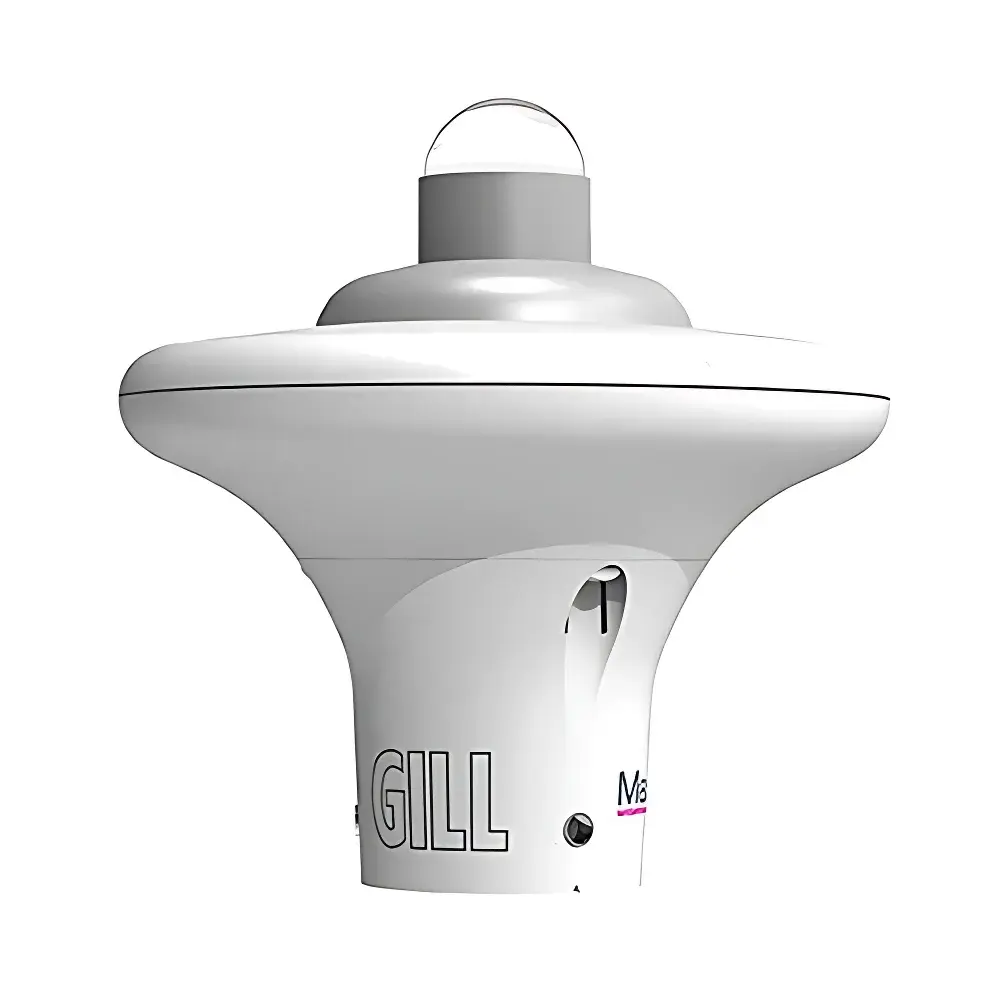
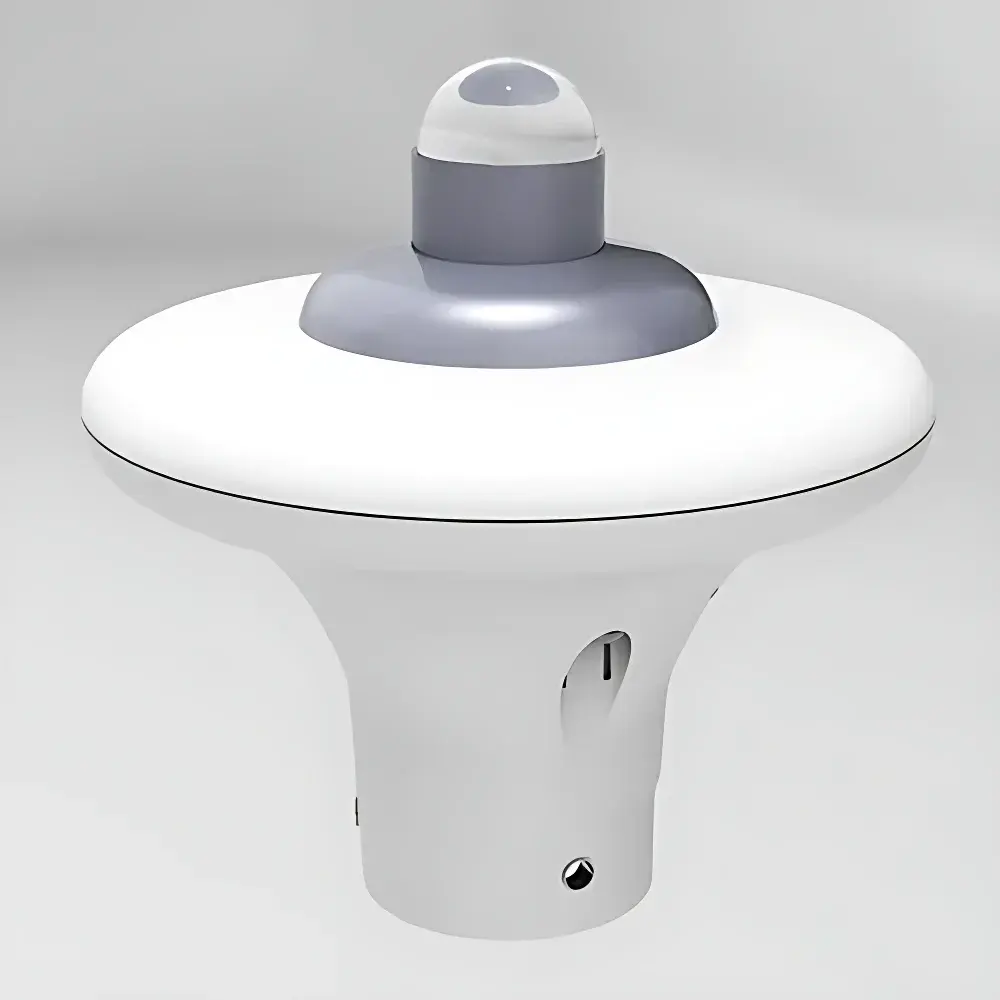
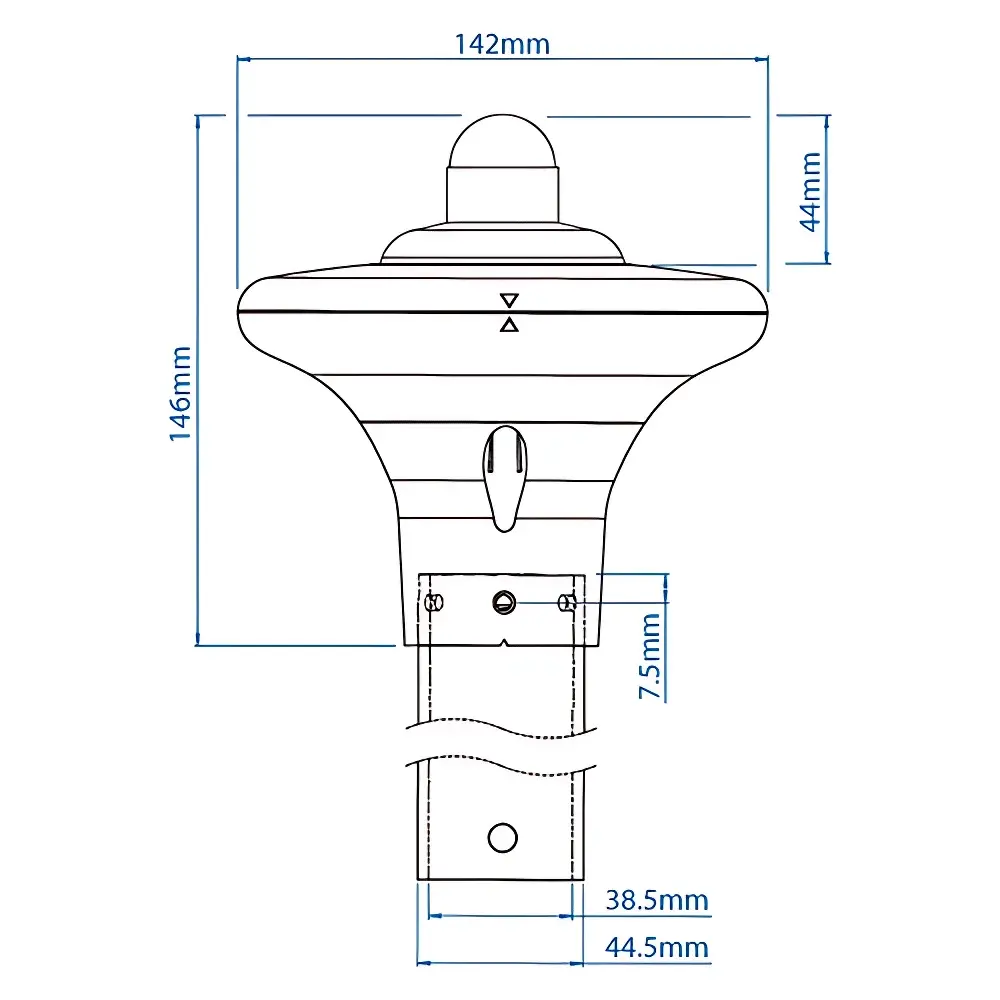
Gill GMX101 Solar Radiation Sensor
| Brand | Gill |
|---|---|
| Origin | United Kingdom |
| Model | GMX101 |
| Spectral Range | 300–3000 nm |
| Full-Scale Output | 0–1600 W/m² |
| Resolution | 1 W/m² (radiation), 1° (tilt) |
| Accuracy | ±3° (tilt), ISO 9060 Class II compliant |
| Field of View | 180° hemispherical |
| Tilt Sensor Range | ±90° |
| Sampling Frequency | 1 Hz |
| Output Interfaces | RS232, RS422, RS485, SDI-12, NMEA, MODBUS, ASCII |
| Power Supply | 5–30 VDC, 28 mA @ 12 VDC |
| IP Rating | IP66 |
| Operating Temperature | −40°C to +70°C |
| EMC Compliance | BS EN 61326:2013, FCC CFR 47 Part 15.109, CE, RoHS |
| Weight | 0.4 kg |
Overview
The Gill GMX101 Solar Radiation Sensor is a compact, integrated environmental measurement module originally developed as part of the MaxiMet series of intelligent weather stations. Engineered for high-fidelity solar irradiance monitoring, it incorporates a factory-calibrated Hukseflux LP02 pyranometer—compliant with ISO 9060:2018 Class II and aligned with World Meteorological Organization (WMO) Guide to Instruments and Methods of Observation (CIMO Guide, Chapter 8). The sensor measures global solar radiation across the full biologically and energetically relevant spectrum (300–3000 nm), delivering continuous analog and digital output at 1 Hz resolution. Its fused silica glass dome ensures spectral transmission stability, minimal thermal offset, and long-term calibration retention under field exposure. Unlike standalone pyranometers, the GMX101 embeds real-time tilt compensation via an internal digital inclinometer (±90° range, ±3° accuracy), enabling automatic correction of cosine response error during installation and operational drift assessment. Designed for unattended deployment in harsh environments, it operates reliably from −40°C to +70°C and meets IP66 ingress protection requirements.
Key Features
- Integrated Hukseflux LP02 thermopile-based pyranometer with ISO 9060:2018 Class II classification
- 180° hemispherical field of view optimized for broadband global horizontal irradiance (GHI) measurement
- Onboard digital inclinometer (±90° range, 1° resolution) with real-time tilt telemetry for installation verification and data quality assurance
- Multi-protocol digital interface support: RS232, RS422, RS485, SDI-12, NMEA 0183, MODBUS RTU, and ASCII serial framing
- Configurable output intervals: 1 s, 1 min, or 1 hr averaging—suitable for both high-resolution research and long-term operational logging
- Robust aluminum housing with marine-grade anodized finish and IP66-rated sealing for coastal, agricultural, and industrial deployments
- Low-power design (28 mA @ 12 VDC) compatible with solar-powered remote stations and battery-buffered telemetry systems
Sample Compatibility & Compliance
The GMX101 is validated for outdoor atmospheric radiation measurement under natural sky conditions, including clear-sky, overcast, and rapidly varying cloud regimes. It adheres strictly to ISO 9060:2018 secondary standard specifications for spectral responsivity, directional (cosine) response, temperature dependence, and non-linearity. Its optical geometry and thermal mass are optimized to minimize zero-offset errors associated with rapid ambient temperature transients—a critical factor in PV performance ratio (PR) monitoring and net radiation budget studies. The device satisfies electromagnetic compatibility (EMC) requirements per BS EN 61326:2013 (industrial environment), FCC Part 15 Subpart B, and EU Directive 2014/30/EU (EMC Directive), and carries CE marking with RoHS 2011/65/EU compliance documentation. While the GMX101 itself is no longer in active production, its metrological traceability remains valid per original factory calibration certificates issued against NPL (UK) and PTB (Germany) reference standards.
Software & Data Management
Data acquisition and configuration are managed via Gill’s proprietary MetSet and MetView software suites, which support Windows-based commissioning, firmware updates, GPS coordinate entry, and time synchronization. GPS metadata input is mandatory for calculating derived parameters—including solar zenith angle, azimuth, sunrise/sunset times, solar noon, twilight transitions (civil, nautical, astronomical), and sunshine duration (using the WMO-defined 120 W/m² threshold). All calculations follow algorithms defined in the NOAA Solar Position Algorithm (SPA) and comply with IEC 61724-1:2021 Annex A for photovoltaic system monitoring. Raw sensor outputs (W/m², tilt degrees, timestamps) are logged in CSV or binary formats with optional embedded audit trail metadata, supporting GLP-aligned data integrity workflows. While the GMX101 does not implement FDA 21 CFR Part 11 electronic signature functionality, its deterministic output protocol and timestamped records facilitate integration into validated SCADA and environmental data management systems (EDMS) meeting ISO/IEC 17025:2017 data handling requirements.
Applications
- Solar energy resource assessment and photovoltaic plant performance monitoring (IEC 61724-1)
- Agricultural microclimate networks for evapotranspiration modeling (FAO-56 Penman-Monteith)
- Coastal and offshore meteorological buoys requiring corrosion-resistant, low-power radiation sensing
- Building energy management systems (BEMS) and daylight harvesting control logic
- Transportation infrastructure monitoring (e.g., road surface temperature prediction, fog detection)
- Educational atmospheric science laboratories requiring traceable, standards-compliant instrumentation
- Government and national meteorological services deploying cost-effective, modular station architectures
FAQ
Is the GMX101 still in production?
No—the GMX101 was discontinued by Gill Instruments in 2021. It remains supported for calibration, repair, and legacy software compatibility through authorized service centers.
Can the GMX101 be used without GPS input?
Yes, but derived solar position parameters (sunrise, sunset, zenith angle, etc.) will not be computable. Direct irradiance (W/m²) and tilt angle measurements remain fully functional.
What is the recommended recalibration interval?
Gill recommends laboratory recalibration every two years when deployed in high-UV or high-dust environments; annually for metrological applications requiring ISO/IEC 17025 traceability.
Does the GMX101 support analog voltage output?
Not natively—the unit provides digital serial output only. Analog conversion requires an external signal conditioner or interface module (e.g., Gill’s optional analog adapter kit).
How is tilt compensation applied to irradiance data?
The onboard inclinometer provides real-time pitch and roll values used in post-processing to correct cosine response deviations; no automatic hardware-level compensation is performed within the sensor.







