Gill TFT Wind Display
| Brand | Gill |
|---|---|
| Origin | USA |
| Model | TFT |
| Display Size | 8.5-inch LED-backlit industrial LCD |
| Viewing Angle | 170° true wide-angle |
| Resolution | WVGA (800 × 480) |
| Wind Data Input | NMEA 0183 (4800 baud) directly from Gill anemometers |
| Power Output | +15 VDC for sensor and daisy-chain expansion |
| Power Input | 100–240 VAC, 50/60 Hz (max. 50 VA) or optional 18–32 VDC |
| Dimensions | 238 × 148.5 × 71 mm |
| Weight | 1.2 kg |
| IP Rating | IP22 |
| Operating Temperature | −15 °C to +55 °C |
| Operating Humidity | 10–93 % RH |
| EMC Compliance | IEC 61000-4-2 (ESD), IEC 61000-4-3 (Radiated Immunity), IEC 61000-4-4 (Fast Transients), IEC 61000-4-5 (Surge), IEC 61000-4-6 (Conducted Immunity) |
Overview
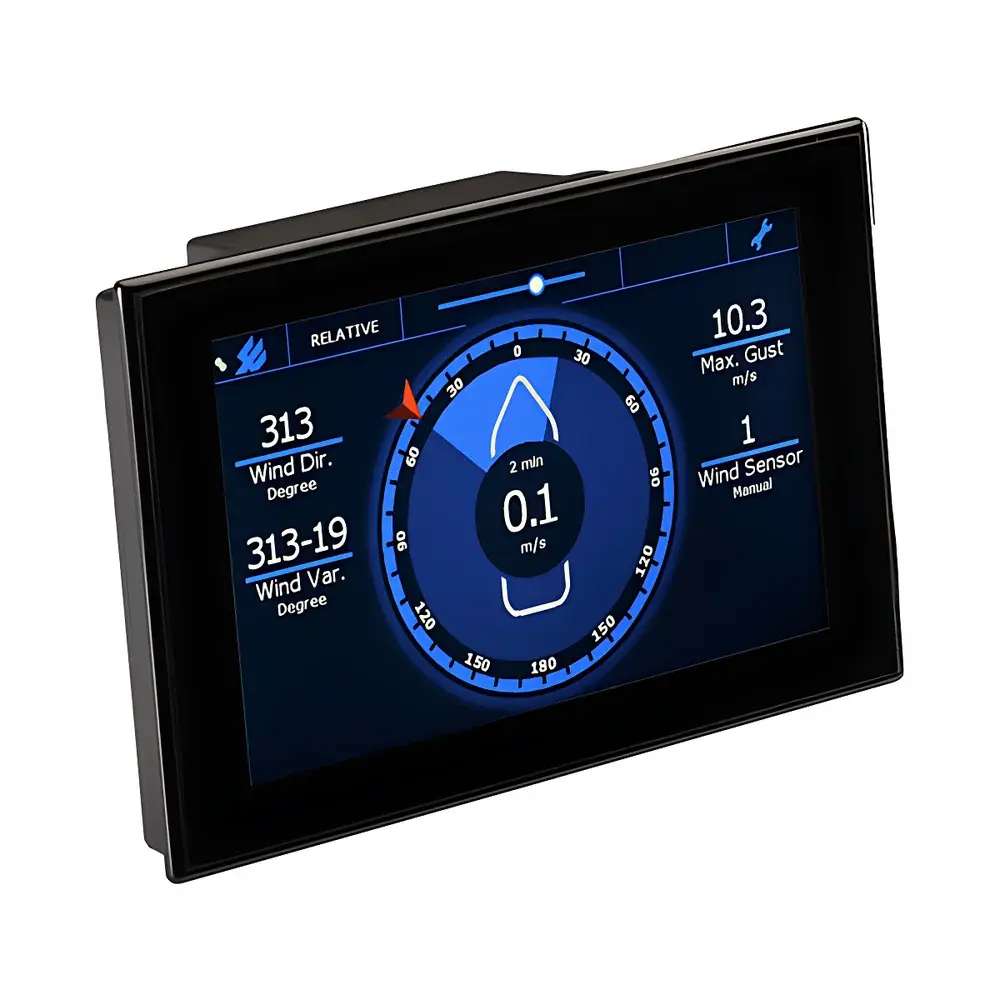
The Gill TFT Wind Display is a rugged, purpose-engineered data acquisition and visualization unit designed for real-time wind monitoring in demanding operational environments. Unlike generic display panels, this device functions as a dedicated NMEA 0183-compliant interface terminal—receiving raw wind speed and direction data directly from Gill’s certified ultrasonic or mechanical anemometers without requiring external protocol converters or signal conditioning hardware. Its core architecture is built around a high-brightness, industrial-grade 8.5-inch TFT-LCD with WVGA resolution (800 × 480) and a 170° viewing angle, ensuring legibility under variable ambient lighting—including direct sunlight and low-illumination bridge wings or control rooms. The unit operates as both a passive display and an active power/data hub: it supplies regulated +15 VDC to the connected wind sensor and supports daisy-chaining to a second identical display via RS422, enabling redundant or distributed monitoring without additional cabling infrastructure.
Key Features
- Direct NMEA 0183 input at 4800 baud—compatible exclusively with Gill-certified wind sensors (e.g., WindSonic, Vector, and 2D/3D ultrasonic models)
- Dual operational modes: Meteorological (N-E-S-W cardinal orientation) and Marine (Port/Starboard relative orientation), configurable via front-panel menu
- Real-time wind metrics: instantaneous wind speed (3-digit, 11 mm height), gust peak (3-digit, 8 mm height), and user-selectable averaging intervals (2 min, 10 min, or custom duration)
- Wind vector visualization: directional arrow overlay with numeric bearing (3-digit, 8 mm height) displayed in gray on left side of screen; dynamic color-coding optional via firmware update
- Unit flexibility: selectable wind speed units—knots, m/s, mph, km/h, and Beaufort scale—without recalibration or hardware modification
- Adaptive display management: automatic brightness control via integrated ambient light sensor, plus manual override for fixed-luminance applications
- Mounting versatility: designed for drop-in replacement into standard 144 × 144 mm instrument cutouts, supporting both landscape and portrait orientations
Sample Compatibility & Compliance
The Gill TFT Wind Display is validated for use with Gill’s full line of marine- and land-rated wind sensors, including those meeting IEC 61000-6-2 (immunity) and IEC 61000-6-4 (emissions) requirements for industrial environments. It does not process or store raw sensor signals; instead, it renders parsed NMEA sentences (e.g., $WIMWV, $WIMWD, $WIMWV) in accordance with NMEA 0183 v4.10 specifications. As a display-only node, it carries no regulatory classification under FDA 21 CFR Part 11 or EU MDR—however, its deterministic rendering behavior and absence of editable configuration parameters make it suitable for GLP-aligned observational logging when paired with compliant data loggers. Environmental resilience is confirmed per IP22 ingress protection (limited drip resistance, non-dust-tight), with thermal performance verified across −15 °C to +55 °C operating range and 10–93 % RH non-condensing humidity.
Software & Data Management
This unit contains no embedded operating system, file storage, or network stack. Configuration is performed locally via six tactile membrane buttons and a non-volatile EEPROM-based setup menu—retaining user preferences (e.g., mode, units, averaging interval) across power cycles. No proprietary software, drivers, or cloud connectivity are required or supported. All display logic resides in firmware hardened against electromagnetic transients per IEC 61000-4 series standards. While the device itself does not generate audit trails or timestamps, its deterministic rendering of NMEA-sourced values ensures traceability when integrated into larger SCADA or vessel monitoring systems that implement ISO/IEC 17025-compliant data handling protocols.
Applications
- Maritime navigation bridges and pilot stations requiring immediate, unambiguous wind vector interpretation in port/starboard context
- Coastal meteorological stations where long-term readability and minimal maintenance are prioritized over graphical trend analysis
- Airfield weather observation points (AWOS/ASOS auxiliary displays) needing NMEA-native integration with existing sensor networks
- Industrial stack emission monitoring systems requiring wind direction correlation with gas dispersion modeling inputs
- Construction site wind safety dashboards for crane operation compliance (e.g., OSHA 1926.1431, EN 13001-2)
- Research vessels deploying multi-sensor arrays where daisy-chained displays reduce wiring complexity and single-point failure risk
FAQ
Does the Gill TFT Wind Display support NMEA 2000?
No. It accepts only NMEA 0183 ASCII sentences at 4800 baud. NMEA 2000 messages require conversion via a dedicated gateway before connection.
Can it display temperature or barometric pressure?
No. This unit is strictly a wind-specific display. It does not parse or render non-wind NMEA sentences such as $WIXDR or $BWC.
Is the 18–32 VDC power option field-installable?
Yes—the DC power module is a plug-in replaceable board; installation must be performed by authorized Gill service personnel to maintain EMC certification.
What is the maximum cable length for daisy-chaining two displays?
When using shielded twisted-pair RS422 cabling, the total loop distance between master display and secondary unit must not exceed 100 meters to maintain signal integrity at 4800 baud.
Does it meet marine classification society requirements (e.g., DNV, LR, ABS)?
While not individually type-approved, the unit complies with IEC 60945 Ed. 4 (2020) environmental and EMC clauses referenced by major classification societies for bridge-mounted instrumentation—subject to system-level verification during vessel commissioning.