
Gill GMX560 Compact Marine Weather Station
| Brand | Gill |
|---|---|
| Origin | United Kingdom |
| Model | GMX560 |
| Instrument Type | Portable Weather Station |
| Enclosure Rating | IP66/IP68 |
| Integrated Sensors | Wind Speed & Direction, Air Temperature, Relative Humidity, Barometric Pressure, Optional GPS |
| Orientation Sensing | 6-Axis Electronic Compass |
| Construction | Corrosion-Resistant Housing with Marine-Grade Connectors |
| Power Supply | 6–30 VDC |
| Communication Protocols | NMEA 0183, SDI-12, Modbus RTU, ASCII Serial, MQTT (via optional cellular or LoRaWAN gateway) |
| Operating Temperature Range | –40 °C to +70 °C |
| Data Output | Single ASCII string per measurement cycle (configurable update interval: 1–300 s) |
Overview
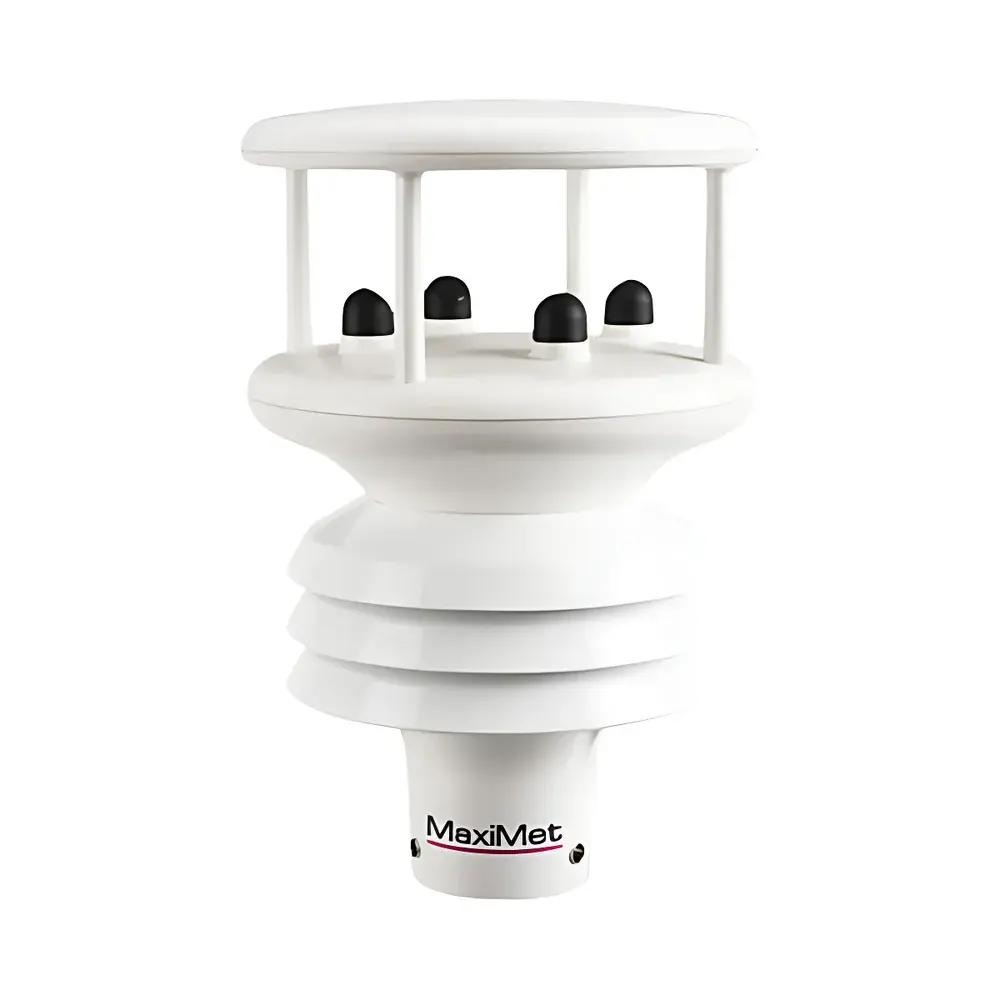
The Gill GMX560 Compact Marine Weather Station is an integrated, low-power environmental sensing platform engineered for continuous, high-reliability operation in demanding maritime and remote deployments. Built upon Gill’s proven MaxiMet architecture, the GMX560 employs solid-state sensor technology—eliminating moving parts in wind, temperature, humidity, and pressure measurement subsystems—to deliver long-term stability, minimal drift, and reduced field maintenance. Its core measurement principle relies on ultrasonic time-of-flight for wind speed and direction, capacitive polymer sensing for relative humidity, thermistor-based thermal response for air temperature, and piezoresistive MEMS transduction for barometric pressure. All sensors are co-located within a single compact housing, ensuring spatial consistency and eliminating inter-sensor alignment errors common in multi-unit mast configurations. The device outputs synchronized, time-stamped environmental data as a configurable ASCII string—enabling seamless integration into SCADA systems, vessel navigation suites, autonomous platform telemetry stacks, and cloud-based IoT infrastructure.
Key Features
- Integrated 5-parameter sensing: ultrasonic wind (0–60 m/s, ±0.1 m/s accuracy), capacitive humidity (0–100 %RH, ±2 %RH typical), thermistor temperature (–40 to +70 °C, ±0.2 °C), piezoresistive barometer (600–1100 hPa, ±0.5 hPa), and optional GPS position/time stamp (IEC 61000-4-3 compliant RF immunity)
- IP66 front-face and IP68 submersible-rated enclosure—validated for continuous exposure to salt spray, high-humidity fog, and temporary immersion up to 1 m for 30 minutes
- Embedded 6-axis electronic compass (3-axis magnetometer + 3-axis accelerometer) enabling true heading compensation without external gyros or inertial units
- Marine-grade stainless-steel mounting hardware and IP67-rated M12 circular connectors with gold-plated contacts and fluorosilicone O-rings
- Low-power architecture: typical idle current < 1.2 mA @ 12 VDC; measurement burst current < 45 mA; compatible with solar-charged battery systems (e.g., 12 Ah LiFePO₄)
- Firmware-upgradable via UART or optional wireless module; supports dual firmware partitions for fail-safe over-the-air updates
Sample Compatibility & Compliance
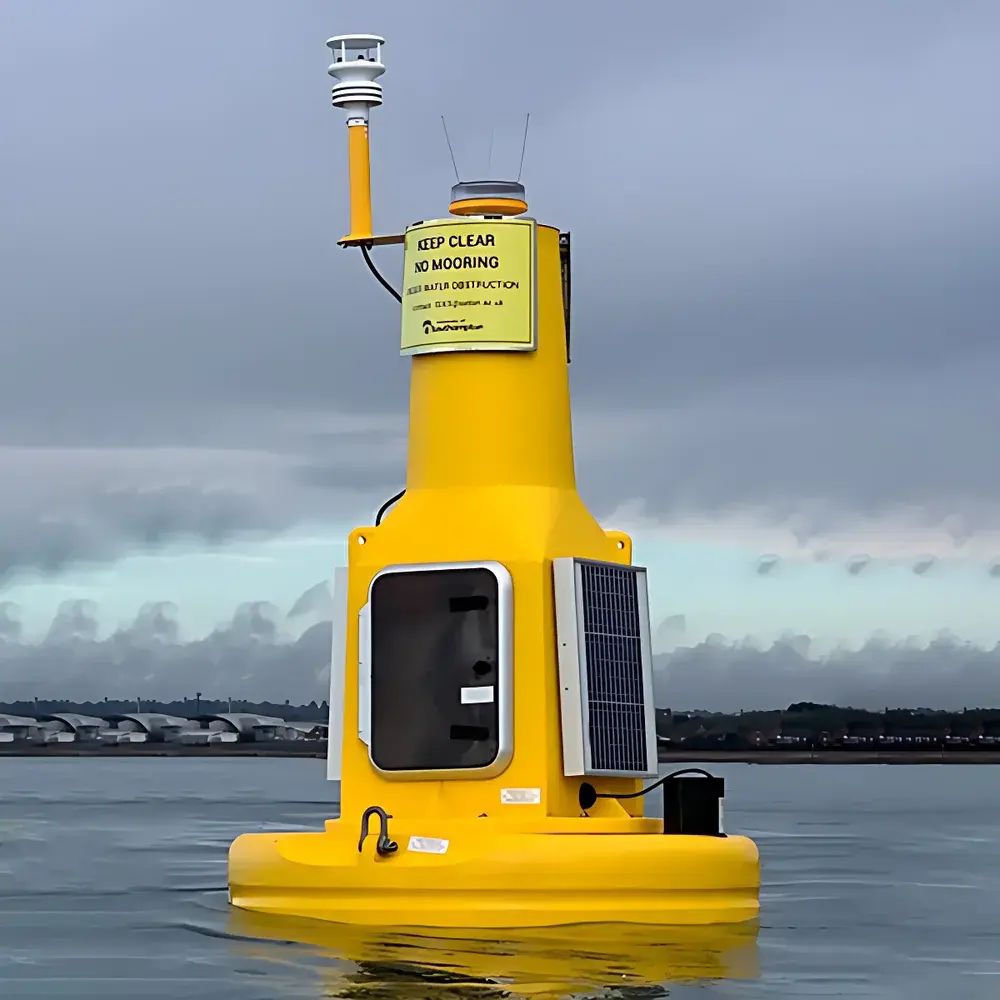
The GMX560 is designed for direct deployment in unsheltered marine environments—including offshore buoys, unmanned surface vehicles (USVs), helicopter landing decks, and turbine nacelles—without auxiliary radiation shields or mechanical wind vanes. Its sensor fusion algorithm compensates for platform motion and pitch/roll-induced airflow distortion using real-time orientation data from the 6-axis IMU. The device complies with IEC 60945 (marine electronic equipment), EN 60950-1 (safety), EN 61000-6-2/-6-4 (EMC immunity/emission), and MIL-STD-810G Method 509.5 (salt fog). It meets WMO Guide to Meteorological Instruments and Methods of Observation (CIMO Guide) requirements for Class II portable stations and supports traceable calibration per ISO/IEC 17025-accredited procedures through Gill’s UK service center.
Software & Data Management
Data output is delivered via RS-232/RS-485 serial interface at user-configurable baud rates (up to 115.2 kbps), supporting ASCII NMEA-0183 sentences (MWV, MWD, GGA, etc.), SDI-12 command sets, and Modbus RTU register mapping. Optional embedded LTE-M or LoRaWAN modules enable secure MQTT publishing to AWS IoT Core, Azure IoT Hub, or private broker endpoints—with TLS 1.2 encryption, certificate-based authentication, and configurable QoS levels. Gill’s free MaxiMet Configuration Utility (Windows/macOS) provides GUI-based parameter setup, firmware updates, and diagnostic logging. All data streams include CRC-16 checksums and optional UTC timestamp synchronization via GPS PPS signal. Audit-trail logs—recording configuration changes, calibration events, and power-cycle history—are retained onboard for GLP-compliant field validation.
Applications
- Offshore renewable energy: real-time wind shear profiling and turbulence intensity monitoring for turbine control logic and predictive maintenance scheduling
- Autonomous maritime systems: environmental input for dynamic path planning, wave-height estimation, and collision avoidance algorithms in USVs and AUVs
- Coastal observatories: networked buoy arrays providing boundary-layer meteorological inputs for regional numerical weather prediction (NWP) model assimilation
- Aviation support: helicopter deck wind advisory systems meeting CAP 437 (UK CAA) and ICAO Annex 3 requirements for wind reporting latency ( 99.5 %)
- Climate resilience infrastructure: long-term microclimate monitoring at port facilities, LNG terminals, and subsea cable landing stations
FAQ
Does the GMX560 require periodic recalibration?
Yes—Gill recommends annual verification against traceable standards; full recalibration is advised every 24 months or after exposure to extreme shock, immersion beyond IP68 limits, or sustained operation above 65 °C.
Can the GMX560 operate without GPS?
Yes—the core meteorological measurements function independently; GPS is optional and only required for georeferenced data, UTC time sync, or heading correction in highly dynamic platforms.
Is firmware customization available for OEM integrations?
Yes—Gill offers white-label firmware development under NDA, including custom ASCII frame formatting, proprietary protocol encapsulation, and extended diagnostics registers.
What mounting options are certified for helicopter deck use?
The GMX560 is supplied with a MIL-DTL-5015-style flange mount and vibration-dampened isolator kit, compliant with UK Ministry of Defence DEF STAN 00-151 Part 3 for rotary-wing aircraft deck installations.
How is data integrity ensured during intermittent connectivity?
Onboard non-volatile memory buffers up to 32,768 records (configurable depth); data is stored with monotonic timestamps and retrieved on connection recovery via auto-resume polling.
Related Products







