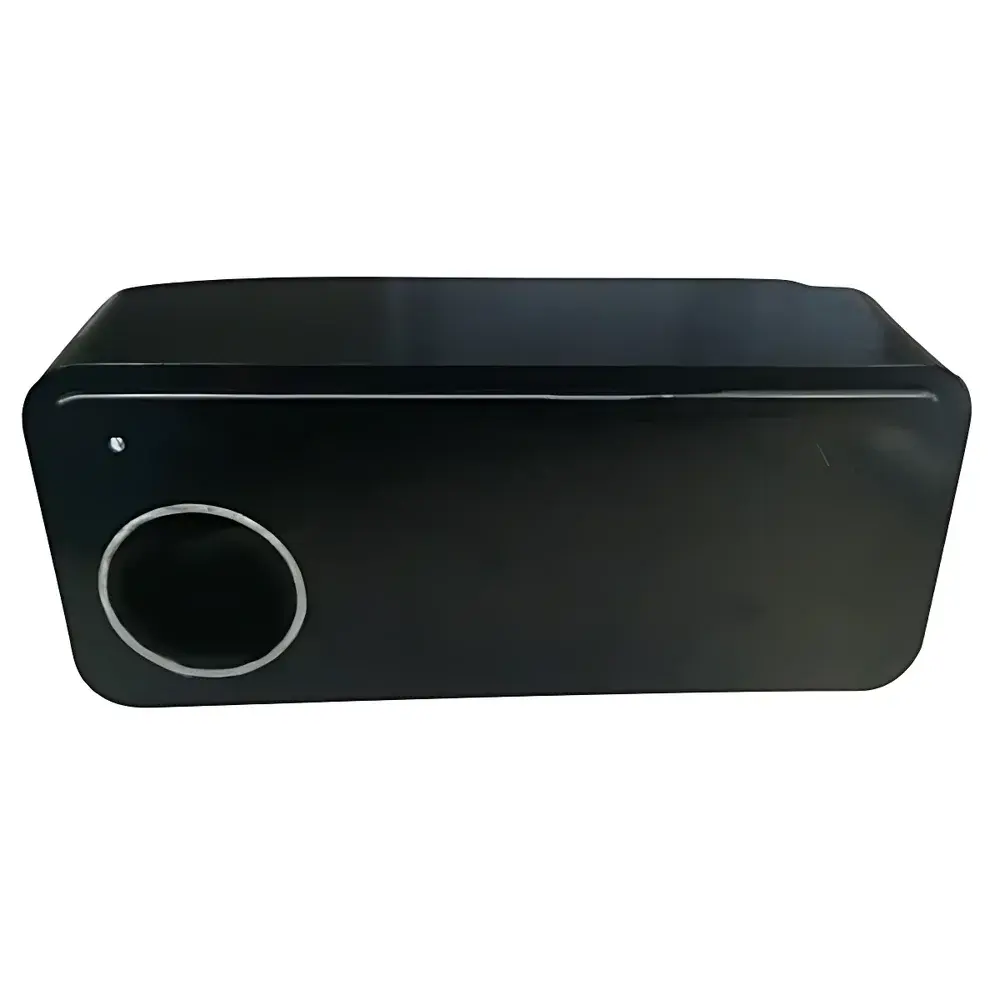
AIRMAR CM599LHW Dual-Band Chirp Depth Sounder
| Brand | AIRMAR |
|---|---|
| Origin | USA |
| Model | CM599LHW |
| Frequency Bands | 28–60 kHz (Low) & 150–250 kHz (High) |
| Beamwidth | 25° constant (High), 23°–9° variable (Low) |
| Output Power | 3000 W |
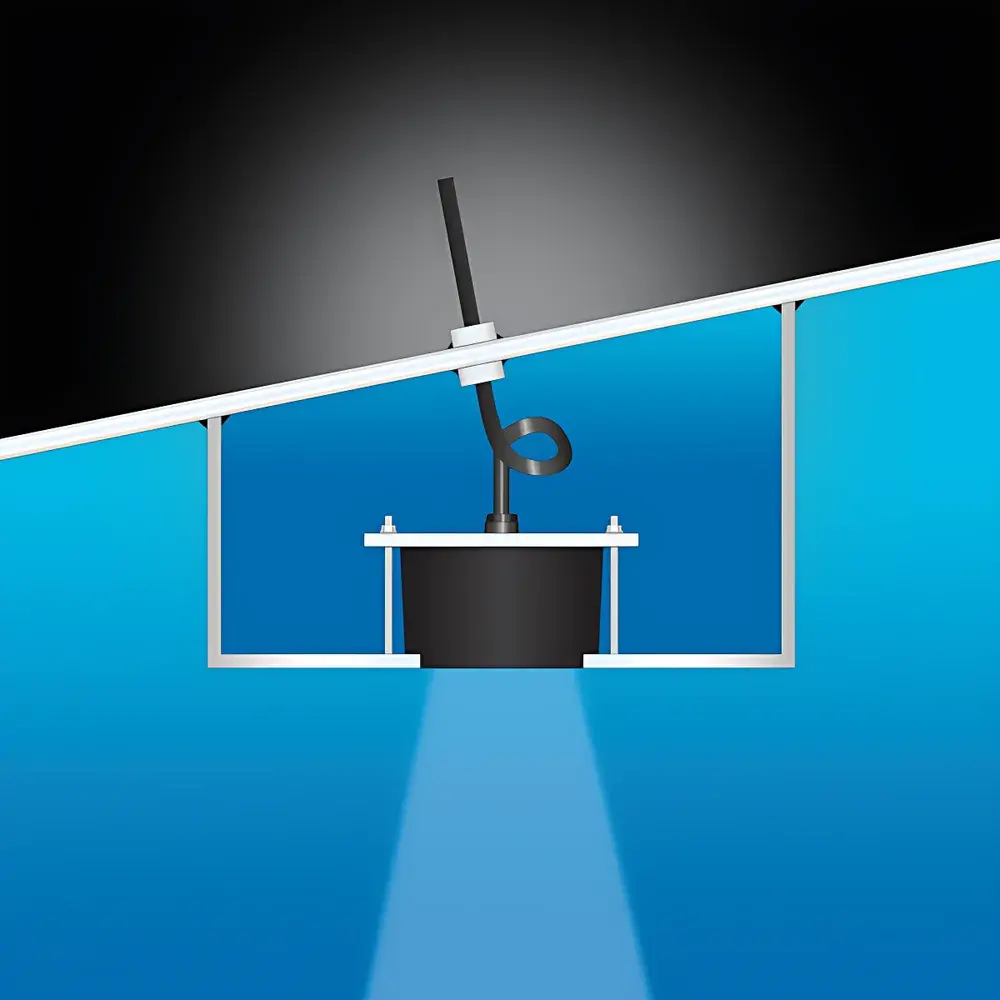
| Installation Type | In-tank mounting |
| Housing Material | Epoxy resin |
| Cable Length | 10 m |
| Integrated Temperature Sensor | Yes |
| Weight | 14.17 kg |
| Compatible Hull Material | Fiberglass |
Overview
The AIRMAR CM599LHW is a dual-band, broadband chirp depth sounder engineered for high-fidelity bathymetric profiling and target discrimination in marine environments. Unlike conventional pulsed echo sounders, the CM599LHW employs frequency-modulated continuous-wave (FMCW) chirp technology across two independently optimized acoustic bands—low-band (28–60 kHz) for deep-water penetration and bottom contour resolution, and high-band (150–250 kHz) for fine-scale target separation and near-surface structural detail. Its constant 25° beamwidth in the high band ensures consistent spatial sampling across varying depths, while the low-band’s adaptive beam narrowing (23° to 9°) maintains angular resolution at greater ranges. Designed for in-tank installation on fiberglass-hulled vessels—including sportfishing boats, commercial workboats, and research platforms—the transducer integrates a calibrated, fast-response thermistor for simultaneous water temperature measurement, supporting density-corrected sound velocity compensation in real time.
Key Features
- Dual-band chirp architecture enabling concurrent low- and high-frequency operation for multi-layered acoustic imaging
- 3000 W peak acoustic output power with dynamic pulse compression for enhanced signal-to-noise ratio and range resolution
- Epoxy-resin housing rated for permanent submersion, providing corrosion resistance and mechanical stability in high-vibration hull environments
- Xducer ID® technology—a proprietary transducer identification and calibration protocol that auto-configures frequency response, beam pattern, and time-lag parameters within compatible chartplotters and sonar processors
- Integrated NTC thermistor with ±0.2°C accuracy over 0–30°C, sampled at 1 Hz and synchronized with depth returns for real-time sound speed correction per ISO 18923:2021 guidelines
- 10-meter shielded, low-noise coaxial cable with molded strain relief and IP68-rated connectors for reliable signal integrity in wet, salt-laden installations
Sample Compatibility & Compliance
The CM599LHW is validated for use on solid fiberglass hulls with flat or moderately curved mounting surfaces (radius ≥ 300 mm). It is not recommended for metal, wood, or cored composite hulls without acoustic isolation kits. The transducer meets IEC 60529 (IP68), EN 60945 (marine electronics environmental testing), and UL 1812 (submersible transducer safety) standards. Its chirp waveform design complies with ITU-R SM.1139 spectral occupancy limits for maritime sonar systems, minimizing interference with adjacent VHF, AIS, and radar bands. For regulatory traceability, each unit carries a factory calibration certificate referencing NIST-traceable hydrophone measurements conducted per ASTM E1065 standard practice for ultrasonic transducer characterization.
Software & Data Management
The CM599LHW outputs raw IQ data and processed depth/temperature streams via NMEA 2000 (PGN 128267, 128275) and analog RS-422 interfaces. When paired with AIRMAR-compatible MFDs or third-party software (e.g., MaxSea TimeZero, Furuno TZtouch, or Qinsy hydrographic suites), it supports full chirp waveform logging, beam-formed sector scanning, and post-processed target strength quantification. Firmware updates are delivered via CAN bus using AIRMAR’s Xducer Manager utility, which also archives calibration metadata—including serial-number-matched beam pattern coefficients and thermal drift compensation tables—for GLP-compliant audit trails.
Applications
- Commercial fisheries: Species-specific echo classification and biomass estimation using differential target strength signatures across dual bands
- Hydrographic surveying: High-density depth grid generation for nautical chart updates under IHO S-44 Special Order specifications
- Aquaculture site monitoring: Real-time detection of net integrity anomalies, predator intrusion, and sediment accumulation beneath cage arrays
- Coastal engineering: Long-term bathymetric change detection in dredged channels and nearshore erosion zones
- Scientific limnology: Stratified water column profiling in estuaries and fjords where temperature gradients necessitate sound velocity correction
FAQ
What hull materials are certified for direct-mount installation?
The CM599LHW is approved for direct bonding only on solid fiberglass hulls. Aluminum, steel, or cored composites require decoupled mounting solutions to prevent acoustic short-circuiting and resonance artifacts.
Does the transducer support integration with non-AIRMAR displays?
Yes—provided the display supports NMEA 2000 PGNs 128267 (depth) and 128275 (water temperature), or accepts RS-422 depth/temperature analog signals with configurable scaling.
Is factory recalibration required after installation?
No. Xducer ID® embeds calibrated beam and sensitivity data; however, users must input hull thickness and material in the host system to enable accurate ray-tracing compensation.
Can the low- and high-band signals be processed independently?
Yes. The dual-band architecture provides separate digital output paths, allowing simultaneous display of low-band bottom track and high-band fish arches without cross-band interference.
What is the maximum operational depth rating?
Rated for continuous operation up to 300 m (984 ft) seawater depth, assuming proper hull mounting and cable routing per AIRMAR Technical Bulletin TB-027.