
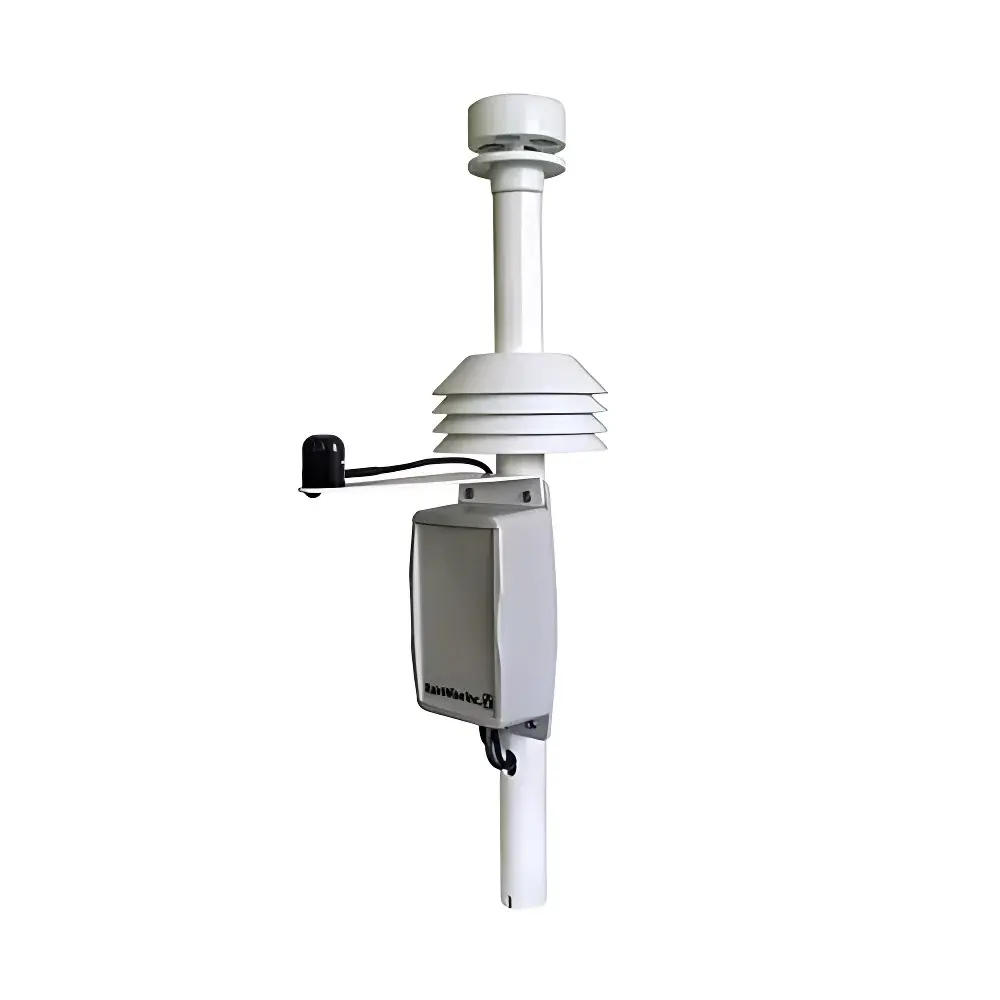
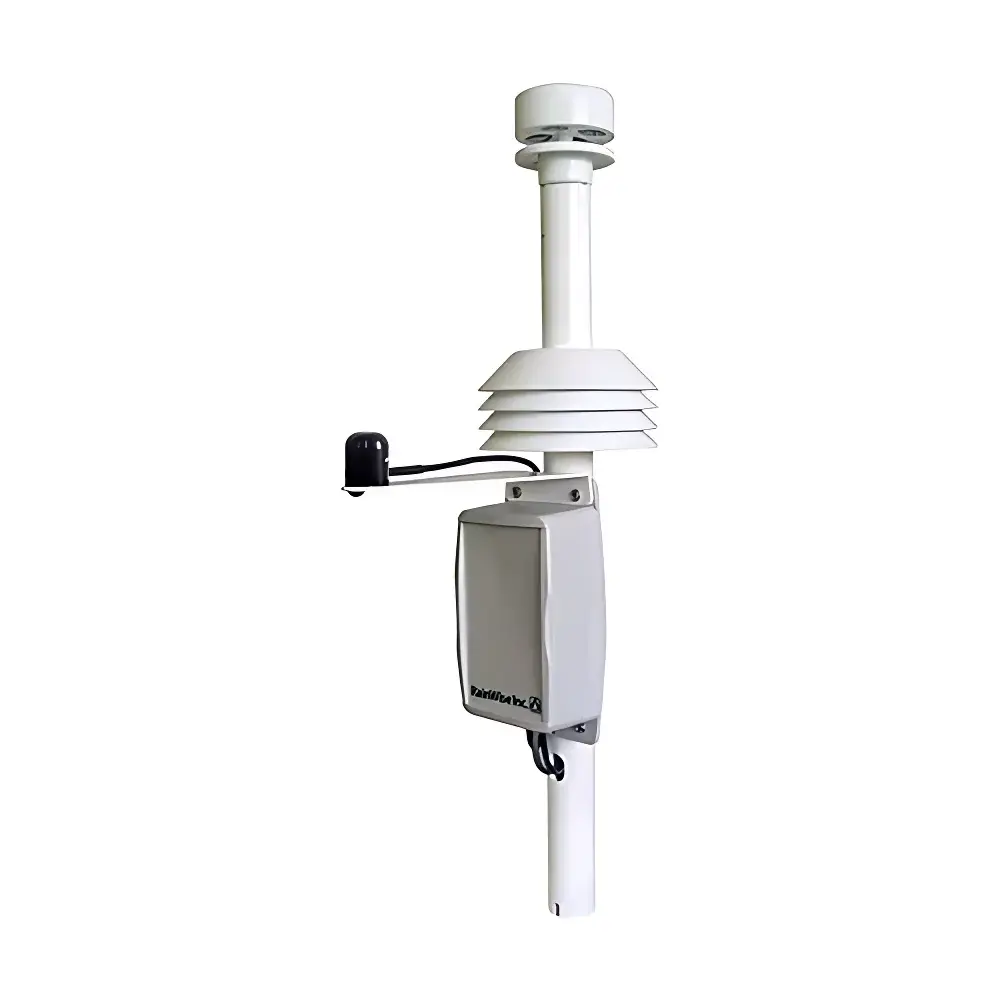
RainWise PVmet 200US Photovoltaic Weather Station
| Brand | RainWise |
|---|---|
| Origin | USA |
| Model | PVmet 200US |
| Sensor Type | Ultrasonic Anemometer (Wind Speed & Direction) |
| Radiation Measurement Range | 0–1750 W/m² |
| Radiation Accuracy | ±5% |
| Air Temperature Range | −40 to +80 °C |
| Air Temperature Accuracy | ±0.3 °C |
| Backsheet Temperature Range | −40 to +80 °C |
| Backsheet Temperature Accuracy | ±0.3 °C |
| Wind Speed Range | 0.25–45 m/s |
| Wind Speed Accuracy | ±0.13 m/s |
| Wind Direction Accuracy | ±1° |
| Communication | RS-485 Modbus RTU (optional Modbus TCP via Ethernet) |
| Power Supply | 10–30 VDC, 50 mA |
| Operating Ambient | −40 to +60 °C, 0–100% RH |
| Enclosure Materials | PVC, ABS, Anodized Aluminum, Stainless Steel, Polycarbonate (LEXAN®/Makrolon® 2658) |
| Compliance | RoHS-compliant, SunSpec Certified |
| Cable Length | 7.62 m |
Overview
The RainWise PVmet 200US is a purpose-built photovoltaic (PV) weather station engineered for high-fidelity environmental monitoring in utility-scale solar farms, distributed generation sites, and performance validation laboratories. Unlike generic meteorological stations, the PVmet 200US integrates sensor physics and data architecture specifically aligned with IEC 61724-1 (Photovoltaic system performance monitoring – Guidelines for measurement, data exchange and analysis) and ASTM E2848 (Standard Practice for Reporting Photovoltaic Performance Measurements). Its core measurement principle relies on calibrated thermopile-based pyranometry for global horizontal irradiance (GHI), spectrally matched silicon-cell sensors for plane-of-array (POA) irradiance, and precision thermistors embedded in thermally representative substrates for PV backsheet temperature—enabling accurate cell temperature estimation per IEC 61215 thermal modeling requirements. The ultrasonic anemometer eliminates mechanical wear, delivering long-term stability in wind speed and direction under harsh desert or coastal conditions without recalibration drift.
Key Features
- Integrated SunSpec-certified Modbus RTU interface (RS-485/422, 2-wire half-duplex) compliant with SunSpec Model 160, enabling seamless integration into SCADA, inverters, and PV monitoring platforms (e.g., SolarLog, SMA, Fronius, and Schneider Electric EcoStruxure).
- Ultrasonic wind sensor with no moving parts: operational range 0.25–45 m/s (wind speed), 0–359° (wind direction); accuracy ±0.13 m/s and ±1°, respectively—critical for soiling loss correction and module cooling coefficient analysis.
- Dual radiation sensing: ISO 9060:2018 Class C thermopile pyranometer for GHI (0–1750 W/m², ±5% uncertainty) and spectrally optimized silicon photodiode sensor for POA irradiance—ensuring spectral mismatch error < 3% under standard AM1.5G conditions.
- Backsheet temperature sensing: Two-channel capability (standard: one sensor; optional second channel configurable via firmware); Pt1000-class thermistors mounted on aluminum heat-sink plates replicating thermal mass of commercial PV modules.
- Ruggedized industrial enclosure: Housing combines UV-stabilized polycarbonate (Makrolon® 2658), anodized aluminum mounting arms, stainless-steel fasteners, and RoHS-compliant PCBs—rated IP65 for continuous outdoor operation from −40 °C to +60 °C at 100% RH.
- Low-power DC architecture: Operates on 10–30 VDC at ≤50 mA, compatible with common PV system auxiliary power rails and battery-backed telemetry gateways.
Sample Compatibility & Compliance
The PVmet 200US is validated for deployment across crystalline silicon (c-Si), thin-film (CdTe, CIGS), and bifacial PV arrays. Its sensor geometry supports mounting on tilt frames, tracker torque tubes, or ground-mount racking per IEC 61724-1 Annex A recommendations. All analog and digital outputs meet EN 61000-6-2 (immunity) and EN 61000-6-4 (emissions) standards. Firmware and communication protocols adhere to SunSpec Alliance certification requirements—including mandatory register mapping, exception handling, and timeout behavior—ensuring interoperability during third-party system audits. Data logging intervals (1–300 sec) are configurable to align with utility-grade performance ratio (PR) reporting cycles and grid code compliance (e.g., IEEE 1547-2018 Annex H).
Software & Data Management
No proprietary software is required. Raw Modbus registers expose calibrated engineering units (W/m², °C, m/s, °, %RH) with linear scaling coefficients pre-programmed per NIST-traceable calibration certificates. Users may poll registers using open-source tools (e.g., pymodbus, QModMaster) or integrate directly into time-series databases (InfluxDB, TimescaleDB) via Python or Node-RED. Optional Ethernet gateway (sold separately) enables Modbus TCP over IPv4/IPv6 with DHCP/Static IP configuration, supporting TLS 1.2 encryption when deployed behind corporate firewalls. Audit logs—including sensor health flags, communication timeouts, and calibration expiration dates—are accessible via discrete Modbus holding registers for GLP/GMP traceability in regulated environments.
Applications
- Performance Ratio (PR) and Yield Analysis per IEC 61724-1 Tier B or C monitoring tiers.
- Soiling rate quantification using GHI/POA ratio trending and wind-driven particulate correlation.
- Thermal derating modeling via simultaneous backsheet temperature and irradiance acquisition.
- Site assessment and bankable energy yield reports (BEYR) for project financing due diligence.
- Real-time fault detection in string-level monitoring systems through irradiance-temperature-wind anomaly correlation.
- Validation of satellite-derived irradiance models (e.g., NSRDB, Solargis) against ground-truth measurements.
FAQ
Is the PVmet 200US suitable for bifacial PV array monitoring?
Yes. Its POA irradiance sensor can be oriented vertically or tilted to capture rear-side albedo contribution when installed according to IEC 61724-1 Annex B guidelines.
Can the backsheet temperature sensor be extended beyond the standard 7.62 m cable?
Custom cable lengths up to 30 m are available upon request; signal integrity remains within specification when using shielded twisted-pair (STP) cabling and proper grounding practices.
Does the device support time-synchronized data acquisition across multiple units?
While the PVmet 200US lacks onboard GPS or PTP, it supports deterministic polling intervals via master controller synchronization—enabling sub-second timestamp alignment across distributed installations when integrated with industrial PLCs or Modbus TCP gateways.
What is the recommended recalibration interval?
RainWise recommends radiometric recalibration every 2 years and thermistor verification annually, consistent with IEC 61724-1 Section 7.3 maintenance guidance.
Is firmware update capability included?
Yes. Field-upgradable firmware is delivered via Modbus register writes using RainWise’s documented bootloader protocol—no physical access or hardware reset required.







