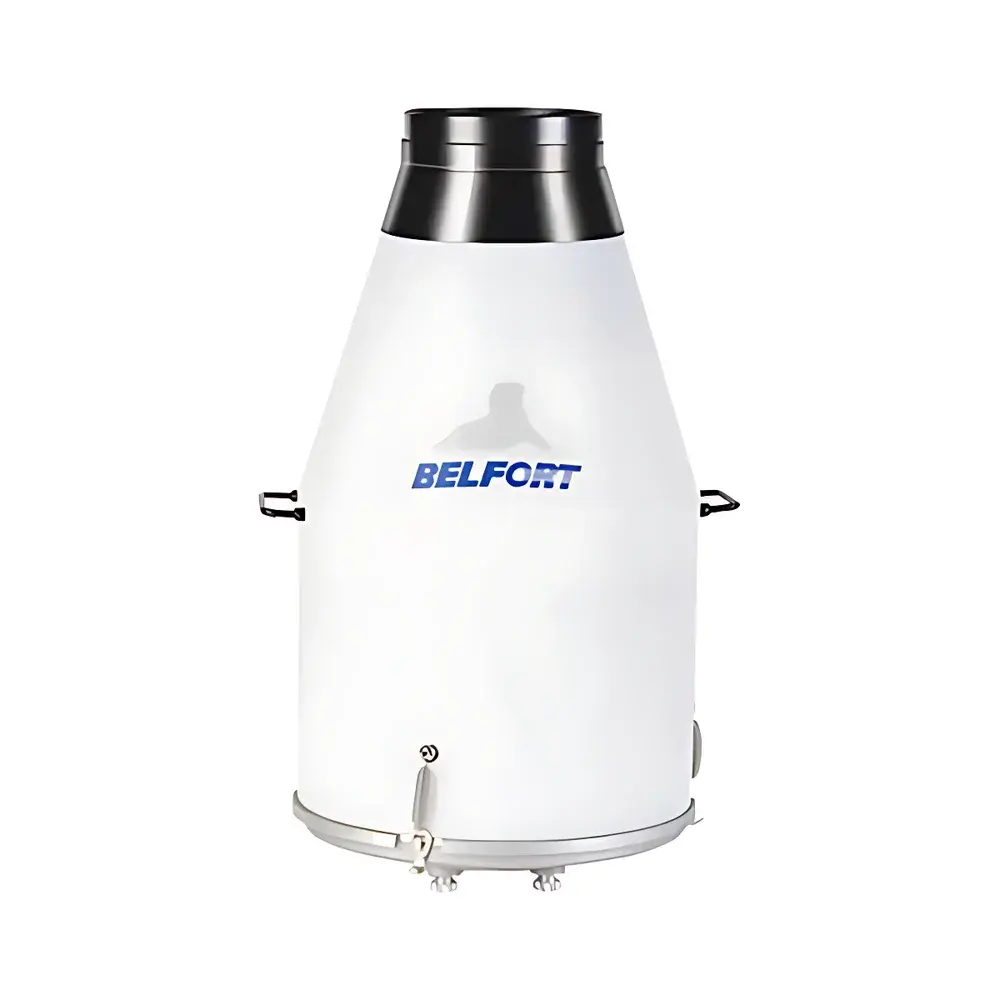
Belfort AEPG II Weighing-Type Precipitation Gauge
| Brand | Belfort |
|---|---|
| Origin | USA |
| Model | AEPG II |
| Operating Temperature Range | -55 °C to +55 °C |
| Collection Area | 200 cm² (16 cm diameter) or 50.26 in² (8 in diameter) |
| Precipitation Rate Range | 0.25 mm/h to 3040 mm/h |
| Resolution | 0.025 mm (0.001 in) |
| Accuracy | ±0.25 mm (±0.01 in) or ±0.1% FS |
| Repeatability | ±0.25 mm (±0.01 in) |
| Output | RS-232 (configurable units: mm/in, mass, frequency, collector temperature) |
| Power Supply | 8–18 VDC (3 W nominal) |
| Optional Heater | 115 VAC/60 Hz/2 A or 12 VDC @ 30/60/90 W |
| Enclosure Material | UV-stabilized high-strength thermoplastic over aluminum frame |
| Weight | 13 kg (28.5 lb) |
| Compliance | WMO No. 8, NOAA/NWS Technical Memorandum NWS OH-1, ASTM D7297 |
Overview
The Belfort AEPG II Weighing-Type Precipitation Gauge is an internationally certified, all-weather precipitation measurement instrument engineered for continuous, unattended operation in meteorological, hydrological, and climate monitoring networks. Unlike tipping-bucket or optical rain gauges, the AEPG II employs precision load-cell-based weighing technology—principally governed by Newtonian force balance—to quantify accumulated precipitation mass in real time. This fundamental approach enables accurate measurement of all precipitation phases: liquid rain, freezing rain, sleet, and dry snow—without mechanical interruption, phase-dependent calibration drift, or undercatch bias induced by wind turbulence. Its design adheres to the World Meteorological Organization (WMO) Guide to Instruments and Methods of Observation (CIMO Guide, Chapter 6) and meets U.S. National Weather Service (NWS) performance criteria outlined in Technical Memorandum NWS OH-1. The gauge’s 200 cm² (16 cm diameter) or 50.26 in² (8 in diameter) standardized orifice conforms to both WMO and NOAA/NWS dimensional specifications, ensuring intercomparability across global observing systems.
Key Features
- Triple-load-cell architecture with independent signal acquisition and real-time cross-validation—enabling automatic fault detection and sensor redundancy compensation without data loss
- On-board microcontroller (OBC) with embedded temperature compensation algorithms that correct for thermal expansion effects on load-cell output and enclosure mass drift
- Fluoropolymer-coated collection funnel (non-stick, UV-resistant, low-hysteresis surface) minimizing adhesion of wet snow, rime, or debris
- Wide operational envelope: -55 °C to +55 °C (-67 °F to +131 °F), validated per IEC 60068-2 environmental stress testing protocols
- No moving parts, no mechanical linkages, no lubrication requirements—reducing long-term maintenance to periodic calibration verification only
- Configurable RS-232 digital output supporting user-selectable units (mm, in, g, kg), raw weight values, transducer excitation frequency, and integrated collector temperature
- Optional low-power heating system (AC or DC variants) activated by precipitation presence—critical for reliable solid-phase accumulation in subfreezing environments
- Integrated LED diagnostic indicators for rapid field-level fault isolation (e.g., sensor imbalance, heater activation, communication timeout)
Sample Compatibility & Compliance
The AEPG II is validated for quantitative measurement of natural atmospheric precipitation across all physical states. Its weighing principle inherently accommodates variable density, particle size distribution, and kinetic energy—eliminating the systematic undercatch observed in funnel-and-bucket designs during high-wind events. Calibration traceability follows NIST-traceable mass standards, with factory verification performed against certified reference weights per ISO/IEC 17025-accredited procedures. Regulatory compliance includes alignment with WMO Recommendation No. 8 (Precipitation Measurement), ASTM D7297 (Standard Practice for Field Calibration of Weighing Rain Gauges), and U.S. Federal Reference Method (FRM) requirements for climate-grade precipitation instrumentation. Data integrity supports GLP/GMP-aligned deployments when paired with audit-trail-capable dataloggers compliant with FDA 21 CFR Part 11.
Software & Data Management
The AEPG II operates as a deterministic sensor node: it does not require proprietary software for basic functionality. Raw RS-232 output is ASCII-formatted and human-readable, enabling seamless integration with Campbell Scientific CR-series, Onset HOBO, Delta-T DL2e, or custom SCADA platforms via standard serial-to-IP gateways. Configuration parameters—including unit selection, output interval, heater activation threshold, and diagnostic reporting level—are set via ASCII command protocol (no firmware upload required). For networked deployments, optional wireless telemetry modules support Modbus RTU over LoRaWAN or cellular NB-IoT, transmitting timestamped mass-weighted precipitation totals with embedded metadata (temperature, heater status, sensor health flags). All output streams include CRC-16 checksums for transmission integrity verification.
Applications
- National meteorological services operating WMO-compliant synoptic observation networks
- Hydrologic forecasting centers requiring phase-agnostic input for snowmelt-runoff modeling
- Climate reference stations (e.g., GCOS, USCRN) where long-term stability and interannual comparability are mandatory
- Airport weather systems (AWOS/ASOS) needing precise liquid-equivalent snowfall quantification for de-icing decision support
- Research campaigns studying precipitation microphysics, aerosol–cloud interactions, or urban rainfall modification effects
- Environmental monitoring programs tracking acid deposition, pollutant washout, or isotopic tracer fluxes
FAQ
Does the AEPG II require annual recalibration?
No scheduled annual recalibration is mandated; however, biennial verification against NIST-traceable mass standards is recommended per WMO CIMO guidance. Field zero-checks can be performed using known test weights without disassembly.
Can the AEPG II distinguish between rain and snow in real time?
It measures total accumulated mass—not phase—but when combined with co-located temperature, humidity, and wind sensors, phase classification is achieved via algorithmic post-processing (e.g., using NOAA’s SNOW-17 or WMO-defined thresholds).
Is the RS-232 output compatible with Campbell Scientific dataloggers?
Yes—configured as asynchronous serial (9600 baud, 8N1), the AEPG II outputs ASCII strings parsable by CR1000X, CR6, and CR300 firmware using standard SerialInScan instructions.
What is the maximum allowable cable length between the gauge and datalogger?
For RS-232, maximum reliable distance is 15 m (50 ft) without repeaters; for longer runs, RS-485 conversion or fiber-optic serial extenders are recommended.
How does the triple-sensor architecture improve measurement reliability?
Each load cell operates independently; the OBC continuously compares outputs and rejects outliers using a median-filtering algorithm—ensuring continuity even if one sensor degrades or experiences localized thermal stress.