
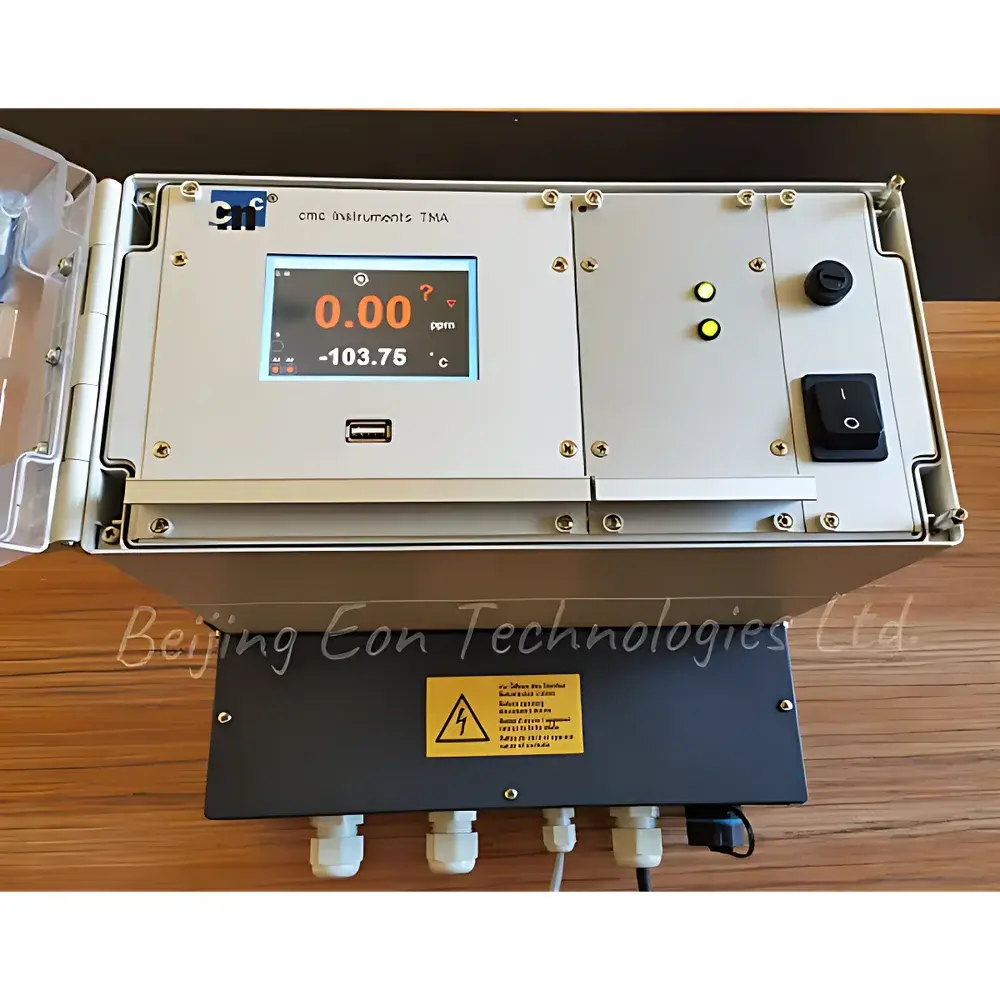
CMC iTMA-202-W-Ex P₂O₅ Electrolytic Dew Point Analyzer for Chlorine and Corrosive Gases
| Brand | CMC (Schimse) |
|---|---|
| Origin | Germany |
| Model | iTMA-202-W-Ex |
| Product Type | In-line Dew Point Analyzer |
| Measurement Principle | Phosphorus Pentoxide (P₂O₅) Electrolytic Method |
| Operating Temperature | 5–50 °C |
| Accuracy | ±1% of full scale |
| Repeatability | ±0.1% of full scale |
| Range Options | 0–10 / 100 / 1,000 / 2,500 ppm H₂O (auto/manual switching) |
| Response Time (T₉₀) | <1 s |
| T₅₀ Response | <8 s |
| Sample Flow Rate | 20 NL/h |
| Recommended Sample Pressure | 0.1–0.5 barg |
| Display | Touchscreen with multilingual UI (including Chinese) |
| Analog Output | 0/4–20 mA (configurable) |
| Alarm Outputs | 2 relay outputs |
| Intrinsic Safety | Integrated Zener barrier |
| Enclosure Rating | Ex d IIC T6 Ga (ATEX/IECEx certified) |
| Dimensions | 310 × 250 × 285 mm (W × H × D) |
| Cable Length | Standard 3 m (up to 300 m optional) |
Overview
The CMC iTMA-202-W-Ex is a high-integrity, intrinsically safe in-line dew point analyzer engineered specifically for continuous moisture monitoring in aggressive, corrosive, and flammable process gases—including chlorine (Cl₂), hydrogen chloride (HCl), sulfur dioxide (SO₂), hydrogen sulfide (H₂S), and other high-purity acid gases. It employs the fundamental electrochemical principle of phosphorus pentoxide (P₂O₅) electrolysis: water vapor in the sample gas is quantitatively decomposed into hydrogen and oxygen at a P₂O₅-coated sensor cell, generating an electrolytic current strictly proportional to the absolute water concentration. This absolute measurement method eliminates drift-related recalibration requirements under stable operating conditions and ensures traceable, NIST-traceable accuracy without reliance on reference standards during routine operation. The sensor architecture—comprising fused-silica cylindrical body, dual parallel electrodes (typically Pt or Rh), and a sub-micron hygroscopic H₃PO₄ film—enables robust performance in chemically demanding environments where optical or capacitive sensors degrade rapidly.
Key Features
- Intrinsically safe design certified to ATEX Directive 2014/34/EU and IECEx Ex d IIC T6 Ga for Zone 1/21 hazardous areas
- P₂O₅ electrolytic sensor with zero-drift stability; no periodic recalibration required under consistent operating conditions
- Ultra-fast response: T₉₀ < 1 second, T₅₀ < 8 seconds—critical for real-time process control in chlor-alkali, semiconductor, and specialty gas production
- Auto-ranging capability across four discrete moisture spans (0–10, 100, 1,000, 2,500 ppm) with seamless switching and auto-zero compensation
- Integrated Zener safety barrier compliant with IEC 60079-11; eliminates need for external barriers in most installations
- Full microprocessor-based control with built-in self-diagnostics at power-on and during continuous operation (per NAMUR NE 43 guidelines)
- Touchscreen HMI supporting multilingual interface—including English, German, French, and Chinese—for global deployment and operator accessibility
Sample Compatibility & Compliance
The iTMA-202-W-Ex is validated for use with non-reactive and moderately reactive gases including N₂, O₂, Ar, He, Kr, Xe, H₂, D₂, CO₂, CH₄, natural gas, SF₆, Freon variants, C₂H₂, and PH₃. Its primary engineering focus is on highly corrosive streams: Cl₂, HCl, SO₂, and H₂S—gases that rapidly deactivate metal-oxide or polymer-based sensors. Compatibility excludes only those gases known to chemically attack phosphoric acid films (e.g., strong alkalis or reducing agents with high reactivity toward P₂O₅). All wetted materials—including sensor housing, flow path, and electrode substrates—are selected per ASTM B162 (nickel alloy) and DIN 17440 (316L stainless steel) specifications. The analyzer meets EN 61000-6-2/-6-3 (EMC immunity/emission), EN 61010-1 (safety), and supports GLP/GMP data integrity requirements via time-stamped event logging and non-volatile memory storage.
Software & Data Management
Firmware supports configurable 4–20 mA analog output with linear or square-root scaling, two programmable relay outputs (SPDT, 250 VAC/3 A), and Modbus RTU over RS-485 (optional). Data logging includes moisture concentration, sensor voltage, temperature, pressure (when integrated), alarm status, and diagnostic flags—all timestamped with millisecond resolution. Internal memory retains ≥30 days of 1-second interval data. Export is supported via USB-C dump to CSV format. The device complies with FDA 21 CFR Part 11 requirements when deployed with audit-trail-enabled SCADA systems: all configuration changes, calibration events (if performed), and alarm acknowledgments are immutably logged with user ID and timestamp. No cloud connectivity is embedded; all communication remains local and deterministic—ensuring cybersecurity compliance in regulated industrial networks.
Applications
- Chlorine drying verification in membrane cell chlor-alkali plants prior to liquefaction and cylinder filling
- Moisture control in HCl synthesis loops and SO₂ conversion units in sulfuric acid manufacturing
- Quality assurance of ultra-high-purity (UHP) process gases for semiconductor etching and chamber purge applications
- Continuous monitoring of natural gas dehydration units and LNG feed gas specification compliance (per ISO 8502-1)
- Validation of desiccant dryer performance in pharmaceutical nitrogen generation systems (meeting USP water content limits)
- Leak detection support in closed-loop fluorocarbon refrigerant systems where trace H₂O indicates seal degradation
FAQ
Is the P₂O₅ sensor regenerable in situ?
Yes—the sensor’s electrolytic membrane can be regenerated by applying reverse polarization for controlled durations, restoring baseline sensitivity without physical replacement.
Does the analyzer require carrier gas or zero-air purge?
No. It operates on direct sample draw with no auxiliary gas supply needed, minimizing system complexity and operational cost.
Can it measure below 1 ppmv in chlorine without interference?
Yes—its detection limit is 0.1 ppmv (at 10 ppm range), and selectivity against Cl₂ is inherent due to the electrochemical specificity of the P₂O₅/H₃PO₄ reaction mechanism.
What maintenance intervals are recommended?
Sensor regeneration every 6–12 months depending on total moisture exposure; full calibration verification annually using traceable NIST-certified moisture standards.
Is firmware upgrade supported remotely?
Firmware updates require local USB-C connection and authenticated firmware files—no remote access or OTA capability is implemented, aligning with IEC 62443-3-3 SL2 cybersecurity requirements.
Related Products





