
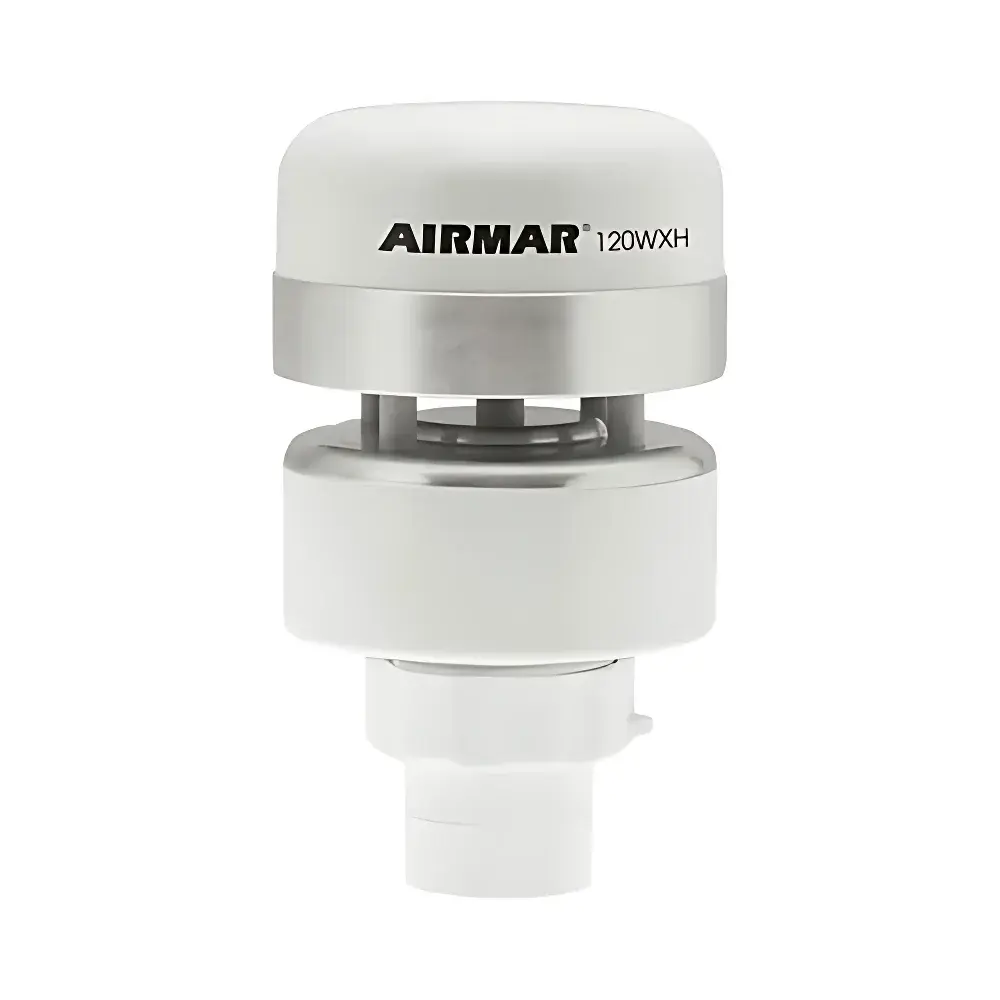
AirMar 120WXH Ultrasonic Weather Station
| Brand | AIRMAR |
|---|---|
| Origin | USA |
| Model | 120WXH |
| Instrument Type | Portable Weather Station |
| Enclosure Rating | IPX6 |
| Communication Interface | NMEA 0183 (RS-422 or RS-232) |
| Heating Function | Integrated thermostatically controlled heater |
| Measurement Principle | Ultrasonic time-of-flight for wind speed & direction |
| Output Parameters | True/Relative wind speed & direction, atmospheric pressure, air temperature, wind chill |
| Discontinued Status | Yes (replaced by 220WXH) |
Overview
The AirMar 120WXH Ultrasonic Weather Station is a discontinued but historically significant compact environmental sensor system engineered for continuous, maintenance-free meteorological monitoring in demanding terrestrial and marine environments. Utilizing ultrasonic time-of-flight measurement principles—where acoustic pulses travel between transducer pairs—the device determines wind speed and direction without mechanical moving parts, eliminating wear, bearing degradation, or icing-induced mechanical obstruction. Its integrated thermostatically regulated heating element maintains transducer surface temperature above freezing during sub-zero operation, mitigating ice accumulation that would otherwise distort acoustic path geometry and compromise data fidelity. Designed to meet the operational requirements of coastal infrastructure, small-vessel navigation, remote weather telemetry nodes, and field-deployed environmental research stations, the 120WXH delivers high reproducibility in wind vector resolution, pressure stability, and thermal response across ambient temperatures ranging from –25 °C to +60 °C. Though superseded by the enhanced 220WXH model, legacy 120WXH units remain in service under calibrated conditions where firmware and interface compatibility are maintained.
Key Features
- Ultrasonic wind measurement: No moving parts; immunity to mechanical fatigue, corrosion, or lubrication failure
- Active anti-icing system: Precision-controlled heater prevents frost formation on transducer faces during low-temperature operation
- Multi-parameter output: Simultaneous real-time reporting of true and relative wind speed (knots, m/s, mph), wind direction (0–359°), barometric pressure (hPa), air temperature (°C/°F), and calculated wind chill index
- Ruggedized marine-grade housing: UV-stabilized polymer enclosure rated to IPX6 (powerful water jet resistance), suitable for permanent deck mounting or temporary field deployment
- Standardized NMEA 0183 output: Dual interface variants available—RS-422 (44-852-1-01) for noise-immune long-haul marine networks and RS-232 (44-851-1-01) for direct PC or data logger integration
- Low power consumption: Optimized for battery-backed or solar-powered remote installations with typical draw <1.2 W at 12 V DC
Sample Compatibility & Compliance
The 120WXH is intended for open-air atmospheric sampling in unobstructed locations with minimal turbulence interference—ideally mounted ≥2 m above ground or deck level and clear of vertical obstructions within a 10 m radius. It complies with IEC 60945 (marine electronic equipment), meets EMC Directive 2014/30/EU radiated emission limits, and conforms to RoHS 2011/65/EU material restrictions. While not certified to ISO/IEC 17025 for metrological traceability out-of-the-box, its factory calibration certificate (NIST-traceable reference standards applied) supports GLP-aligned data logging workflows when paired with compliant acquisition systems. Pressure and temperature outputs align with WMO Guide to Instruments and Methods of Observation (CIMO Guide, Chapter 12) performance expectations for Class II portable stations.
Software & Data Management
The included WeatherCaster software provides native Windows-based configuration, real-time visualization, and ASCII log export (CSV/TXT). It supports baud rate selection (4800–38400), sentence filtering (e.g., $WIMWV, $WIMDA), and user-defined averaging intervals (1–60 seconds). Raw NMEA streams are compatible with third-party platforms including NOAA’s MADIS ingest pipeline, Campbell Scientific LoggerNet, and Python-based PySerial data acquisition scripts. Firmware updates were historically distributed via AirMar’s legacy support portal; archived binaries remain accessible through authorized distributor technical libraries. Data integrity is preserved through standard NMEA checksum validation; no proprietary encryption or FDA 21 CFR Part 11 audit trail functionality is implemented.
Applications
- Marine navigation safety: Real-time wind vector input for autopilot feedforward control and collision avoidance algorithms
- Coastal erosion monitoring: Long-term wind stress and pressure trend analysis correlated with tidal gauge and sediment trap data
- Agricultural microclimate assessment: Field-level wind speed thresholds for pesticide drift modeling and irrigation scheduling
- Renewable energy site screening: Preliminary wind resource characterization prior to cup-anemometer mast deployment
- Educational atmospheric science labs: Hands-on instruction in ultrasonic anemometry, sensor physics, and environmental data logging protocols
- Emergency response weather situational awareness: Rapid-deploy meteorological node for wildfire perimeter tracking or flood forecasting
FAQ
Is the 120WXH still supported by AirMar?
No—AirMar officially discontinued the 120WXH in 2021 and replaced it with the 220WXH, which features improved pressure sensor stability, extended temperature range, and dual NMEA 2000/NMEA 0183 output.
Can the 120WXH operate reliably in freezing rain conditions?
Yes—its thermostatically controlled heater activates automatically below +2 °C and maintains transducer surfaces above 0 °C, preventing ice bridging between ultrasonic paths.
Does the unit require periodic recalibration?
Factory calibration is stable for 24 months under normal operating conditions; annual verification against a traceable reference thermometer and barometer is recommended for regulatory or QA-critical deployments.
What is the minimum recommended mounting height?
For representative boundary-layer measurements, install at least 2 meters above ground or deck level, with horizontal clearance exceeding 10 times the height of nearest obstruction.
Is WeatherCaster software compatible with modern Windows versions?
WeatherCaster v3.2 (included) runs on Windows 7–10 via compatibility mode; newer Windows 11 systems may require virtualization or alternative NMEA parsing tools.
Related Products







