
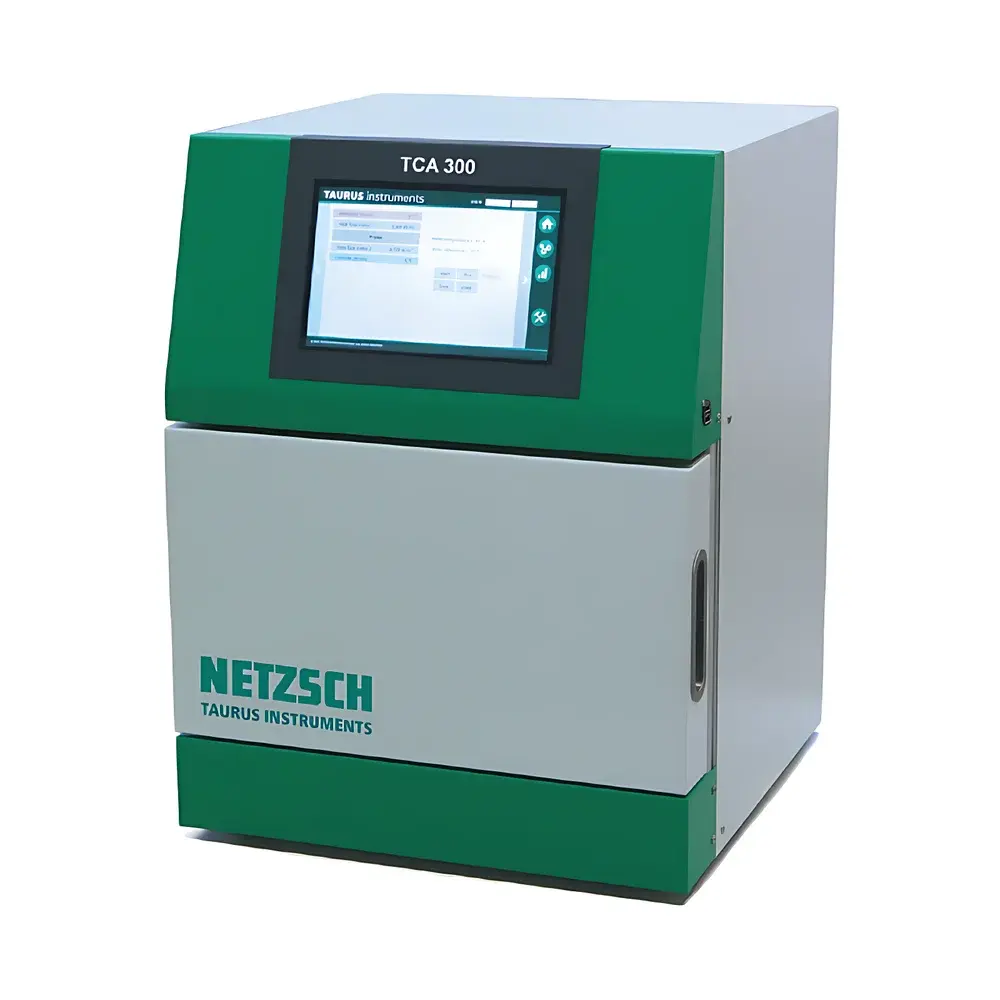
Netzsch TCA 300 Heat Flow Meter Thermal Conductivity Analyzer
| Brand | Netzsch |
|---|---|
| Origin | Germany |
| Model | TCA 300 |
| Measurement Principle | Heat Flow Meter (HFM) Method |
| Dimensions (L×W×H) | 44 × 40 × 62 cm |
| Accuracy | ±1.0% |
| Thermal Conductivity Range | 0.002 – 1.0 W/(m·K) |
| Repeatability | ±0.5% |
| Sample Size (L×W) | 100 × 100 mm to 300 × 300 mm |
| Sample Thickness (H) | 5 – 100 mm |
| Cold Plate Temperature Range | −20 °C to +60 °C |
| Hot Plate Temperature Range | −10 °C to +70 °C |
| Compliance | ISO 8301, ASTM C518, DIN EN 1946-3, EN 12664, EN 12667, EN 12939 |
Overview
The Netzsch TCA 300 is a precision-engineered heat flow meter (HFM) thermal conductivity analyzer designed for steady-state measurement of thermal transport properties in low-to-moderate conductivity solid materials. Operating on the principle of one-dimensional, guarded hot plate heat transfer under controlled temperature gradients, the TCA 300 applies Fourier’s law of conduction—λ = q·δ/ΔT—where thermal conductivity (λ) is derived from measured heat flux (q), sample thickness (δ), and the temperature difference (ΔT) across the specimen. This method ensures high reproducibility and traceable calibration for materials exhibiting λ values between 0.002 and 1.0 W/(m·K), making it especially suited for insulation characterization in building science, aerospace composites, and energy-efficient material development.
Key Features
- Two symmetrically mounted, calibrated heat flux transducers (thermopile-based) for differential heat flow detection and intrinsic system symmetry verification
- Motorized, programmable hot-plate lifting mechanism enabling precise, repeatable sample loading and gap minimization without manual intervention
- Full-perimeter adiabatic guard system surrounding the main test chamber to eliminate lateral heat loss and enforce true one-dimensional conduction
- Independent dual-zone temperature control with high-stability PID regulation: hot plate range −10 °C to +70 °C; cold plate range −20 °C to +60 °C
- Integrated environmental monitoring of ambient temperature and humidity to support uncertainty analysis per ISO/IEC 17025 requirements
- Modular design compliant with CE marking and RoHS directives, supporting long-term operational stability in ISO 17025-accredited laboratories
Sample Compatibility & Compliance
The TCA 300 accommodates rigid, semi-rigid, and flexible low-conductivity solids with dimensions up to 300 mm × 300 mm and thicknesses from 5 mm to 100 mm. It is routinely deployed for testing fibrous insulations (glass wool, mineral wool, ceramic fiber mats), cellular foams (PUR, EPS, XPS, polyimide), vacuum insulated panels (VIPs), laminated composites, gypsum board, wood-based panels, fired clay bricks, and aerated concrete. All measurements adhere strictly to international standard test methods—including ISO 8301 (determination of thermal resistance by means of the heat flow meter apparatus), ASTM C518 (standard test method for steady-state thermal transmission properties), and the European harmonized standards EN 12664, EN 12667, EN 12939, and DIN EN 1946-3—ensuring data acceptability in regulatory submissions, third-party certification (e.g., CE marking for construction products), and EPBD (Energy Performance of Buildings Directive) compliance reporting.
Software & Data Management
Instrument operation and data acquisition are managed via Netzsch’s proprietary TCA Control Software, a Windows-based application offering full audit trail functionality aligned with FDA 21 CFR Part 11 requirements (electronic signatures, user access levels, change history). The software supports automated test sequencing, real-time thermal gradient stabilization monitoring, iterative convergence assessment, and uncertainty propagation per GUM (Guide to the Expression of Uncertainty in Measurement). Export formats include CSV, XML, and PDF reports with embedded metadata (operator ID, calibration certificate IDs, environmental logs). Raw data files retain timestamped sensor readings at configurable intervals (down to 1 Hz), facilitating retrospective GLP/GMP-compliant reanalysis and inter-laboratory comparison studies.
Applications
- Thermal performance validation of building envelope components per EN ISO 10456 and national energy codes (e.g., ASHRAE 90.1, UK Building Regulations Part L)
- Material qualification for passive house and zero-energy building certifications (PHI, Passivhaus Institut)
- R&D of next-generation insulation systems including nano-porous silica aerogels and multilayer reflective barriers
- Quality control of industrial insulation products in manufacturing environments subject to ISO 9001 and IATF 16949
- Thermal aging studies involving cyclic temperature exposure followed by HFM retesting to quantify degradation kinetics
- Supporting life-cycle assessment (LCA) modeling through accurate λ(T) datasets across service temperature ranges
FAQ
What standards does the TCA 300 comply with for thermal conductivity measurement?
It conforms to ISO 8301, ASTM C518, EN 12664, EN 12667, EN 12939, and DIN EN 1946-3 for steady-state heat flow meter testing.
Can the TCA 300 measure anisotropic materials such as oriented fiber boards?
Yes—when samples are mounted with defined orientation relative to the heat flow direction, directional λ∥ and λ⊥ can be determined using orthogonal sample sets and comparative analysis.
Is calibration traceable to national metrology institutes?
All heat flux transducers and temperature sensors are factory-calibrated against NIST-traceable reference standards, with certificates provided per ISO/IEC 17025.
How is edge loss minimized during measurement?
Through active perimeter guarding and high-aspect-ratio sample geometry enforcement (minimum 4:1 width-to-thickness ratio), combined with thermal symmetry diagnostics built into the software.
Does the system support automated temperature ramping for λ(T) profiling?
While primarily optimized for isothermal steady-state tests, multi-point λ determination across discrete temperatures (e.g., −10 °C, 23 °C, 40 °C) is fully supported via programmable setpoint sequences.



