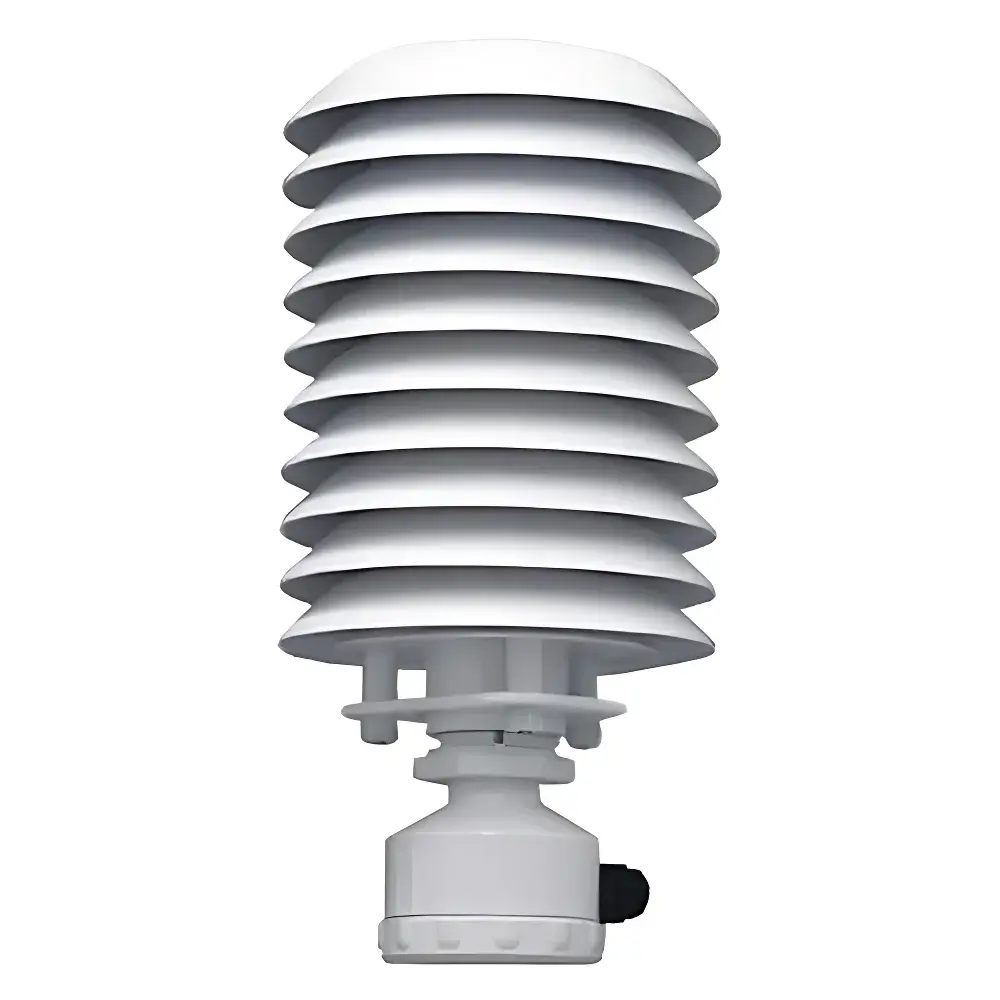
R.M. Young 41003 Multi-Layer Radiation Shield for Temperature and Relative Humidity Sensors
| Brand | R.M. Young |
|---|---|
| Origin | USA |
| Model | 41003 |
| Dimensions | 12 cm (D) × 27 cm (H) |
| Weight (net) | 0.7 kg |
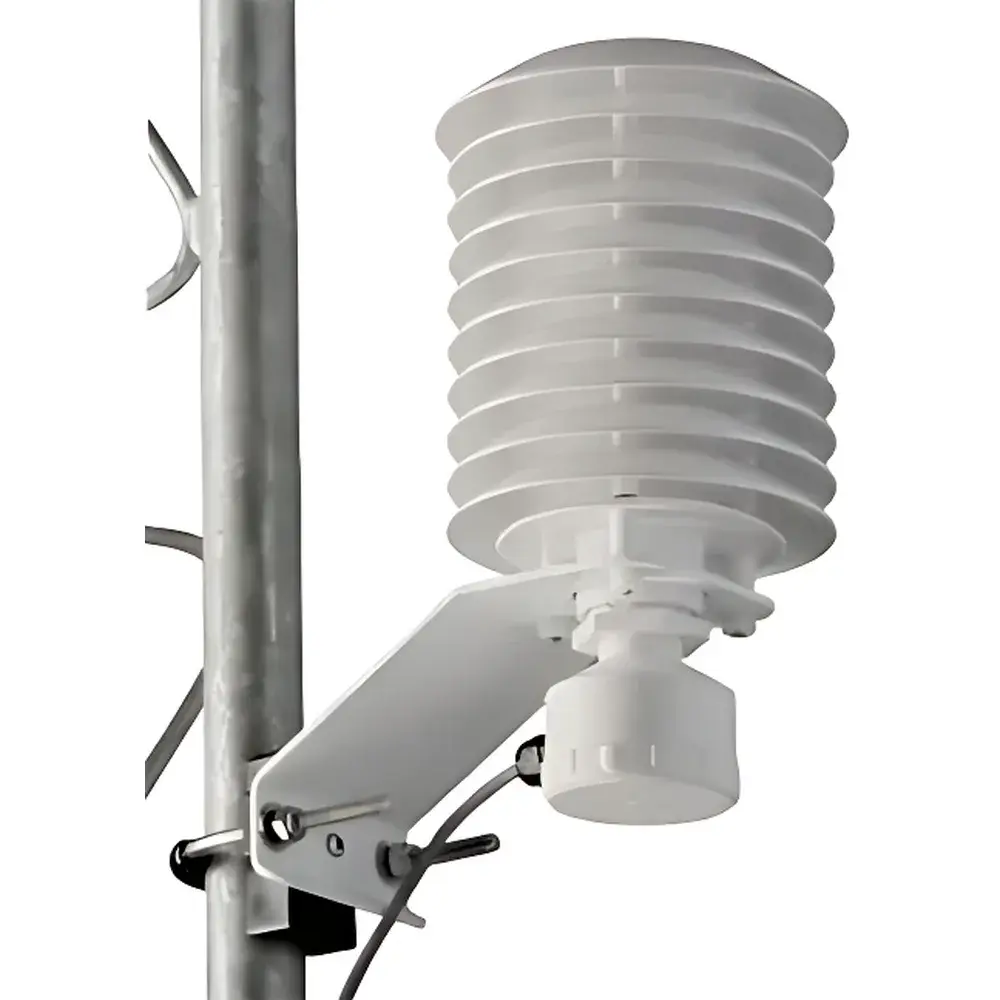
| Mounting | U-bolt clamp for masts up to 2 inches (50.8 mm) diameter |
| Sensor compatibility | 41003 — up to 16 mm diameter |
| Radiative error (at 1080 W/m² solar irradiance) | ≤0.4 °C RMS @ 3 m/s wind speed |
| Housing material | UV-stabilized white thermoplastic with high-reflectivity, low-thermal-conductivity disk |
| Compliance | Designed per WMO Guide to Meteorological Instruments and Methods of Observation (CIMO Guide), ISO 4690:2022 (Environmental monitoring — Performance requirements for radiation shields), ASTM D7237-21 (Standard Practice for Evaluation of Radiation Shields for Air Temperature Sensors) |
Overview
The R.M. Young 41003 Multi-Layer Radiation Shield is an engineered passive thermal management solution designed specifically for outdoor deployment of temperature and relative humidity sensors in meteorological, environmental, and industrial monitoring applications. Unlike single-plate or aspirated shields, the 41003 employs a patented multi-tiered, non-rotating concentric disk architecture that minimizes radiative heating error through geometric shadowing, spectral reflectance optimization, and natural convective ventilation. Its operational principle relies on maximizing longwave and shortwave radiation rejection while sustaining laminar airflow across the sensor surface—critical for achieving traceable air temperature measurements under high solar load (up to 1080 W/m²) and variable wind conditions (1–3 m/s). The shield conforms to internationally recognized performance benchmarks defined in the World Meteorological Organization (WMO) CIMO Guide and ISO 4690:2022, ensuring data integrity for networks requiring compliance with climate reference standards or regulatory-grade environmental reporting.
Key Features
- Multi-layer reflective disk stack with precision-machined spacing to suppress direct and diffuse solar radiation without impeding airflow
- UV-stabilized white thermoplastic housing with high-albedo coating (≥0.85 solar reflectance) and low thermal conductivity (≤0.25 W/m·K) to minimize conductive heat transfer
- Integrated aluminum support frame with molded V-groove plastic liners and stainless-steel U-bolt clamping system—compatible with mast diameters from 25 mm to 50 mm (1″ to 2″)
- Modular sensor adapter system: Standard 41003 accommodates sensors up to 16 mm diameter; 41003P variant supports 16–26 mm sensors with user-specified bore size at time of order
- Compact form factor (12 cm × 27 cm) and lightweight construction (0.7 kg net) enable rapid installation on towers, rooftops, buoys, and mobile platforms without structural reinforcement
- Passive design eliminates power requirements, moving parts, or calibration drift associated with fan-aspirated systems
Sample Compatibility & Compliance
The 41003 is validated for use with R.M. Young’s certified environmental sensors—including the 41342 precision temperature probe and the 41382 combined temperature/humidity transducer—as well as third-party sensors meeting IEC 60751 Class A Pt100 or ISO 11462-1 RH response profiles. Its geometry satisfies the WMO-recommended minimum clearance distances between shield surfaces and sensor elements to prevent boundary layer stagnation. All materials comply with UL 94 HB flammability rating and ASTM G154 accelerated UV exposure testing (1,000 hrs QUV cycle). The assembly meets CE marking requirements for electromagnetic compatibility (EN 61326-1) and environmental stress resistance (IEC 60068-2 series), supporting deployment in GLP-compliant field laboratories and EPA-approved ambient air quality monitoring stations.
Software & Data Management
As a purely mechanical shielding component, the 41003 requires no embedded firmware, driver software, or configuration utilities. It integrates transparently into existing data acquisition ecosystems—including Campbell Scientific CR-series loggers, Onset HOBO UX120 systems, and custom SCADA architectures—by preserving native sensor output signal integrity (e.g., 4–20 mA, 0–5 V, or digital RS-485 Modbus RTU). When deployed in networks governed by FDA 21 CFR Part 11 or ISO/IEC 17025, the shield’s passive nature eliminates electronic audit trail dependencies; however, its serial-numbered mounting hardware supports full traceability in instrument calibration records and metrological chain-of-custody documentation.
Applications
- Surface meteorological networks (ASOS, AWOS, and mesonet installations) requiring WMO-class air temperature accuracy
- Long-term climate observation sites adhering to GCOS Reference Upper-Air Network (GRUAN) or Baseline Surface Radiation Network (BSRN) protocols
- Industrial stack emission monitoring where sensor thermal lag must be minimized under solar loading
- Agricultural microclimate stations measuring canopy-level temperature and humidity gradients
- Urban heat island studies utilizing dense low-cost sensor arrays with consistent radiative error correction
- Calibration validation labs performing intercomparison tests between aspirated and passive shielding methodologies
FAQ
What is the maximum sensor diameter supported by the standard 41003 model?
The base 41003 configuration accepts sensors with outer diameters up to 16 mm using its universal spring-loaded clamp adapter.
How does wind speed affect measurement uncertainty when using this shield?
Radiative error is inversely proportional to wind velocity: ≤0.4 °C RMS at 3 m/s, ≤0.7 °C RMS at 2 m/s, and ≤1.5 °C RMS at 1 m/s—values derived from empirical wind tunnel testing per ISO 4690 Annex B.
Can the 41003 be mounted on non-circular masts such as square tubing or tripods?
Yes—the stainless-steel U-bolt clamp includes adjustable nylon-faced pressure pads that conform to flat, curved, or irregular cross-sections up to 50 mm equivalent diameter.
Is the 41003 compatible with heated or aspirated sensors?
It is not recommended for use with active-heated probes, as internal heat generation may disrupt natural convection flow; however, it may be used downstream of aspirated inlets provided the airflow path remains unobstructed and sensor placement avoids recirculation zones.
Does the shield require periodic cleaning or maintenance?
Annual visual inspection and gentle wiping with isopropyl alcohol are sufficient to maintain reflectance; no recoating or replacement parts are specified within the 10-year service life under typical outdoor exposure.