
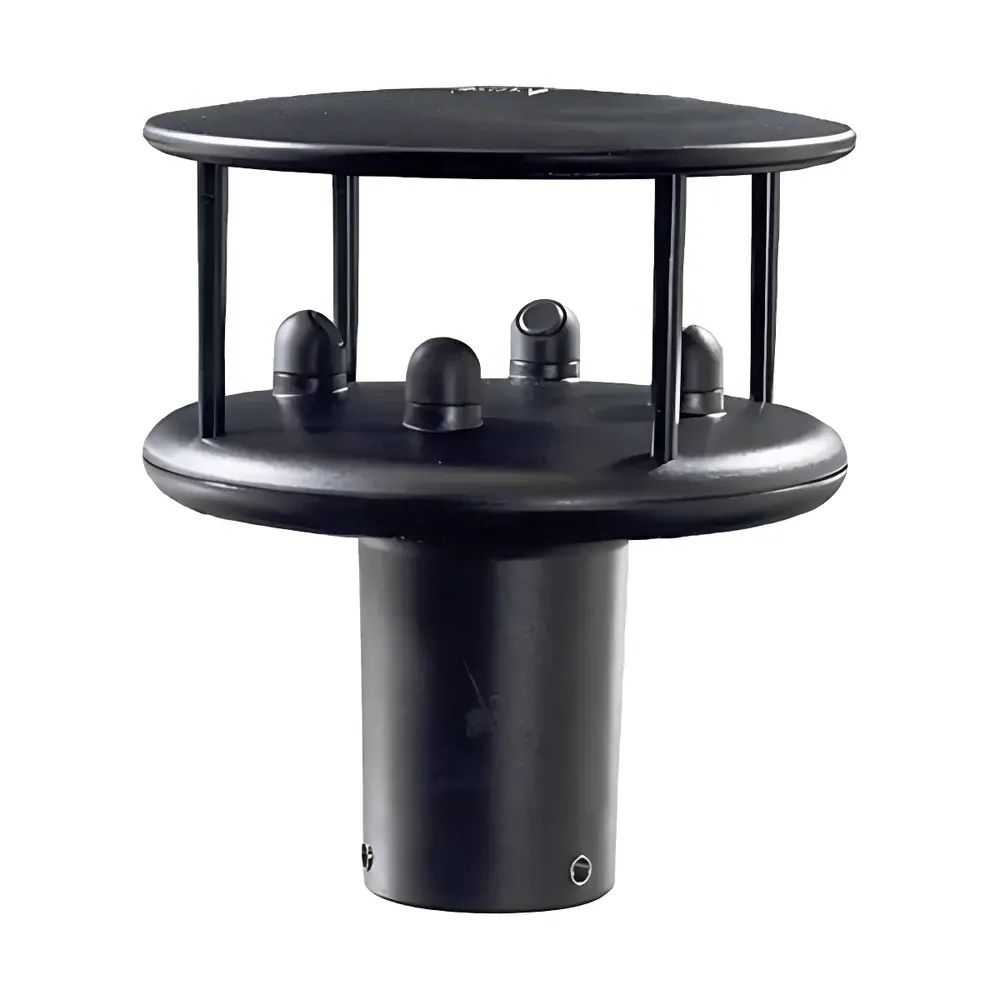
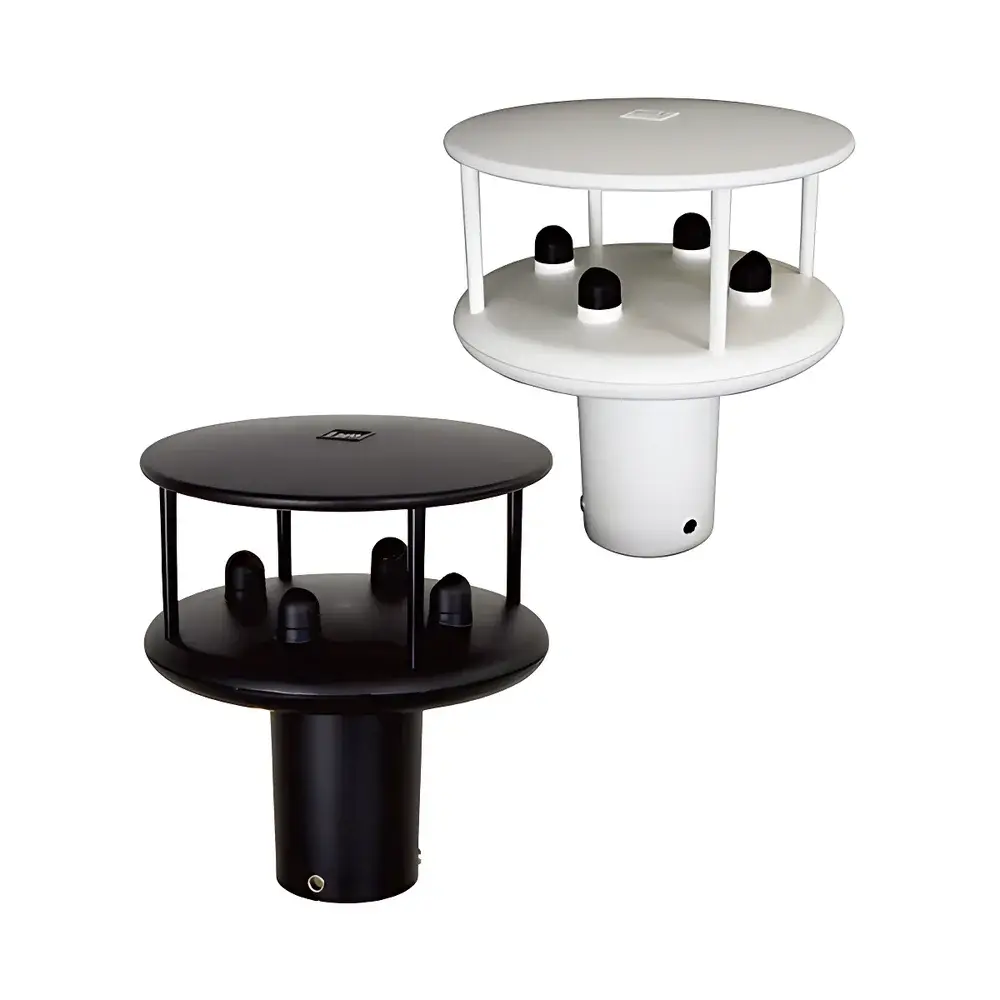
Gill WindSonic 75 Ultrasonic Anemometer
| Brand | Gill |
|---|---|
| Origin | United Kingdom |
| Model | WindSonic 75 |
| Instrument Type | Ultrasonic Anemometer |
| Resolution | 0.01 m/s |
| Measurement Range | 0–75 m/s |
| Accuracy | ±2% of reading |
| Operating Temperature | −40 °C to +70 °C |
| Operating Humidity | 0–100% RH |
| Output Options | RS-232/RS-485 serial, dual analog (4–20 mA or 0–5 V), NMEA 0183 compliant |
Overview
The Gill WindSonic 75 Ultrasonic Anemometer is a solid-state, two-dimensional ultrasonic wind sensor engineered for continuous, high-reliability measurement of horizontal wind speed and direction in demanding environmental monitoring applications. Unlike mechanical cup-and-vane anemometers, the WindSonic 75 employs time-of-flight ultrasonic transit-time differential measurement across two orthogonal acoustic paths. By precisely calculating the time difference between transmitted and received ultrasonic pulses along perpendicular axes, the instrument determines both wind speed (magnitude) and wind direction (azimuth) without moving parts—eliminating mechanical wear, inertia lag, and directional dead zones. This principle ensures stable zero-offset performance, rapid response to transient gusts (< 1 s time constant), and immunity to icing or salt accumulation under marine exposure. Designed and manufactured in the UK, the WindSonic 75 meets the operational requirements of long-term unattended deployment in coastal, offshore, and industrial environments where maintenance access is constrained.
Key Features
- Solid-state ultrasonic sensing architecture with no rotating or pivoting components—enabling true maintenance-free operation over extended service intervals
- Compact, lightweight housing constructed from UV-stabilized, corrosion-resistant polycarbonate—certified for continuous outdoor exposure per IEC 60529 IP66
- Dual-output flexibility: configurable RS-232/RS-485 serial interface (NMEA 0183 v3.01 compliant) and two isolated analog outputs (4–20 mA or 0–5 V, user-selectable per channel)
- Integrated status reporting: each data packet includes a diagnostic status byte indicating transducer health, signal quality, temperature validity, and internal error flags
- Low power consumption: typical operating current < 25 mA at 12 V DC—suitable for solar-battery telemetry systems and remote wireless nodes
- Fast wake-up time (< 2 s) and stable output within 5 s of power-on—critical for mobile or event-triggered deployments
- Calibrated wind speed range: 0–75 m/s (0–146 knots) with 0.01 m/s resolution; wind direction range: 0–360° with 1° resolution
Sample Compatibility & Compliance
The WindSonic 75 is designed for direct integration into fixed and mobile environmental monitoring platforms—including meteorological masts, offshore buoys, vessel decks, tunnel portals, airport perimeter stations, and mobile survey vehicles. Its ruggedized enclosure and wide thermal operating envelope (−40 °C to +70 °C) support deployment across Arctic, desert, and tropical maritime zones. The sensor complies with EN 61326-1:2013 (EMC for industrial environments), RoHS 2011/65/EU, and WEEE 2012/19/EU directives. While not certified to specific meteorological standards such as WMO Guide to Instruments and Methods of Observation (CIMO Guide) Chapter 8 Class 1 requirements, its performance characteristics align with WMO-recommended thresholds for Class 2 automated surface observation systems. Data integrity is maintained through CRC-16 checksum validation on all serial frames, supporting traceable, audit-ready field records.
Software & Data Management
The WindSonic 75 operates as a smart peripheral—requiring no embedded firmware updates or configuration software for basic operation. Configuration (e.g., output protocol selection, baud rate, analog scaling) is performed via ASCII command set over serial interface. Raw wind vector data (speed, direction, status) are timestamped by the host data logger, enabling synchronization with co-located sensors (e.g., barometric pressure, temperature, humidity). When integrated into SCADA or cloud-based environmental data platforms (e.g., ThingWorx, Ignition, or custom MQTT brokers), the device supports structured JSON payloads via optional gateway firmware. All analog outputs meet IEC 61298-1 linearity and hysteresis specifications. For regulated environments requiring electronic record integrity, the sensor’s deterministic output timing and status-coded telemetry facilitate compliance with FDA 21 CFR Part 11 principles when paired with validated data acquisition systems featuring audit trail and electronic signature capabilities.
Applications
- Offshore meteorological buoys and autonomous surface vehicles (ASVs) requiring corrosion resistance and low-power operation
- Maritime navigation systems on commercial vessels, pilot boats, and research ships
- Wind shear and microburst detection at small airports, helipads, and UAV launch sites
- Tunnel ventilation control systems—monitoring inflow/outflow velocity profiles for dynamic fan modulation
- Urban air quality networks integrating wind vector data for dispersion modeling and source attribution
- Coastal erosion and sediment transport studies requiring long-term, high-cadence wind forcing inputs
- Renewable energy site assessment—pre-construction wind resource mapping in complex terrain
- Environmental impact assessments (EIAs) for port expansion, offshore wind farm construction, and dredging operations
FAQ
Does the WindSonic 75 require periodic recalibration?
No—ultrasonic path geometry is factory-fixed and thermally compensated; calibration is traceable to NPL (UK National Physical Laboratory) standards and remains valid for the instrument’s service life under normal operating conditions.
Can it operate submerged or in heavy rain?
It is rated IP66—not submersible—but fully resistant to high-pressure water jets and persistent rainfall; condensation inside the transducer housings is mitigated by hydrophobic vent membranes.
Is lightning protection integrated?
The unit itself does not include surge suppression; external gas-discharge tube (GDT) protectors compliant with IEC 61643-21 are recommended for installations in high-isokeraunic regions.
How is wind direction ambiguity resolved near 0°/360°?
The sensor applies continuous circular interpolation using sine/cosine decomposition of orthogonal velocity components—ensuring seamless transition across the north reference boundary without step discontinuities.
What is the maximum cable length for RS-485 communication?
Up to 1,200 meters at 9,600 bps using twisted-pair shielded cable (AWG24) with proper termination resistors—verified per TIA/EIA-485-A physical layer specifications.







