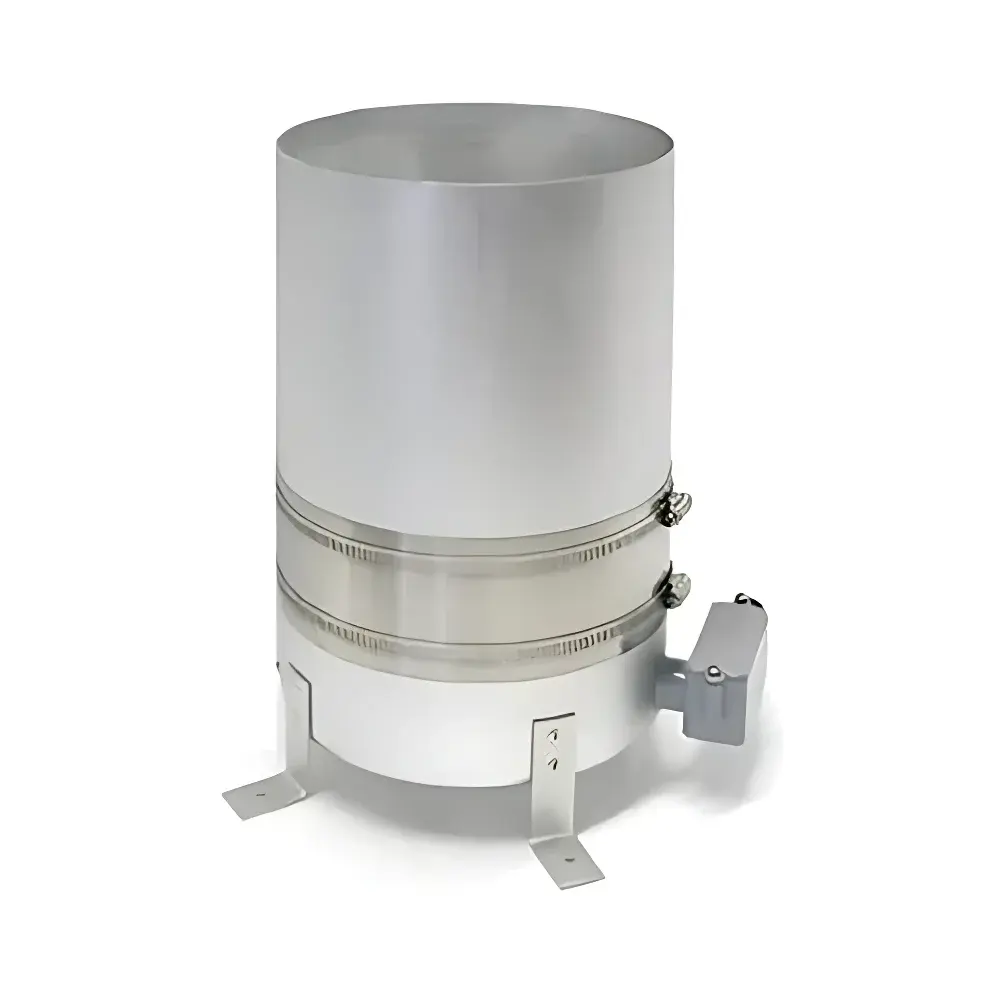
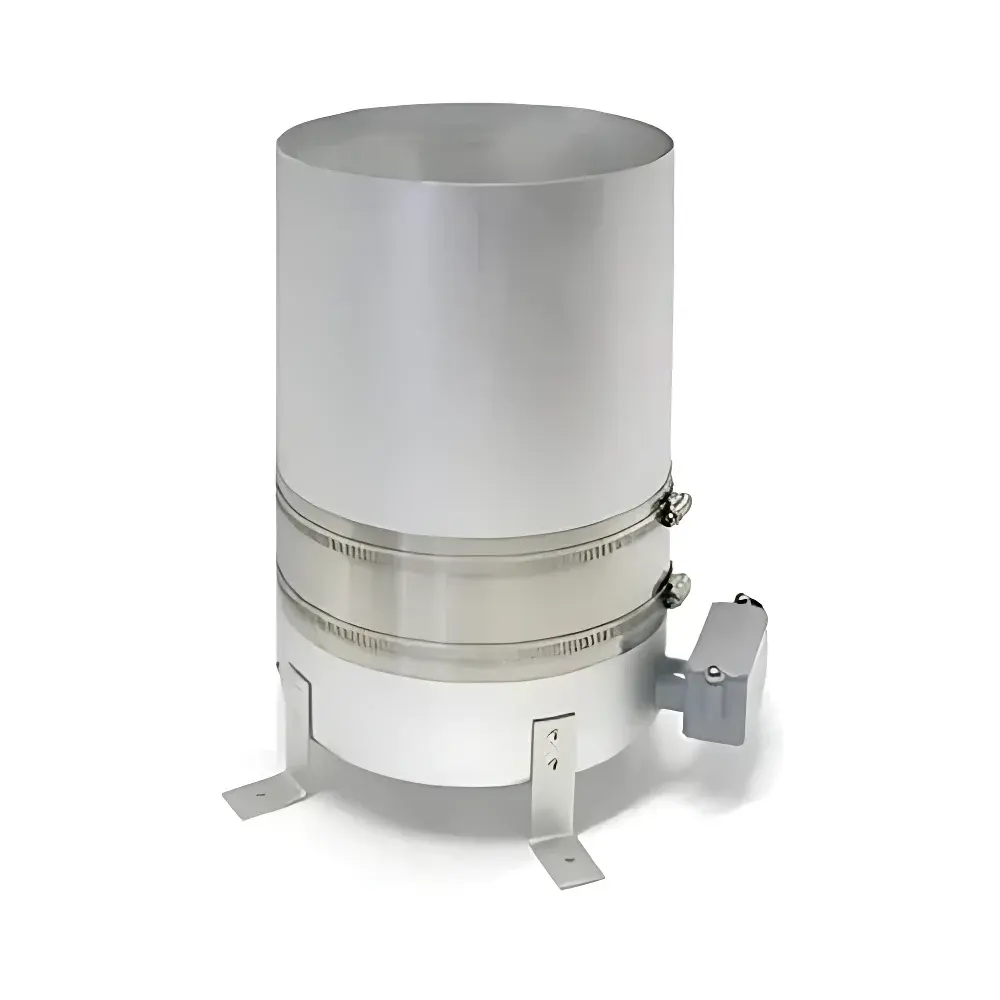
RainWise RGA Tipping Bucket Rain Gauge
| Brand | RainWise |
|---|---|
| Origin | USA |
| Model | RGA |
| Housing Material | Anodized Aluminum & Stainless Steel |
| Sensor Type | Tipping Bucket |
| Switch Mechanism | Reed Switch |
| Output Signal | Momentary Pulse (< 0.1 s duration) |
| Resolution Options | 0.25 mm, 0.2 mm, or 0.1 mm per tip |
| Accuracy | ±0.5% at 12.5 mm/h rainfall rate |
| Effective Orifice Diameter | 21.9 cm |
| Height | 31.75 mm |
| Integrated Level Indicator | Yes |
| Mounting Compatibility | RainWise Monopod Stand |
Overview
The RainWise RGA Tipping Bucket Rain Gauge is a precision-engineered meteorological sensor designed for long-term, unattended measurement of liquid precipitation in environmental monitoring, hydrological research, agricultural weather stations, and municipal climate networks. Operating on the well-established tipping bucket principle, the RGA employs a dual-chamber collector mechanism where accumulated rainfall fills one side of a balanced, low-tension plastic tipping bucket until gravitational torque triggers a symmetrical inversion—emptying the collected water and simultaneously actuating a hermetically sealed reed switch. Each tip generates a discrete, low-jitter pulse signal (< 0.1 s duration), enabling high-fidelity temporal resolution of rainfall intensity and cumulative depth. The sensor’s open-orifice design (21.9 cm diameter) conforms to WMO guidance for standard rain gauge exposure, while its anodized aluminum and stainless-steel housing ensures structural integrity, thermal stability, and resistance to UV degradation, salt spray, and atmospheric corrosion—critical for coastal, industrial, or remote deployment.
Key Features
- Robust dual-material construction: Anodized aluminum upper housing and stainless-steel base provide mechanical rigidity and long-term dimensional stability under cyclic thermal and humidity loads.
- Low-surface-tension polymer tipping bucket engineered for minimal adhesion hysteresis and consistent emptying dynamics across temperature ranges from –40 °C to +70 °C.
- Hermetically sealed reed switch with gold-plated contacts ensures >10 million operational cycles and immunity to moisture ingress or contact oxidation.
- Integrated bubble level indicator enables rapid field alignment without external tools—essential for minimizing wind-induced undercatch errors.
- Modular mounting interface compatible with RainWise Monopod stands and industry-standard 1″ NPT or 3/4″ threaded mast adapters.
- User-selectable resolution options (0.1 mm, 0.2 mm, or 0.25 mm per tip) allow optimization for local climatology and data logger input requirements.
Sample Compatibility & Compliance
The RGA is calibrated and validated for liquid precipitation only; it does not measure snow, sleet, or freezing rain without auxiliary heating or wind-shield integration. Its physical dimensions and orifice geometry align with ISO 9468:1991 (Rain Gauges — Specifications and Testing Methods) and ASTM D7349-21 (Standard Practice for Installation and Maintenance of Precipitation Gauges). While the sensor itself does not carry CE or FCC certification as a standalone component, it complies with EMC Class B emission limits when integrated into certified weather station systems. Data generated by the RGA satisfies minimum reporting criteria for NOAA COOP, USGS NWIS, and EEA AirBase networks when deployed per WMO No. 8 guidelines on siting and exposure.
Software & Data Management
The RGA outputs TTL-compatible, dry-contact closure pulses—making it interoperable with virtually all industrial data loggers (e.g., Campbell Scientific CR series, Onset HOBO, Delta-T DL2e) and SCADA platforms. RainWise-provided configuration utilities support pulse-to-depth mapping, event-based logging thresholds, and diagnostic self-test routines. When paired with compliant data acquisition firmware (e.g., LoggerNet v5.0+ or HOBOware Pro), the system supports audit-trail-enabled timestamping, error-flagged record rejection, and export to CSV/NetCDF formats suitable for QA/QC workflows under ISO/IEC 17025-accredited laboratories. No proprietary drivers or cloud dependencies are required for raw pulse ingestion.
Applications
- Real-time flood forecasting in urban catchments and river basins via integration with telemetry gateways.
- Calibration reference for radar-derived quantitative precipitation estimates (QPE) in mesoscale model validation.
- Long-term trend analysis in climate observatories requiring traceable, maintenance-light instrumentation.
- Irrigation scheduling support in precision agriculture networks using sub-hourly intensity metrics.
- Regulatory compliance monitoring for stormwater management plans (e.g., EPA NPDES Phase II requirements).
- Education and outreach programs where mechanical transparency and reliability reinforce core hydrometeorological concepts.
FAQ
What is the recommended cleaning interval for the RGA under typical rural deployment conditions?
Under low-dust, non-industrial environments, visual inspection every 6 months and gentle rinse with deionized water is sufficient. In high-pollen or coastal settings, quarterly cleaning with soft brush and mild detergent is advised.
Can the RGA be used with heated enclosures to extend functionality to winter precipitation?
Yes—the RGA’s passive mechanical design allows safe integration with externally powered heating elements (e.g., 12 VDC resistive bands), provided thermal gradients across the orifice remain below 5 K to avoid convective distortion.
Does the reed switch require periodic recalibration?
No. The reed switch is a solid-state, wear-free component with no drift over time; calibration pertains solely to the mechanical tipping threshold and is factory-set per resolution option.
Is the 0.1 mm resolution option suitable for high-intensity tropical rainfall events?
Yes—while resolution defines minimum detectable increment, the RGA’s mechanical response time (< 1.2 s between successive tips at 100 mm/h) maintains fidelity up to 150 mm/h under controlled wind-shielded conditions.
How does the RGA handle wind-induced undercatch compared to weighing gauges?
Like all orifice-type gauges, the RGA exhibits measurable undercatch at wind speeds > 5 m/s; mitigation requires co-location with a double-fence intercomparison (DFIR) shield or correction algorithms derived from local wind profile measurements.