
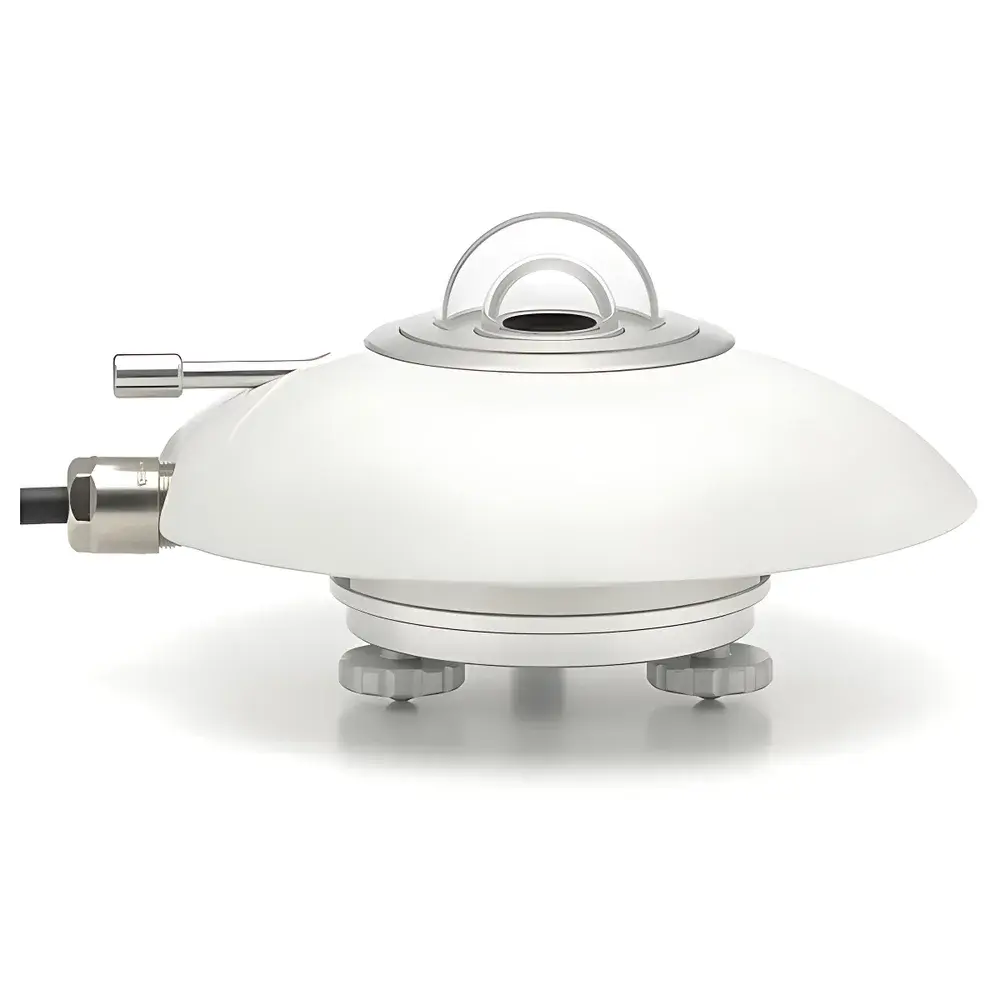
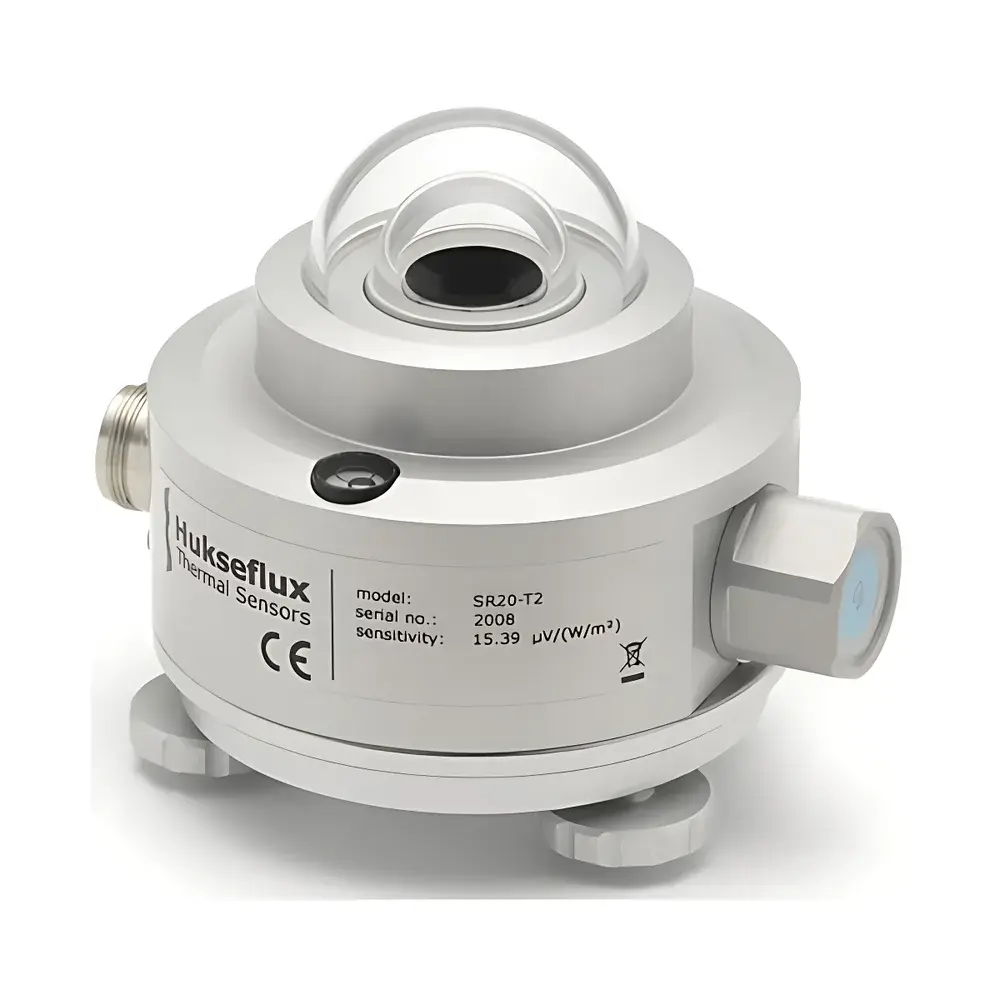
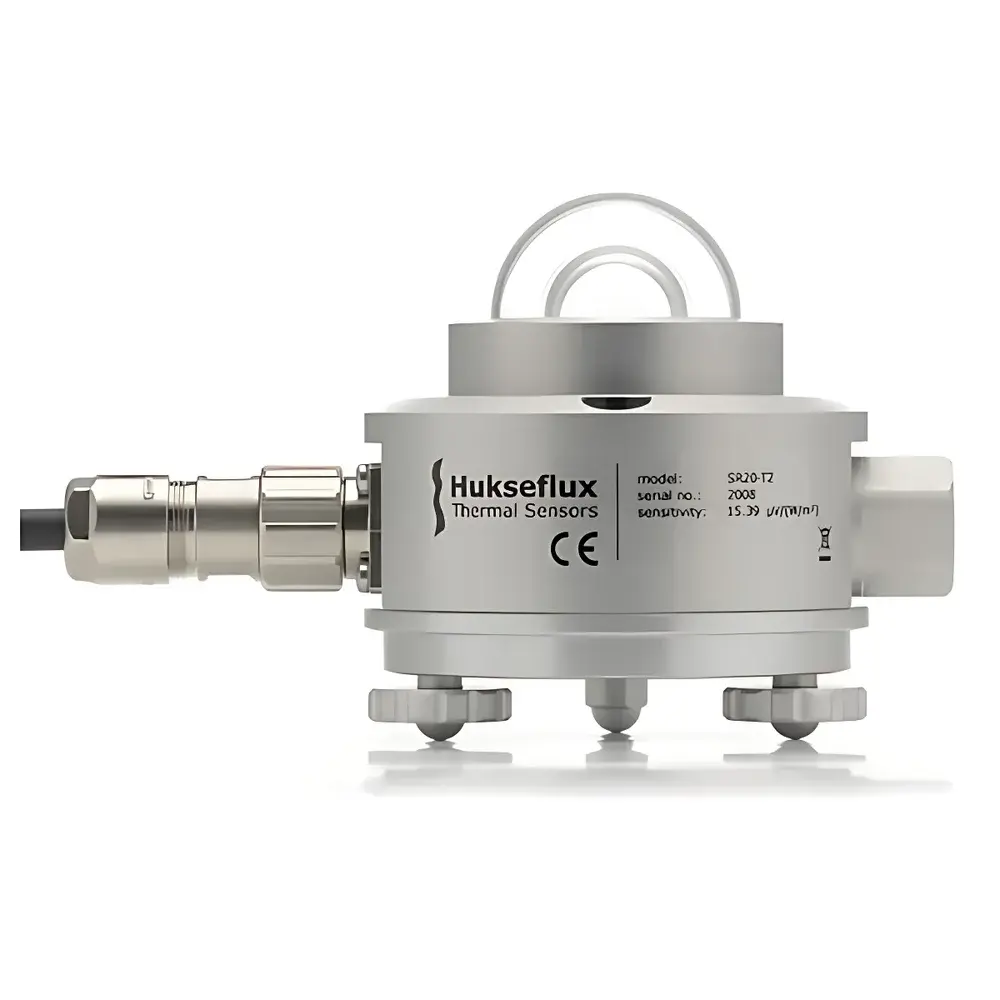
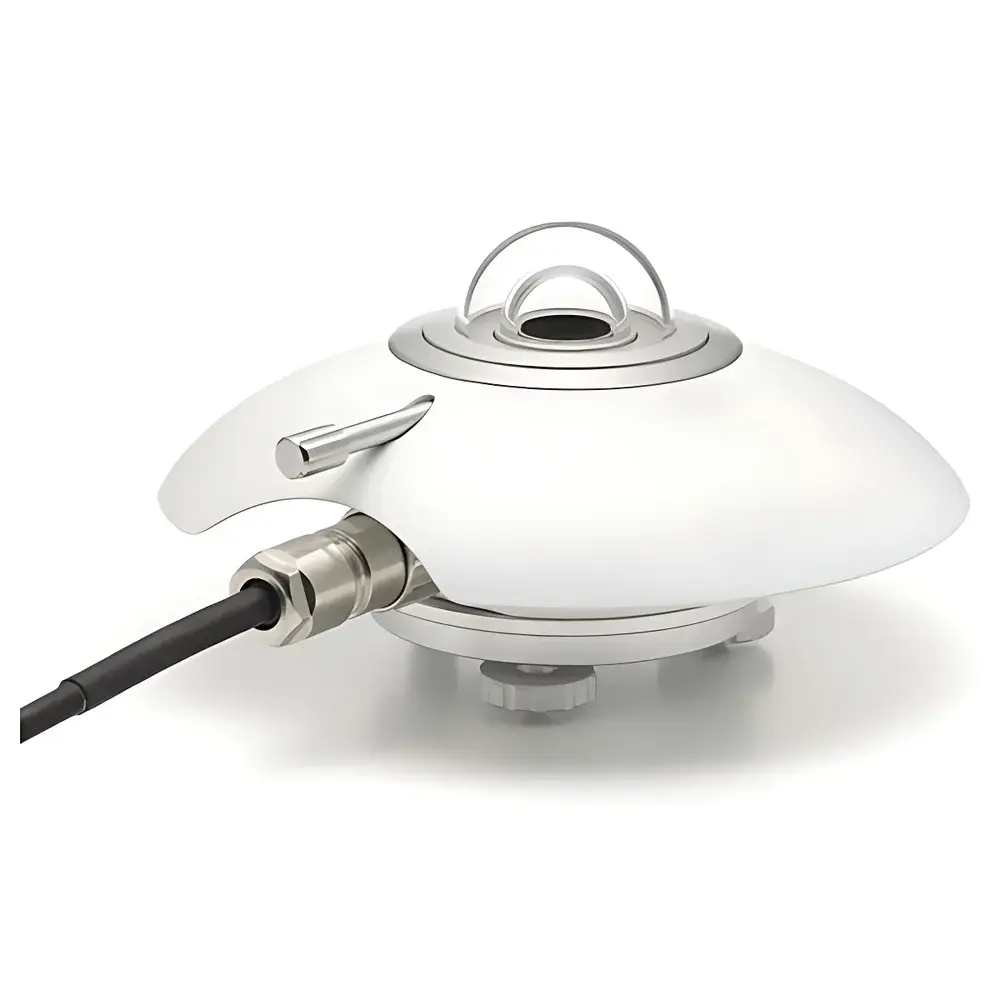
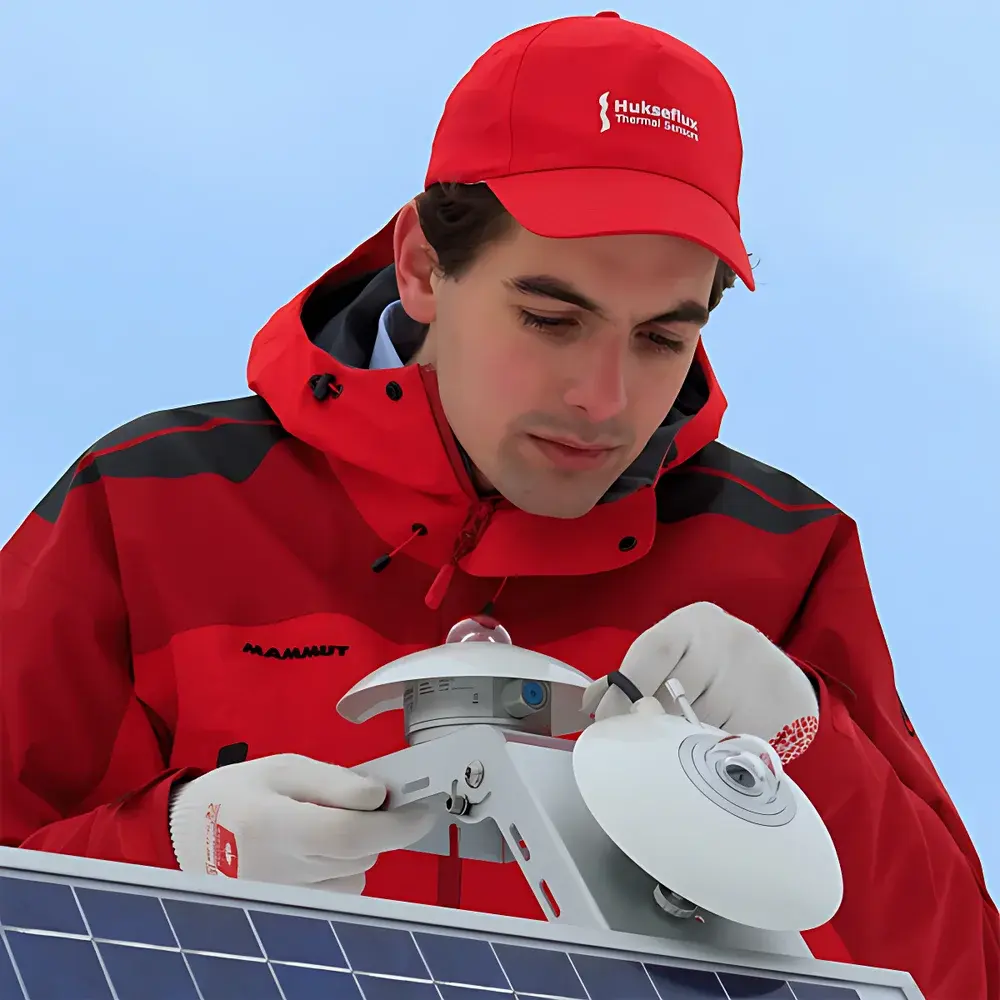
Hukseflux SR20 Secondary Standard Pyranometer
| Brand | Hukseflux |
|---|---|
| Origin | Netherlands |
| Model | SR20 |
| Calibration Traceability | World Radiometric Reference (WRR) |
| ISO 9060 | 2018 Classification: Secondary Standard |
| Measurement Range | 0–4000 W/m² |
| Spectral Range | 285–3000 nm |
| Sensitivity | 15 × 10⁻⁶ V/(W/m²) |
| Calibration Uncertainty | < 1.2 % (k = 2) |
| Zero Offset (a) | < 5 W/m² (unventilated), 2.5 W/m² (with VU01 ventilation unit) |
| Operating Temperature | −40 to +80 °C |
| Temperature Response | < ±1 % (−10 to +40 °C) |
| Directional Response Report | Included |
| Temperature Dependence Characterization | Individual quadratic polynomial provided per unit |
| Heating Power | 1.5 W @ 12 VDC |
| Output Signal | Analog voltage (mV) |
| Supply Voltage | 8–30 VDC |
| Integrated Temperature Sensor | Pt100 or 10 kΩ thermistor |
| Cable Length | 5 m (extendable in 5-m increments) |
Overview
The Hukseflux SR20 Secondary Standard Pyranometer is a high-accuracy, thermopile-based solar irradiance sensor engineered for applications demanding metrological rigor and long-term stability. Designed and manufactured in the Netherlands, the SR20 complies fully with ISO 9060:2018 classification requirements for secondary standard pyranometers—representing the highest tier of performance available outside primary reference instruments maintained at world radiometric laboratories. Its measurement principle relies on a blackened thermopile detector housed under two precision-ground, spectrally neutral quartz domes, enabling broadband hemispherical detection of global horizontal irradiance (GHI) across the full solar spectrum (285–3000 nm). The instrument delivers an analog voltage output proportional to incident irradiance (15 µV per W/m²), with a nominal range of 0–4000 W/m²—sufficient to capture peak insolation even under high-albedo or desert conditions.
Key Features
- ISO 9060:2018 secondary standard classification—validated through independent intercomparisons and traceable calibration against the World Radiometric Reference (WRR).
- Calibration uncertainty reduced to <1.2 % (k = 2), representing a 15 % improvement over typical industry benchmarks for secondary-class instruments.
- Exceptionally low thermal offset (zero offset “a”): <5 W/m² without ventilation; further reduced to 2.5 W/m² when paired with the optional VU01 active ventilation unit—significantly outperforming conventional specifications (typically 12 W/m² unventilated, 7 W/m² ventilated).
- Individually characterized temperature dependence: Each SR20 unit undergoes full thermal testing from −40 °C to +80 °C, and a unique second-order polynomial correction function is supplied to enable post-processing compensation for temperature-induced drift.
- Integrated PTC heater (1.5 W @ 12 VDC) minimizes dew and frost formation on the upper dome during early-morning or high-humidity operation—critical for maintaining data continuity in automated weather stations and PV monitoring systems.
- Robust mechanical design with stainless-steel housing, IP67-rated enclosure, and dual quartz domes optimized for minimal spectral distortion and long-term transmission stability.
Sample Compatibility & Compliance
The SR20 is compatible with standard meteorological data loggers supporting differential voltage input (e.g., Campbell Scientific CR series, Delta-T DL6, Onset HOBO RX3000) and requires no external signal conditioning. It meets IEC 61724-1:2021 requirements for PV system performance monitoring and is widely deployed in BSRN (Baseline Surface Radiation Network) and GCOS (Global Climate Observing System) sites. All calibrations are performed at the Physikalisch-Meteorologisches Observatorium Davos / World Radiation Center (PMOD/WRC) and documented with full uncertainty budgets per the Guide to the Expression of Uncertainty in Measurement (GUM, JCGM 100:2008). The instrument supports GLP-compliant data acquisition workflows when used with compliant logging hardware and metadata documentation practices.
Software & Data Management
Hukseflux provides a dedicated uncertainty evaluation spreadsheet (Excel-based) aligned with GUM methodology, enabling users to quantify total measurement uncertainty under specific site conditions—including combined effects of calibration, zero offset, temperature response, tilt error, and directional response. No proprietary software is required for basic operation; however, Hukseflux’s free PyraSoft utility (Windows) assists in configuration, real-time diagnostics, and validation of temperature compensation coefficients. Raw output is fully compatible with common environmental data platforms (e.g., PVsyst, Solargis, Meteodyn WT) and supports integration into SCADA and cloud-based monitoring systems via Modbus RTU (when used with optional interface modules).
Applications
- High-fidelity photovoltaic (PV) power plant performance ratio (PR) analysis and yield assessment in accordance with IEC 61724-1 Class A requirements.
- Reference-grade radiation measurements in national meteorological networks, climate research observatories, and satellite validation campaigns.
- Benchmarking and intercomparison studies—frequently employed as a transfer standard between primary laboratories and field-deployed sensor networks.
- Long-term solar resource assessment in extreme environments: validated operational performance from Arctic tundra (−40 °C) to Saharan deserts (+65 °C ambient with surface heating).
- Calibration facility support—used for in-situ verification of working standards prior to field deployment.
FAQ
Is the SR20 suitable for use in unventilated installations?
Yes—the SR20 maintains <5 W/m² zero offset “a” without ventilation, making it viable for low-maintenance deployments. However, for highest accuracy in variable or humid climates, pairing with the VU01 ventilation unit is recommended to reduce offset to 2.5 W/m² and suppress convective errors.
Does the SR20 require periodic recalibration?
Per ISO 9060:2018 and IEC 61724-1, secondary standard pyranometers should be recalibrated every two years under normal outdoor exposure. Hukseflux recommends scheduled recalibration at PMOD/WRC or an accredited laboratory using WRR-traceable procedures.
Can the temperature compensation polynomial be applied in real time?
The quadratic polynomial is intended for post-processing, but can be implemented in real time on capable data loggers (e.g., Campbell CR6 with user-defined math functions) when the integrated Pt100 or thermistor output is simultaneously recorded.
What mounting options are compatible with the SR20?
The SR20 uses a standard 1/4″-20 UNC threaded base and is designed for use with passive leveling mounts, solar trackers (e.g., Solys 2), or fixed-tilt brackets meeting ISO 9060:2018 alignment tolerances (±0.5° level, ±1° azimuth).
Is the 5-meter cable shielded and suitable for industrial EMI environments?
Yes—the standard cable is twisted-pair, foil-shielded, and jacketed for outdoor use (IP67-rated connector). For high-EMI settings (e.g., near inverters or switchgear), Hukseflux recommends specifying the optional double-shielded variant or installing ferrite chokes at the logger end.







