
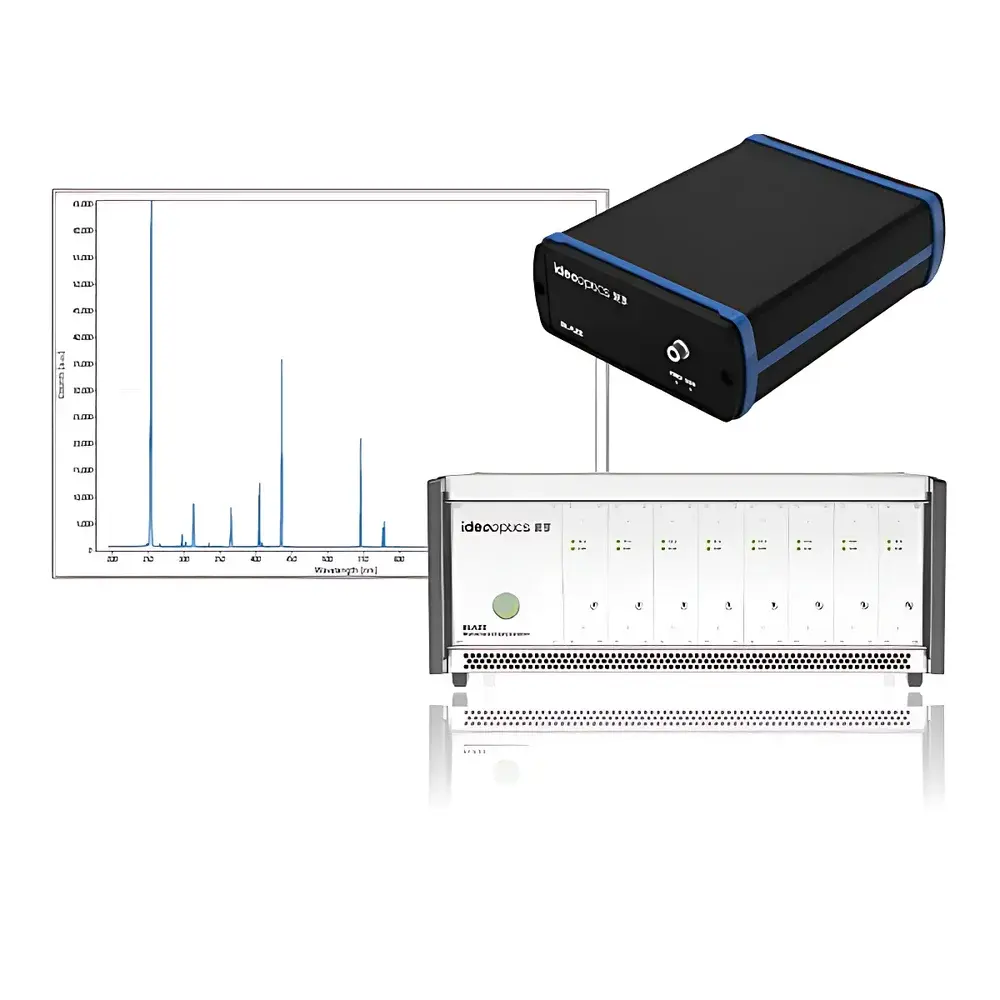
IdeaOptics BLAZE Plasma Optical Emission Spectrometer
| Brand | IdeaOptics |
|---|---|
| Origin | Shanghai, China |
| Manufacturer Type | Original Equipment Manufacturer (OEM) |
| Product Origin | Domestic (China) |
| Model | BLAZE |
| Spectral Range | 200–1100 nm |
| Resolution | Up to 0.06 nm (with 3600 l/mm grating) |
| Signal-to-Noise Ratio | 400:1 (at saturation) |
| Dynamic Range | 4500:1 |
| Stray Light | 0.05–1% (grating-dependent) |
| Minimum Integration Time | 9 µs |
| Trigger Delay | <1 µs |
| Trigger Jitter | <1 ns |
| Wavelength Drift | ≤0.05 pixel/°C (20–40 °C operating range) |
| Data Throughput | up to 2000 spectra/s (buffered mode) |
| Interface | Gigabit Ethernet |
Overview
The IdeaOptics BLAZE Plasma Optical Emission Spectrometer is a high-performance, fiber-coupled spectrometer engineered for time-resolved atomic emission spectroscopy in laser-induced breakdown spectroscopy (LIBS), spark discharge analysis, and plasma diagnostics. It operates on the principle of optical emission spectroscopy (OES), where transient plasma emissions—generated by pulsed laser ablation or electrical discharge—are dispersed via a high-line-density Czerny-Turner optical bench and resolved by a back-illuminated scientific CMOS detector. The system delivers sub-nanometer spectral resolution and nanosecond-scale temporal gating capability, enabling selective acquisition of atomic line emissions during the optimal decay window (e.g., ~1 µs post-plasma initiation), while suppressing broadband continuum radiation from early plasma expansion. This temporal discrimination is critical for enhancing elemental selectivity, improving signal-to-noise ratio (SNR), and achieving reliable quantification of trace elements in heterogeneous solid, liquid, or gaseous matrices.
Key Features
- High-Resolution Optical Platform: Features a 72.5 mm focal length Czerny-Turner monochromator with selectable 3600 l/mm holographic gratings, supporting spectral resolution down to 0.06 nm (FWHM) across the 200–1100 nm range—enabling clear separation of adjacent atomic lines such as Fe I 238.204 nm / Mn I 238.213 nm.
- Nanosecond-Level Temporal Gating: Powered by SuperEngine™ timing architecture, the BLAZE offers minimum integration time of 9 µs, trigger delay <1 µs, and jitter <1 ns—allowing precise synchronization with Q-switched lasers or spark generators to isolate atomic line emission windows and reject early-stage continuum background.
- Thermal Stability for Field Deployment: Incorporates HeatResist™ passive thermal management, ensuring wavelength stability ≤0.05 pixel/°C over 20–40 °C ambient operation—critical for long-term calibration retention in industrial process monitoring or mobile LIBS systems.
- Gigabit Ethernet Interface: Supports deterministic, low-latency communication with real-time data streaming and buffered acquisition at up to 2000 spectra per second—compatible with PLC-triggered automation, distributed sensor networks, and ISO/IEC 17025-compliant laboratory data acquisition workflows.
- Modular Multi-Channel Architecture: Designed for parallel spectral acquisition; multiple BLAZE units can be synchronized via TTL/trigger bus for extended spectral coverage or multi-point plasma sampling without spectral stitching artifacts.
Sample Compatibility & Compliance
The BLAZE spectrometer is compatible with standard SMA905 fiber inputs (core diameters 50–400 µm) and supports direct coupling to ICCD-free LIBS probes, arc/spark sources, and inductively coupled plasma (ICP) torches. Its UV-VIS-NIR spectral response (200–1100 nm) covers key analytical lines for C, Si, Mn, Cr, Ni, Al, Mg, Ca, Na, K, and heavy metals (e.g., Pb 405.78 nm, Cd 228.80 nm). The instrument meets mechanical and electromagnetic compatibility requirements per IEC 61326-1:2013 for industrial measurement equipment. While not certified for medical device use, its hardware design supports configuration within GLP/GMP environments when integrated into validated analytical platforms compliant with FDA 21 CFR Part 11 (audit trail, electronic signature, and data integrity controls implemented at system software level).
Software & Data Management
The BLAZE is controlled via IdeaOptics’ SpectraStudio™ SDK (C/C++, Python, MATLAB APIs) and GUI application, supporting full parameter scripting, real-time spectral preview, dark/baseline correction, peak fitting (Gaussian-Lorentzian deconvolution), and multivariate calibration (PLS, PCA). Raw spectral data are stored in HDF5 format with embedded metadata (wavelength calibration, integration time, temperature, trigger timestamp), ensuring FAIR (Findable, Accessible, Interoperable, Reusable) data principles. Export options include CSV, ASCII, and ASTM E131-compliant spectral data files. Audit trails, user access logs, and version-controlled method files are available under enterprise license tiers aligned with ISO/IEC 17025:2017 clause 7.7 (result reporting) and clause 8.3 (control of nonconforming work).
Applications
- Coal Characterization & Combustion Diagnostics: Real-time monitoring of ash composition (Si, Al, Fe, Ca), sulfur content (S I 180.7 nm), and alkali metals (K I 766.5 nm, Na I 589.0 nm) during fluidized bed combustion—enabling dynamic furnace control and slagging prediction.
- Metallurgical QC/QA: Rapid quantitative analysis of carbon (<0.01% detection limit in steel), silicon, manganese, and phosphorus in hot metal samples using gated LIBS, eliminating need for vacuum purge or electrode preparation required by traditional spark-OES.
- Bio-Elemental Imaging: Coupled with laser ablation, enables spatially resolved mapping of Ca, Zn, Cu, and Fe distributions in tissue sections—supporting research in neurodegenerative disease biomarkers and pharmacokinetic studies under IRB-approved protocols.
- Environmental Monitoring: Field-deployable soil and sediment screening for heavy metals (Pb, Cd, As) with detection limits comparable to ICP-MS in optimized LIBS configurations (e.g., double-pulse excitation + temporal gating).
FAQ
What plasma sources is the BLAZE spectrometer compatible with?
The BLAZE accepts optical input from Nd:YAG laser-induced plasmas (1064 nm, 532 nm, 266 nm), spark discharges (DC/AC), microwave-induced plasmas (MIP), and inductively coupled plasmas (ICP) via standard 200–600 µm core optical fibers.
Does the BLAZE support NIST-traceable wavelength calibration?
Yes—factory calibration uses Hg/Ne/Ar spectral lamps per NIST SRM 2035a, with optional user-performed recalibration using built-in LED reference source and automated peak-matching algorithms.
Can the BLAZE operate unattended for extended periods in industrial settings?
Yes—the thermally stabilized optical bench, fanless enclosure, and Gigabit Ethernet interface enable 24/7 operation in ambient temperatures from 20–40 °C; mean time between failures (MTBF) exceeds 25,000 hours per IEC 62304 Class B software safety assessment.
Is spectral data export compliant with LIMS integration standards?
Yes—CSV and ASTM E131 exports include header metadata (instrument ID, timestamp, integration parameters); API-based integration with Thermo Fisher SampleManager, LabVantage, and STARLIMS is supported via RESTful endpoints and OPC UA drivers.
How does the BLAZE handle stray light in UV measurements below 250 nm?
Stray light is minimized through order-sorting filters (UV-VIS cut-on at 350 nm), dual-blazed gratings, and internal black anodized baffling; measured stray light remains ≤0.05% at 220 nm when using the dedicated UV-enhanced grating option.





