
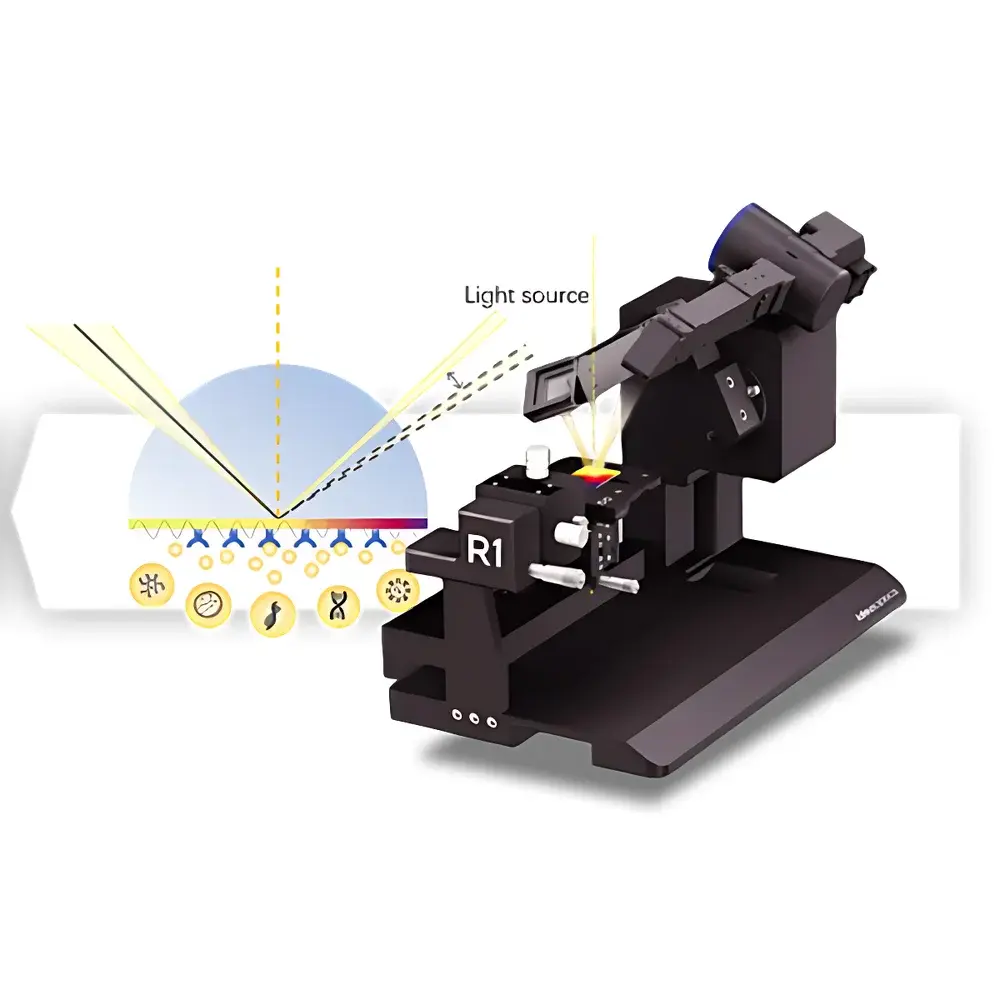
IdeaOptics R1-SPR Surface Plasmon Resonance Spectrometer
| Brand | IdeaOptics |
|---|---|
| Origin | Shanghai, China |
| Manufacturer Type | Original Equipment Manufacturer (OEM) |
| Product Origin | Domestic (China) |
| Model | R1-SPR |
| Pricing | Upon Request |
Overview
The IdeaOptics R1-SPR Surface Plasmon Resonance Spectrometer is a high-precision angular and spectral characterization system engineered for quantitative analysis of surface plasmon resonance (SPR) phenomena across multiple coupling configurations. It operates on the fundamental principle of optical excitation of collective electron oscillations at metal–dielectric interfaces, enabling label-free, real-time detection of refractive index changes induced by molecular binding events. Unlike conventional fixed-angle SPR instruments, the R1-SPR implements full 0–360° rotational control of incident light relative to the sensor surface—critical for resolving angular dispersion of resonance conditions in prism-coupled, grating-coupled, and localized SPR (LSPR) architectures. Its broad spectral coverage (220–2500 nm) supports P-polarized illumination across UV-Vis-NIR regimes, facilitating systematic investigation of resonance wavelength shifts, angular sensitivity profiles, and mode hybridization effects in nanostructured plasmonic substrates.
Key Features
- Full 0–360° continuous angular scanning capability enabled by dual high-resolution stepper motor stages with sub-0.01° positional repeatability
- Wideband P-polarized spectral acquisition from 220 nm to 2500 nm using a back-illuminated CCD array spectrometer and stabilized halogen broadband source
- Modular optical path design supporting interchangeable collimators, polarizers, and fiber-coupled input/output ports
- Integrated precision kinematic stage for alignment-critical SPR chips (e.g., gold-coated BK7 prisms, nanoimprinted gratings, colloidal nanoparticle monolayers)
- Dual-mode operation compatibility: angle-scanning mode for dispersion mapping and wavelength-scanning mode for kinetic resonance tracking
- Optional laser/LED integration port for monochromatic excitation and time-resolved angular interrogation
Sample Compatibility & Compliance
The R1-SPR accommodates standard SPR chip formats including Kretschmann-configured prism slides (76 × 26 mm), 1-inch diameter grating substrates, and glass coverslips functionalized with Au or Ag nanodisks, nanorods, or nanohole arrays. Fluidic interfacing is supported via standard 1/4″-28 UNF ports compatible with commercial microfluidic manifolds (e.g., Elveflow OB1, Fluigent MFCS). All mechanical and optical components conform to ISO 9001 manufacturing standards. Data acquisition workflows support audit-trail generation and user-access logging in accordance with GLP and GMP-aligned laboratory practices. While not certified for clinical diagnostics, the system meets general requirements for research-grade instrumentation under ISO/IEC 17025-compliant calibration traceability frameworks.
Software & Data Management
Control and analysis are performed via IdeaOptics’ proprietary SPRAssist software suite (v4.2+), which provides synchronized motor-spectrometer triggering, real-time angular-spectral heatmap visualization, and batch processing of multi-dimensional datasets. Raw data are saved in HDF5 format with embedded metadata (wavelength grid, angle timestamp, polarization state, environmental temperature/humidity if logged). The software supports export to CSV, MATLAB .mat, and Origin-compatible OPJ files. For regulated environments, optional 21 CFR Part 11 compliance modules include electronic signatures, role-based access control, and immutable audit logs for instrument parameter changes and measurement sessions.
Applications
- Characterization of novel SPR transduction mechanisms—including hybrid modes in metasurfaces, Fano resonances in asymmetric nanostructures, and coupled plasmon–phonon excitations in 2D material heterostructures
- Quantitative evaluation of sensor chip performance: angular sensitivity (dθ/dn), figure-of-merit (FOM), and bulk vs. surface refractive index resolution limits
- Kinetic analysis of biomolecular interactions (e.g., antibody–antigen, protein–DNA, receptor–ligand) under varied incidence angles to decouple mass transport limitations from intrinsic binding affinity
- Development and validation of LSPR biosensors where resonance linewidth and angular dependence inform local field enhancement and hot-spot distribution
- Calibration and cross-validation of commercial SPR platforms (e.g., Biacore, Reichert SR7500DC) using reference angular spectra and known RI standards
FAQ
What types of SPR configurations can the R1-SPR characterize?
It supports prism-coupled (Kretschmann and Otto), grating-coupled, and localized SPR (LSPR) geometries requiring variable-angle illumination and broadband spectral detection.
Is the system compatible with microfluidic flow cells?
Yes—standard fluidic interfaces allow integration with laminar-flow chambers, injection valves, and temperature-controlled sample holders for real-time binding assays.
Can the R1-SPR perform kinetic measurements?
Yes, when combined with fluidic control and time-stamped angular-spectral acquisition, it enables association/dissociation rate determination comparable to dedicated biosensing platforms.
Does the system require external calibration standards?
Factory calibration includes NIST-traceable angular encoders and spectral lamp references; users may perform routine verification using air/glass/water RI benchmarks.
Is remote operation supported?
The SPRAssist software supports TCP/IP-based network control and secure VNC access for collaborative lab environments and shared instrumentation facilities.




