
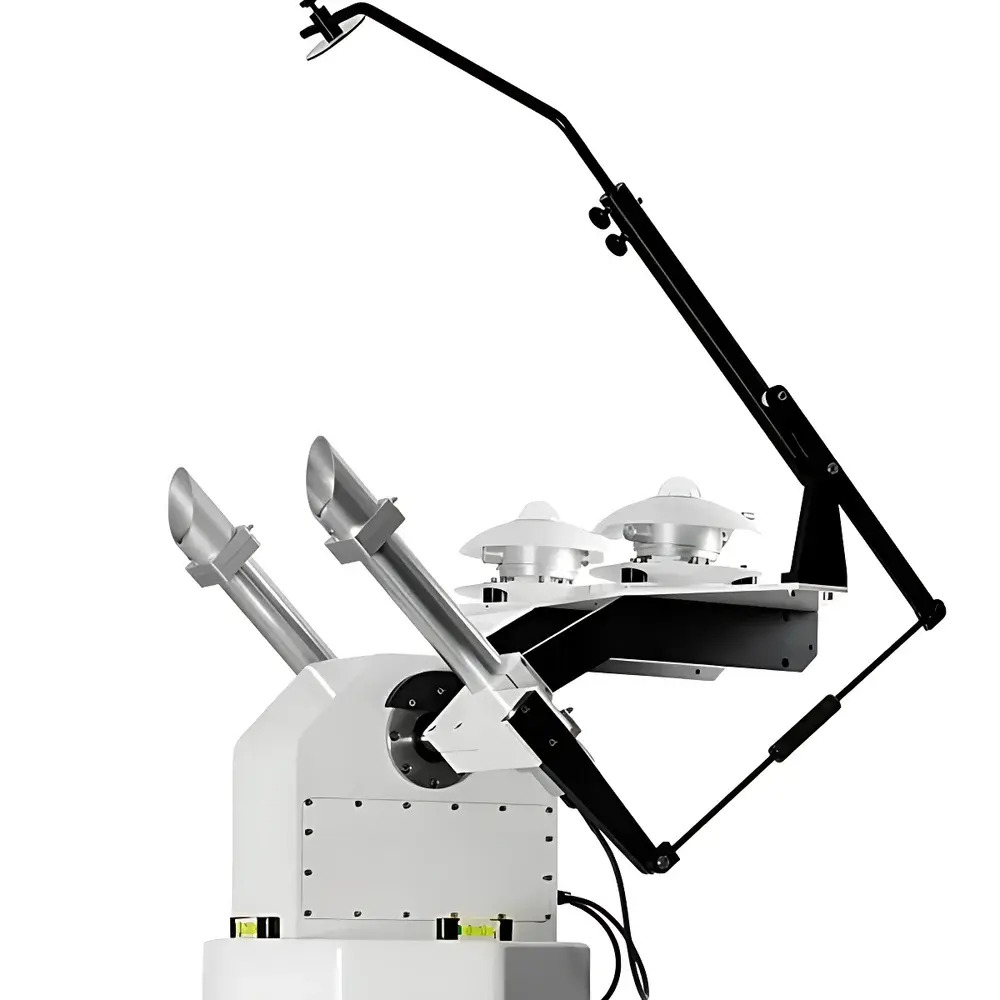
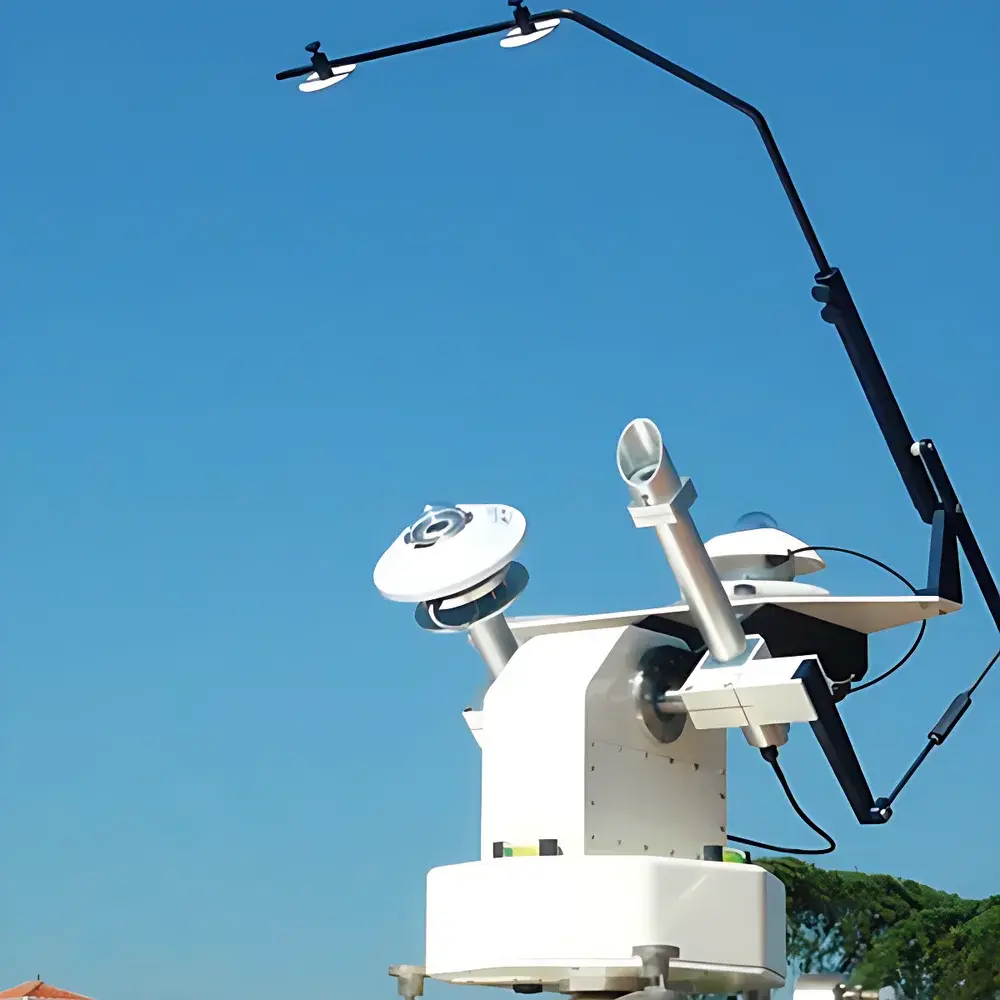
Geonica SunTracker-3000 Solar Tracker
| Brand | Geonica |
|---|---|
| Origin | Spain |
| Model | SunTracker-3000 |
| Power Consumption | <3 W |
| Azimuth & Elevation Accuracy | 0.1° (passive), 0.02° (active with optional radiometer feedback) |
| Payload Capacity | 30 kg |
| Operating Temperature | -20 to +60 °C |
| Relative Humidity | 0–100% RH |
| Weight | 25 kg |
| Dimensions | 460 × 490 × 490 mm |
| Drive Mechanism | Precision worm-gear train |
| Torque | 35 N·m |
| Angular Velocity | 9.4°/s |
| Angular Acceleration | 136.4°/s² |
| Mounting | Tripod base with dual bubble levels |
| Housing Material | Rust-resistant aluminum alloy, 304 stainless steel worm, bronze gear |
| Communication Interface | RS-485 (external control module), RS-232/422/485 & Ethernet (METEODATA data logger) |
| Time Synchronization | Internet NTP or integrated GPS receiver |
| Positioning Update Rate | Real-time, 1 Hz (solar zenith and azimuth) |
Overview
The Geonica SunTracker-3000 is a fully automated, dual-axis solar tracker engineered for high-accuracy alignment of pyrheliometers and pyranometers with the solar vector at any terrestrial location. It operates on a celestial mechanics-based astronomical algorithm—precomputed in real time by the METEODATA data acquisition system—to determine instantaneous solar zenith and azimuth angles with sub-arcminute resolution. Unlike open-loop mechanical trackers relying solely on pre-programmed ephemeris tables, the SunTracker-3000 supports both passive tracking (0.1° RMS pointing error) and active closed-loop refinement (0.02° RMS) when integrated with compatible radiometric feedback sensors. Its low-power architecture—drawing less than 3 W from a 12 VDC supply—enables autonomous operation powered entirely by a single 75 W photovoltaic panel, eliminating dependence on grid electricity in remote or off-grid monitoring sites. The system is designed for long-term unattended deployment in meteorological observatories, solar resource assessment campaigns, PV performance testing laboratories, and atmospheric radiation research networks.
Key Features
- Fully autonomous dual-axis positioning driven by real-time astronomical calculations updated at 1 Hz
- Integrated diagnostics for stepper motor health, mechanical alignment, and sensor coherence via ADAS-3000 software
- Remote configuration and calibration via GSM/GPRS, 3G, satellite, Wi-Fi, or WiMa protocols using METEODATA data loggers
- Onboard clock synchronization through either Internet-based NTP or an optional internal GPS receiver for sub-second time accuracy
- Continuous logging of solar position parameters (zenith, azimuth) alongside radiometric measurements for post-hoc data validation
- Low-power design enabling co-powering of tracker and data logger from one solar panel—no AC mains required
- Robust mechanical construction: precision worm-gear transmission with 35 N·m torque output, 30 kg payload capacity, and IP65-rated enclosure
- Triple-level alarm system delivering SMS alerts (to up to five users) or TCP/IP notifications upon detection of sensor drift, misalignment, dome soiling, or algorithmic inconsistency
Sample Compatibility & Compliance
The SunTracker-3000 accommodates standard ISO 9060:2018-compliant instruments—including thermopile-based direct normal irradiance (DNI) pyrheliometers and global horizontal irradiance (GHI)/diffuse horizontal irradiance (DHI) pyranometers—mounted via industry-standard flanges or custom brackets. Optional shading assemblies enable simultaneous measurement of GHI and DHI under controlled shadow-band or rotating-shadow-disk configurations. The system adheres to IEC 61724-1:2021 requirements for solar monitoring station accuracy and traceability. All firmware and ADAS-3000 diagnostic logic are validated against NREL’s SOLPOS and NOAA’s SPA reference algorithms. Data provenance—including timestamps, GPS-derived coordinates, and solar geometry metadata—is preserved in accordance with GLP-aligned audit trails, supporting compliance with ISO/IEC 17025:2017 documentation requirements for accredited radiation monitoring labs.
Software & Data Management
Control and diagnostics are executed through the METEODATA platform, which provides native support for Modbus RTU/ASCII/TCP, SDI-12, and ASCII serial protocols. The ADAS-3000 Automatic Diagnostic and Alarm Software runs directly on the METEODATA logger, performing continuous cross-validation among DNI, GHI, and DHI measurements using physical consistency checks derived from solar geometry and atmospheric transmittance models. Each diagnostic event—including motor stall detection, azimuth offset drift >0.05°, or radiometric coherence failure—is timestamped, geotagged, and stored in a dedicated alarm channel with configurable retention policies. Export formats include CSV, NetCDF4, and CF-compliant HDF5, compatible with PVsyst, SAM, and NASA POWER ingestion pipelines. Remote access is secured via TLS 1.2 encryption and role-based authentication; all configuration changes and alarm acknowledgments generate immutable audit logs compliant with FDA 21 CFR Part 11 electronic record requirements.
Applications
- Solar resource assessment for utility-scale photovoltaic and concentrating solar power (CSP) plant feasibility studies
- Calibration and intercomparison campaigns at BSRN (Baseline Surface Radiation Network) and WRMC (World Radiation Monitoring Center) stations
- Long-term atmospheric transparency monitoring for aerosol optical depth (AOD) and water vapor column retrieval
- Performance ratio (PR) analysis and degradation rate quantification in operational PV parks
- Validation of satellite-derived surface irradiance products (e.g., CAMS, NSRDB, SARAH)
- Research into cloud radiative forcing and clear-sky model uncertainty quantification
FAQ
What is the pointing accuracy under passive vs. active tracking modes?
Passive mode achieves ≤0.1° RMS error using only astronomical ephemeris; active mode refines this to ≤0.02° RMS when paired with a feedback-capable radiometer and enabled ADAS-3000 correction loop.
Can the SunTracker-3000 operate without a METEODATA data logger?
No—it requires the METEODATA unit for real-time solar position computation, motor control sequencing, and communication protocol handling; no standalone controller is provided.
Is GPS synchronization mandatory for accurate tracking?
No—Internet-based NTP synchronization suffices for most applications; however, GPS is recommended for sites with unreliable network connectivity or where microsecond-level time stamping is required for spectral irradiance correlation studies.
How does ADAS-3000 detect sensor soiling?
By identifying persistent deviations between measured DNI×cos(θz) + DHI and GHI over multiple clear-sky intervals, while accounting for expected cosine response and atmospheric extinction models.
What maintenance intervals are recommended for the mechanical drive system?
The bronze gear and stainless steel worm require no scheduled lubrication; annual visual inspection of mounting hardware and level calibration is advised per IEC 61724-1 maintenance guidelines.







