
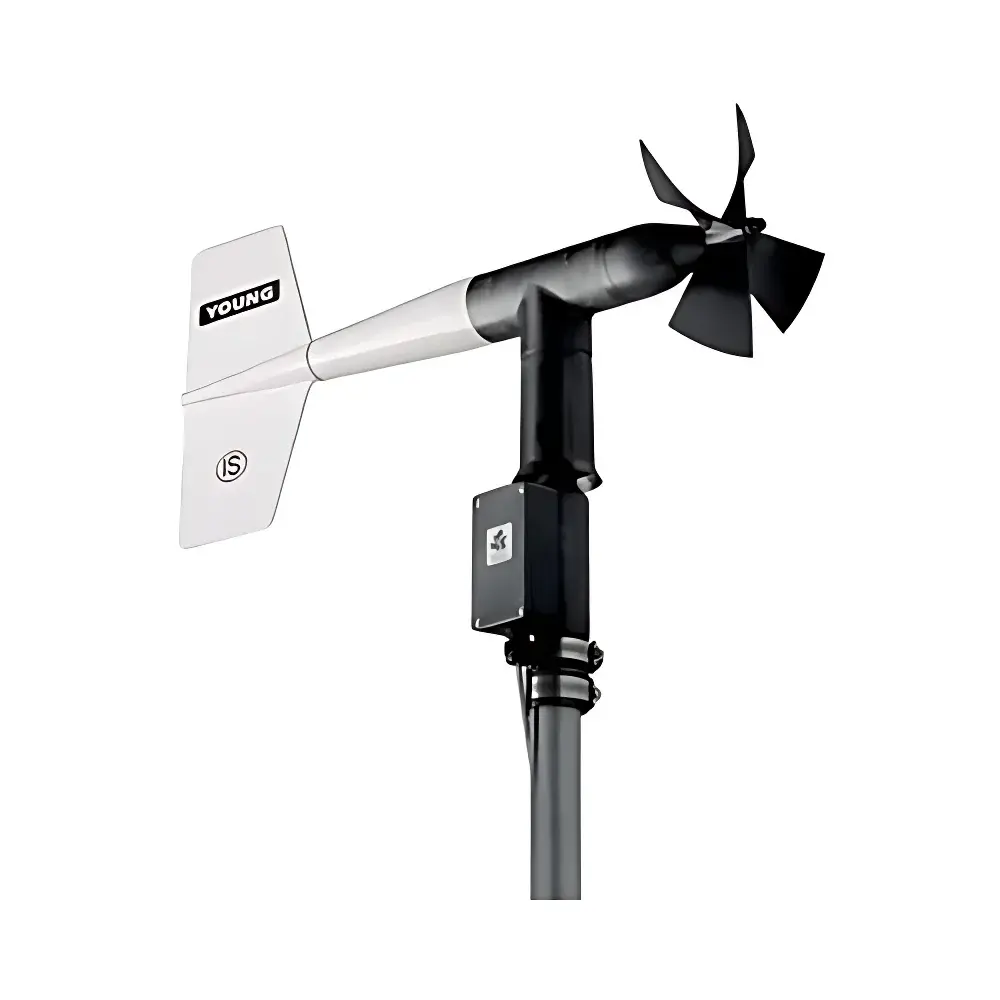
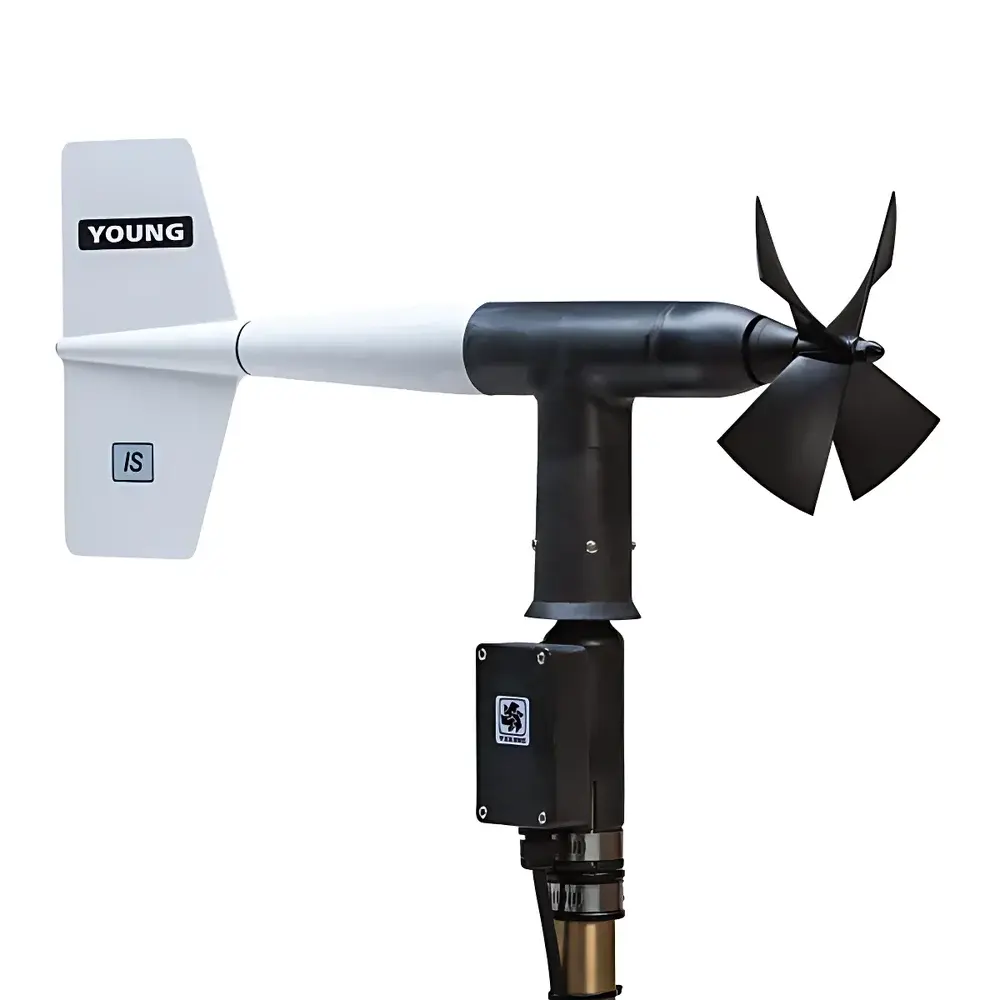
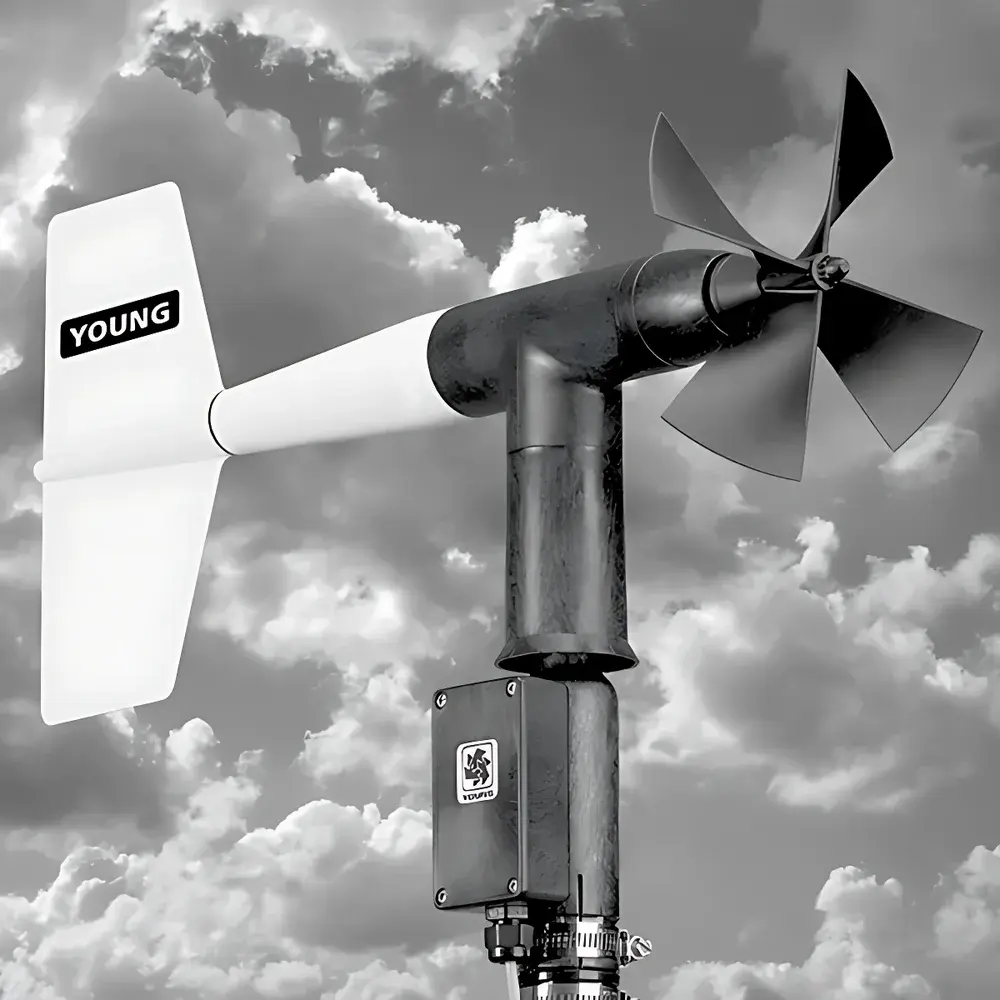
R.M. Young 05501LM Intrinsically Safe Propeller Anemometer
| Brand | R.M. Young |
|---|---|
| Origin | USA |
| Model | 05501LM |
| Instrument Type | Propeller Anemometer |
| Resolution | 0.1 m/s |
| Measurement Range | 0–60 m/s (continuous), 0–50 m/s (rated), 100 m/s (gust) |
| Accuracy | ±0.3 m/s or ±1% of reading (wind speed), ±3° (wind direction) |
| Operating Temperature | −50°C to +50°C |
| Operating Humidity | 0–100% RH |
| Output | Dual 4–20 mA (wind speed: 0–50 m/s standard, 0–100 m/s optional |
| wind direction | 0–360°) |
| Power Supply | 8–30 VDC, ≤40 mA |
| Startup Velocity | 1.0 m/s (propeller), 1.1 m/s (vane) |
| Dynamic Response | Propeller distance constant 2.7 m, vane lag distance 1.3 m, damping ratio 0.3 |
| Construction | Stainless steel shaft & bearings, anodized aluminum housing, UV-stabilized polymer components |
| Mounting | Standard 1-inch NPT pipe thread (34 mm OD) |
| Sensor Weight | 1.0 kg |
| Shipping Weight | 2.3 kg |
Overview
The R.M. Young 05501LM Intrinsically Safe Propeller Anemometer is a rigorously certified environmental sensing instrument engineered for continuous, high-reliability wind speed and wind direction measurement in hazardous locations classified under Class I, Division 1, Groups A, B, C, and D per UL 913 (8th Edition) and CSA C22.2 No. 157. Its intrinsic safety design ensures safe operation in atmospheres containing flammable gases, vapors, or combustible dusts—without risk of ignition—even during fault conditions. The sensor employs a four-blade propeller driven by airflow, coupled with a non-contact magnetic coil transducer that eliminates wear-prone slip rings and brushes. Wind direction is measured via a robust molded vane whose angular position is sensed by a sealed, precision-wound potentiometer with extended mechanical life. All signal conditioning electronics reside within the base-mounted junction box, enabling direct integration into industrial process control systems using industry-standard 4–20 mA analog outputs.
Key Features
- Intrinsically safe certification per UL 913 for Class I, Div. 1 (Groups A–D), Class II/III, Div. 1 (Groups E–G) — verified for use in petrochemical plants, refineries, offshore platforms, and grain handling facilities.
- Dual independent 4–20 mA outputs: one for wind speed (0–50 m/s default, 0–100 m/s configurable), one for wind direction (0–360° linear output), optimized for noise immunity over long cable runs (>1 km typical).
- Propeller assembly features precision-ground stainless steel ball bearings and aerodynamically balanced blades for low startup velocity (1.0 m/s) and minimal hysteresis.
- Vane mechanism incorporates a sealed, high-cycle-life potentiometer housed in an IP66-rated cavity, ensuring stable angular resolution across full 360° mechanical rotation (electronic range: 355° with 5° dead zone).
- Robust mechanical construction: marine-grade 316 stainless steel spindle, anodized 6061-T6 aluminum housing, and UV-resistant thermoplastic components rated for sustained exposure from −50°C to +50°C ambient.
- Junction box located at sensor base provides accessible screw-terminal connections, strain relief for dual-conductor shielded cable, and compatibility with approved IS barriers (e.g., Pepperl+Fuchs KFD2-STC4-Ex1, Phoenix Contact MINI MCR-SL-UI-UP-I).
Sample Compatibility & Compliance
The 05501LM is designed for outdoor and semi-enclosed industrial environments where explosive atmospheres may be present during normal or abnormal operation. It complies with international intrinsic safety standards including UL 913 (USA/Canada), IEC 60079-11 (Ed. 7.0), and ATEX 2014/34/EU (Category 1G). Its mechanical design meets NEMA 4X and IP66 ingress protection requirements. Calibration traceability follows ISO/IEC 17025 procedures through R.M. Young’s accredited calibration laboratory. The device supports compliance with site-specific Hazardous Area Classification (HAC) studies and integrates into Safety Instrumented Systems (SIS) when paired with SIL2-capable barrier modules. No field recalibration is required under normal operating conditions; periodic verification against NIST-traceable reference anemometers is recommended per API RP 500 and NFPA 496 guidelines.
Software & Data Management
While the 05501LM operates as a standalone analog sensor, its 4–20 mA outputs are fully compatible with programmable logic controllers (PLCs), distributed control systems (DCS), SCADA platforms, and data loggers supporting HART, Modbus RTU (via optional signal conditioner), or analog input cards. When integrated into validated systems, the sensor supports audit trails and electronic record retention compliant with FDA 21 CFR Part 11 and EU Annex 11 requirements—provided the host system implements appropriate user access controls, change management, and data integrity safeguards. R.M. Young provides detailed loop-check documentation, wiring schematics, and barrier selection guides to assist in functional safety assessments (IEC 61508/61511).
Applications
- Continuous ventilation monitoring in hazardous-area chemical storage tanks and reactor vent stacks.
- Wind shear and crosswind detection at LNG terminal berths and flare stack zones.
- Process air velocity verification in pharmaceutical cleanroom HVAC ducts classified as Zone 1 (ATEX) or Class I Div. 1.
- Emergency shutdown trigger input for gas detection systems in offshore oil & gas platforms.
- Environmental compliance reporting for EPA Title V and EU Industrial Emissions Directive (IED) monitoring networks.
- Real-time meteorological input for dispersion modeling software (e.g., AERMOD, CALPUFF) used in risk assessment for hazardous material handling facilities.
FAQ
What intrinsic safety barriers are compatible with the 05501LM?
The sensor requires a certified entity-compliant barrier meeting UL 913 Clause 9.3. Recommended models include Pepperl+Fuchs KFD2-STC4-Ex1, Phoenix Contact MINI MCR-SL-UI-UP-I, and Moore Industries STT4. Barrier selection must account for loop resistance, cable capacitance, and maximum allowable voltage/current per the 05501LM’s datasheet.
Can the 05501LM be used in Class II or III hazardous locations?
Yes—when installed with an appropriate barrier, it is certified for Class II (combustible dusts) and Class III (ignitable fibers) Division 1 environments per UL 913, Groups E, F, and G.
Is the wind direction output truly 360° linear?
The vane rotates mechanically through 360°, but the potentiometer’s electrical output spans 355° (5° mechanical dead zone). Output scaling is linear within this range; users must configure PLC/DCS input scaling accordingly.
What is the maximum cable length between sensor and barrier?
For standard 22 AWG twisted-shielded cable, maximum distance is 1,200 meters at 24 VDC supply. Loop resistance must remain below 450 Ω to maintain 4–20 mA integrity.
Does the 05501LM require periodic recalibration?
Not under normal service conditions. However, annual verification against a calibrated reference anemometer is recommended per ISO 5167 and IEC 61260-1 for critical safety applications.







