
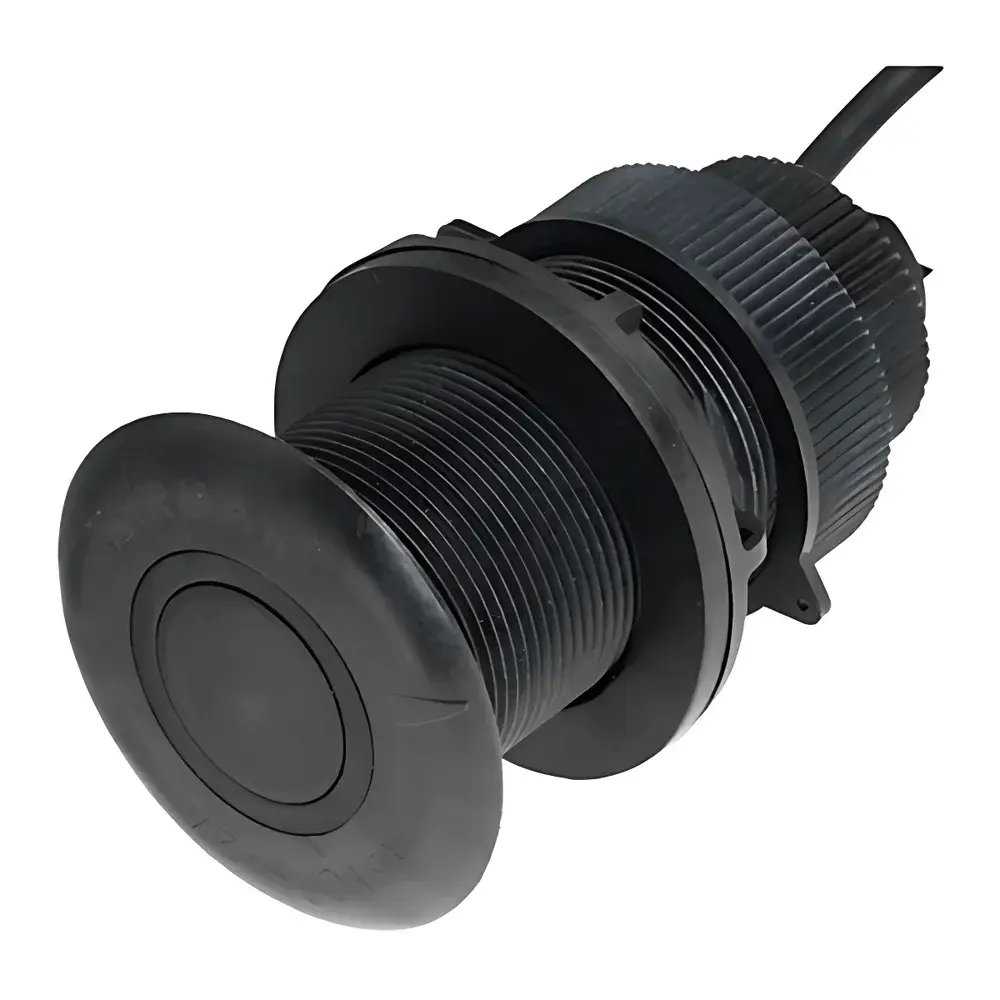
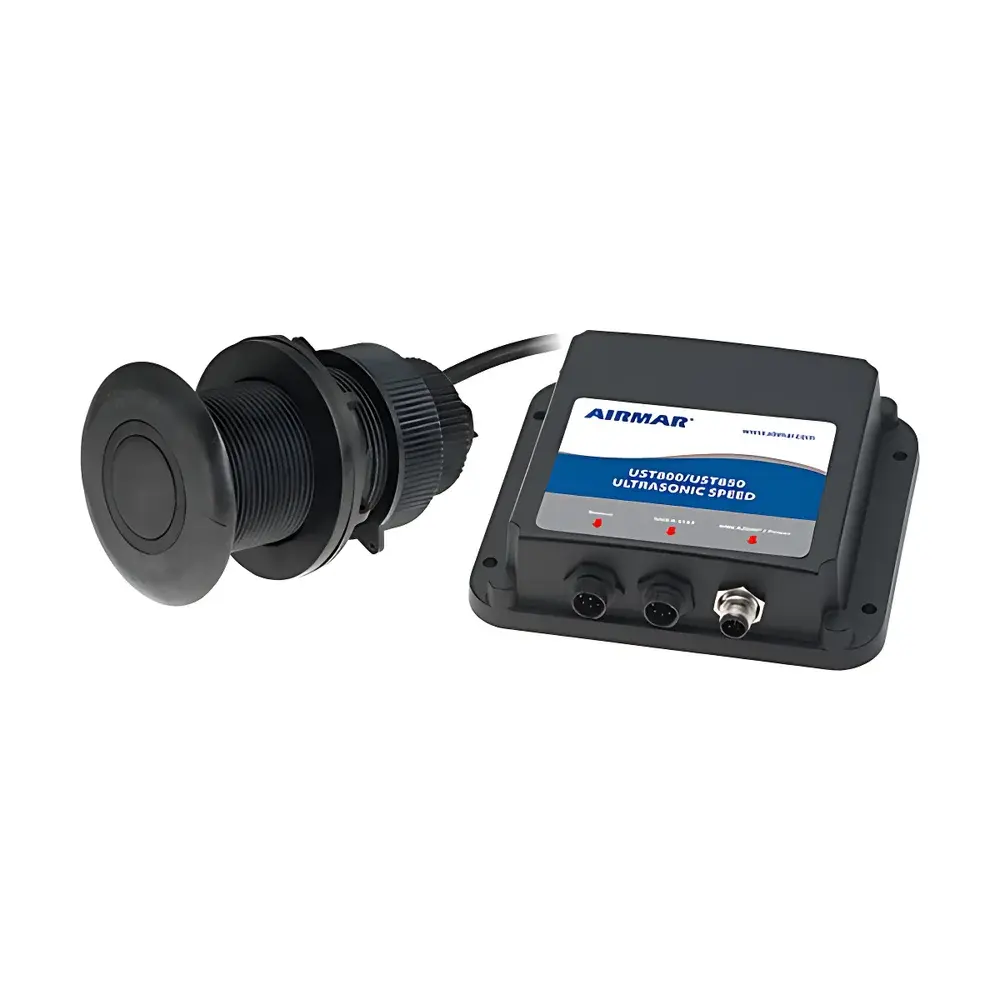
Airmar UST800 Ultrasonic Speed Through Water Sensor
| Brand | Airmar |
|---|---|
| Origin | USA |
| Model | UST800 |
| Speed Range | 0.1–50 knots |
| Operating Frequency | 4.5 MHz |
| Pulse Repetition Frequency | 0.5–12 kHz (adaptive) |
| Temperature Range | −4 to 40 °C |
| Output Protocols | NMEA 0183, NMEA 2000® |
| Power Supply | 9–16 VDC, avg. 125 mA @12 VDC |
| Housing Material | Plastic / Bronze / Stainless Steel |
| Housing Diameter | 51 mm |
| Weight | 1.4–1.8 kg |
| Compliance | NMEA 2000® Class B Device, EN 60945, EN 60529 IP67 (when installed) |
Overview
The Airmar UST800 Ultrasonic Speed Through Water (STW) Sensor is an embedded, solid-state marine transducer engineered for high-fidelity vessel speed measurement in both freshwater and seawater environments. Unlike mechanical paddlewheel or electromagnetic flow sensors, the UST800 employs time-of-flight ultrasonic correlation technology—operating at a nominal 4.5 MHz carrier frequency—to determine water velocity relative to the hull. Its principle of operation relies on cross-correlation of backscattered acoustic echoes from suspended particles and microturbulence in the water column, enabling robust, drift-free velocity estimation without moving parts. Designed specifically for integration into modern NMEA 2000® and NMEA 0183 networks, the UST800 delivers real-time STW data with sub-knot resolution across a wide dynamic range (0.1–50 knots), making it suitable for performance-critical applications including racing yachts, commercial workboats, and OEM navigation systems.
Key Features
- True solid-state architecture: No rotating components, eliminating mechanical wear, bearing failure, or fouling-related calibration drift.
- Adaptive pulse repetition frequency (PRF): Dynamically adjusts between 0.5 kHz and 12 kHz based on vessel speed and water conditions to optimize signal-to-noise ratio and temporal resolution.
- Integrated temperature sensing: Built-in thermistor provides simultaneous water temperature measurement (−4 to 40 °C) for thermal compensation and environmental logging.
- High-speed data processing: Onboard digital signal processor performs up to 25 velocity calculations per second, ensuring rapid response to acceleration/deceleration events.
- Multi-protocol output: Configurable NMEA 0183 (4800/38400 baud) and NMEA 2000® PGN 128259 (Speed Water Referenced) outputs for seamless interoperability with chartplotters, autopilots, and VDRs.
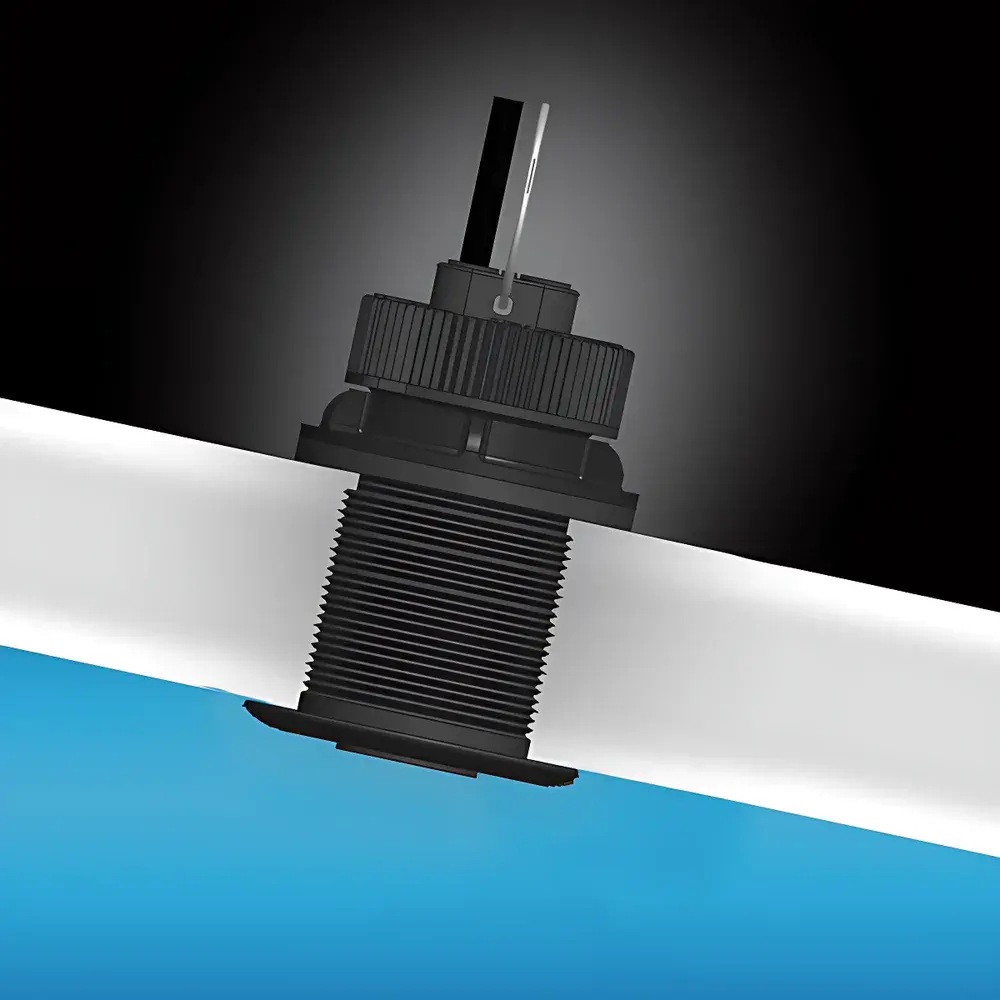
- Modular through-hull design: 51 mm (2″) diameter housing available in plastic, bronze, or stainless steel variants—compatible with standard thru-hull fittings and optimized for minimal hydrodynamic drag.
Sample Compatibility & Compliance
The UST800 operates reliably across salinity gradients—from brackish estuaries to full-strength seawater (35 ppt)—and maintains accuracy in turbid or low-particle-content freshwater due to its adaptive echo correlation algorithm. Its transducer face is acoustically matched to common hull materials (fiberglass, aluminum, and GRP), and installation requires only a single 51 mm hole with no internal mounting hardware. The device complies with IEC 60945 (Maritime Navigation and Radiocommunication Equipment), EN 60529 (IP67 ingress protection when properly sealed), and meets EMC requirements per EN 60945 Annex B. As a NMEA 2000® Class B device, it supports plug-and-play integration without external gateways and conforms to NMEA’s electrical and protocol conformance standards for interoperability assurance.
Software & Data Management
While the UST800 functions autonomously as a self-contained sensor node, its NMEA 2000® output includes built-in diagnostic fields (e.g., signal quality index, temperature status, and transducer health flags) that are accessible via compatible display units or PC-based NMEA analyzers (e.g., Actisense NGT-1, Maretron USB100). Raw velocity and temperature values are transmitted using standardized PGNs, enabling direct ingestion into vessel management software, performance analytics platforms (e.g., Sailmon, Expedition), or custom SCADA systems. For regulatory traceability, timestamped STW data can be archived alongside GPS position, heading, and engine parameters—supporting GLP-aligned log integrity when deployed in survey or compliance-critical operations. Firmware updates (if released) are delivered via NMEA 2000® firmware update PGNs, requiring no physical reprogramming.
Applications
- Racing and performance sailing: Real-time STW input for polar optimization, VMG calculation, and sail trim feedback loops.
- OEM integration: Embedded STW source for integrated bridge systems (IBS), electronic chart display and information systems (ECDIS), and autonomous surface vehicle (ASV) control stacks.
- Commercial fishing and coastal patrol: Accurate speed-over-water reference for fuel efficiency monitoring and AIS reporting compliance.
- Hydrographic survey support: STW synchronization with multibeam sonar motion sensors to correct for vessel-induced Doppler bias.
- Educational and research vessels: Low-maintenance, repeatable velocity measurement for fluid dynamics coursework and near-field current profiling studies.
FAQ
Does the UST800 require calibration after installation?
No. The sensor is factory-calibrated and does not require user-initiated recalibration. Its solid-state design and adaptive signal processing eliminate zero-drift and sensitivity drift over time.
Can the UST800 be installed on metal hulls?
Yes—provided the installation location avoids structural stiffeners, weld seams, or coating inconsistencies that may attenuate ultrasonic energy. A hull compatibility test using the included acoustic coupling gel is recommended prior to permanent mounting.
Is temperature compensation applied automatically?
Yes. The onboard thermistor feeds real-time water temperature into the velocity calculation algorithm, correcting for sound speed variation across the operational range (−4 to 40 °C).
What is the minimum water depth required for reliable operation?
The UST800 requires a minimum water column of 0.5 m beneath the transducer face to ensure sufficient scatterer density for correlation. Performance remains stable in depths exceeding 1 m, with no upper limit imposed by the sensor itself.
How does the UST800 handle air bubbles or biofouling?
Its adaptive PRF and multi-pulse averaging strategy mitigates transient signal dropout caused by bubble clouds. While heavy biofouling may reduce sensitivity over extended periods (>12 months), routine visual inspection and light cleaning restore nominal performance without disassembly.
Related Products







