
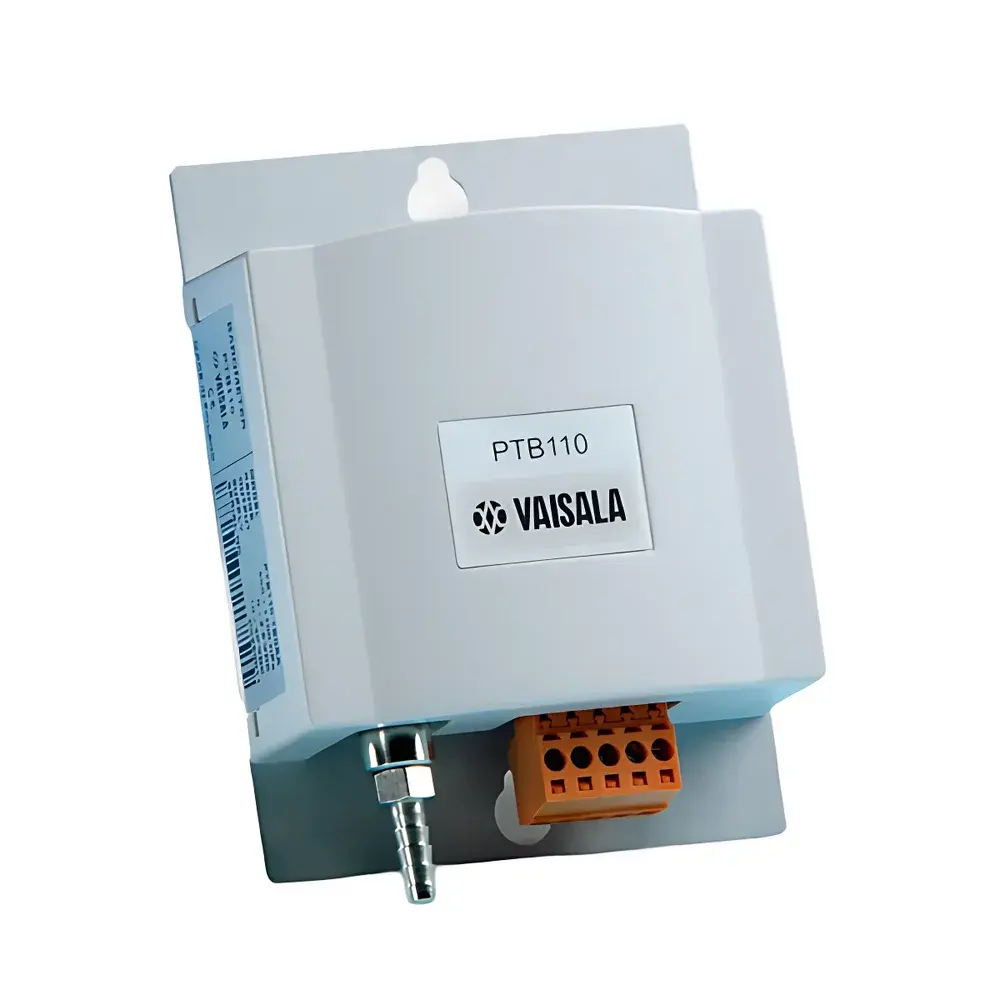
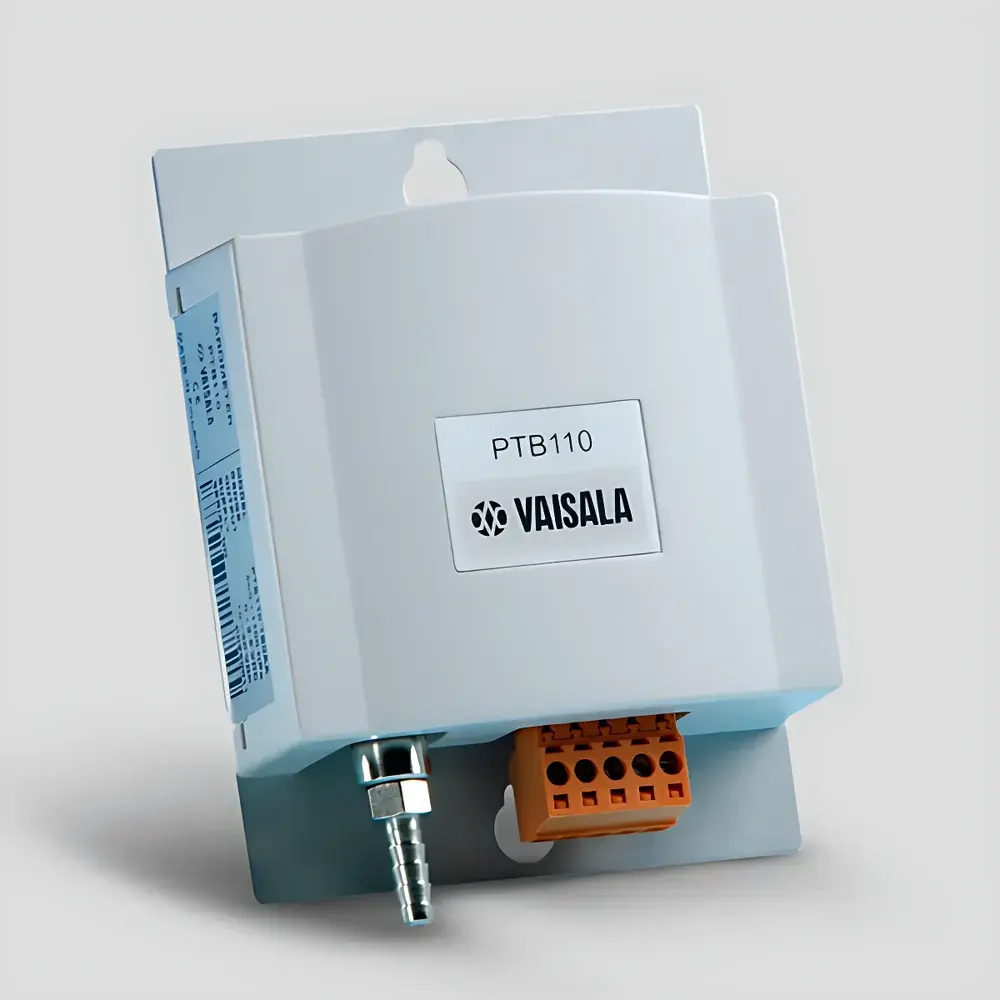
Vaisala PTB110 BAROCAP® Absolute Pressure Sensor
| Brand | Vaisala |
|---|---|
| Origin | Finland |
| Model | PTB110 |
| Measurement Principle | Silicon Capacitive Absolute Pressure Sensing (BAROCAP®) |
| Pressure Ranges | 500–1100 hPa, 600–1100 hPa, 800–1100 hPa, 800–1060 hPa, 600–1060 hPa |
| Accuracy (20 °C) | ±0.3 hPa |
| Long-Term Stability | ±0.1 hPa/year |
| Resolution | 0.1 hPa |
| Output Options | 0–2.5 VDC, 0–5 VDC, or 500–1100 Hz frequency |
| Supply Voltage | 10–30 VDC |
| Average Power Consumption | <0.10 W @ 12 V |
| Operating Temperature | −40 to +60 °C |
| Enclosure Rating | IP32 |
| Dimensions | 97.3 × 68.4 × 28.1 mm |
| Weight | 90 g |
| Traceability | NIST-traceable calibration certificate included |
Overview
The Vaisala PTB110 is a high-precision, absolute pressure sensor engineered for long-term reliability in atmospheric and environmental monitoring applications. It employs Vaisala’s proprietary BAROCAP® sensing technology—a silicon-based capacitive transduction principle—where pressure-induced deflection of a monocrystalline silicon diaphragm alters the capacitance between fixed and movable electrodes. This architecture leverages the exceptional elastic consistency and mechanical fatigue resistance of single-crystal silicon, enabling metrologically robust performance across wide thermal and temporal domains. Unlike piezoresistive or strain-gauge alternatives, the BAROCAP® design exhibits negligible hysteresis (<±0.03 hPa) and minimal acceleration sensitivity, making it suitable for static and quasi-static pressure measurements in mobile or vibration-prone installations such as buoys, unmanned aerial platforms, and geodetic instrumentation. The PTB110 delivers traceable absolute pressure output referenced to vacuum, eliminating drift associated with barometric reference dependencies.
Key Features
- Vaisala BAROCAP® silicon capacitive absolute pressure sensor with monocrystalline diaphragm
- Multiple configurable pressure ranges (e.g., 500–1100 hPa, 600–1060 hPa) to match application-specific resolution and dynamic range requirements
- High accuracy: ±0.3 hPa at 20 °C; ±0.6 hPa over 0–40 °C; ±1.5 hPa over full operating range (−40 to +60 °C)
- Exceptional long-term stability: ≤±0.1 hPa/year, minimizing field recalibration intervals and supporting multi-year unattended deployments
- Low-power operation: average current draw <4 mA; power consumption <0.10 W @ 12 VDC
- Configurable analog outputs (0–2.5 VDC or 0–5 VDC) and frequency output (500–1100 Hz), compatible with most data loggers and PLCs
- External TTL-level trigger input for controlled power cycling—critical for battery-powered systems with duty-cycled measurement protocols
- DIN rail mountable (35 mm standard), compact footprint (97.3 × 68.4 × 28.1 mm), and lightweight construction (90 g)
- Factory-calibrated with NIST-traceable certificate, including pressure and voltage calibration uncertainties (±0.15 hPa and ±0.7 mV respectively)
Sample Compatibility & Compliance
The PTB110 is designed for clean, dry, non-corrosive gas media—primarily ambient air—and is not rated for liquid immersion or condensing humidity environments. Its operational humidity specification explicitly excludes condensation, ensuring stable dielectric behavior of the capacitive sensing element. The device complies with EN 61326-1 for electromagnetic compatibility in industrial environments, supporting reliable operation near motors, RF sources, and switching power supplies. While not intrinsically safe or ATEX-certified, its low energy design (<0.10 W) and absence of hazardous materials align with general-purpose environmental instrumentation safety expectations. For regulatory traceability, each unit ships with a calibration certificate documenting uncertainty budgets per ISO/IEC 17025 principles, enabling integration into GLP-compliant meteorological networks or ISO 17025-accredited calibration labs.
Software & Data Management
The PTB110 operates as a self-contained analog transducer and does not require embedded firmware or host software for basic functionality. However, its analog and frequency outputs are fully compatible with industry-standard data acquisition systems—including Campbell Scientific CR series, HOBO UX120, and National Instruments DAQ platforms—that support voltage/frequency-to-pressure linearization using user-defined calibration polynomials. Vaisala provides detailed transfer function documentation (including temperature-compensated coefficients upon request) to facilitate implementation of second-order correction models in SCADA or Python-based processing pipelines. For audit-ready deployments, the NIST-traceable calibration certificate supports 21 CFR Part 11-aligned record retention when paired with timestamped, integrity-verified data logging infrastructure.
Applications
- Atmospheric pressure monitoring in weather stations, mesonets, and climate observatories
- Pressure referencing in laser interferometry and gravitational wave detection facilities requiring sub-millibar thermal stability
- Hydrological and agricultural monitoring systems (e.g., evapotranspiration modeling, soil moisture network reference nodes)
- Marine data buoys and autonomous surface vehicles where low mass, low power, and long-term drift resilience are critical
- Altitude-referenced UAV navigation systems and flight test instrumentation
- Calibration transfer standards in metrology labs performing intercomparisons against primary manometers
FAQ
Is the PTB110 suitable for use in saturated or condensing environments?
No. The sensor requires non-condensing humidity conditions. Prolonged exposure to dew point conditions may compromise dielectric integrity and long-term accuracy.
Can the PTB110 be used for differential pressure measurement?
No. It is an absolute pressure sensor only. Differential or gauge configurations require separate hardware or dual-sensor setups.
What is the recommended warm-up time before achieving full accuracy?
Stabilization to full specified accuracy occurs within 1 second after power-on, assuming ambient thermal equilibrium.
Does the PTB110 support digital communication protocols (e.g., RS-485, I²C)?
No. It provides analog voltage or frequency outputs only. Digital interfacing requires external ADC or frequency counter circuitry.
How often should field recalibration be performed?
Under typical environmental monitoring conditions, recalibration is recommended every 2–3 years due to its ±0.1 hPa/year stability specification—but final interval must be risk-assessed per ISO/IEC 17025 or site-specific QA procedures.







