
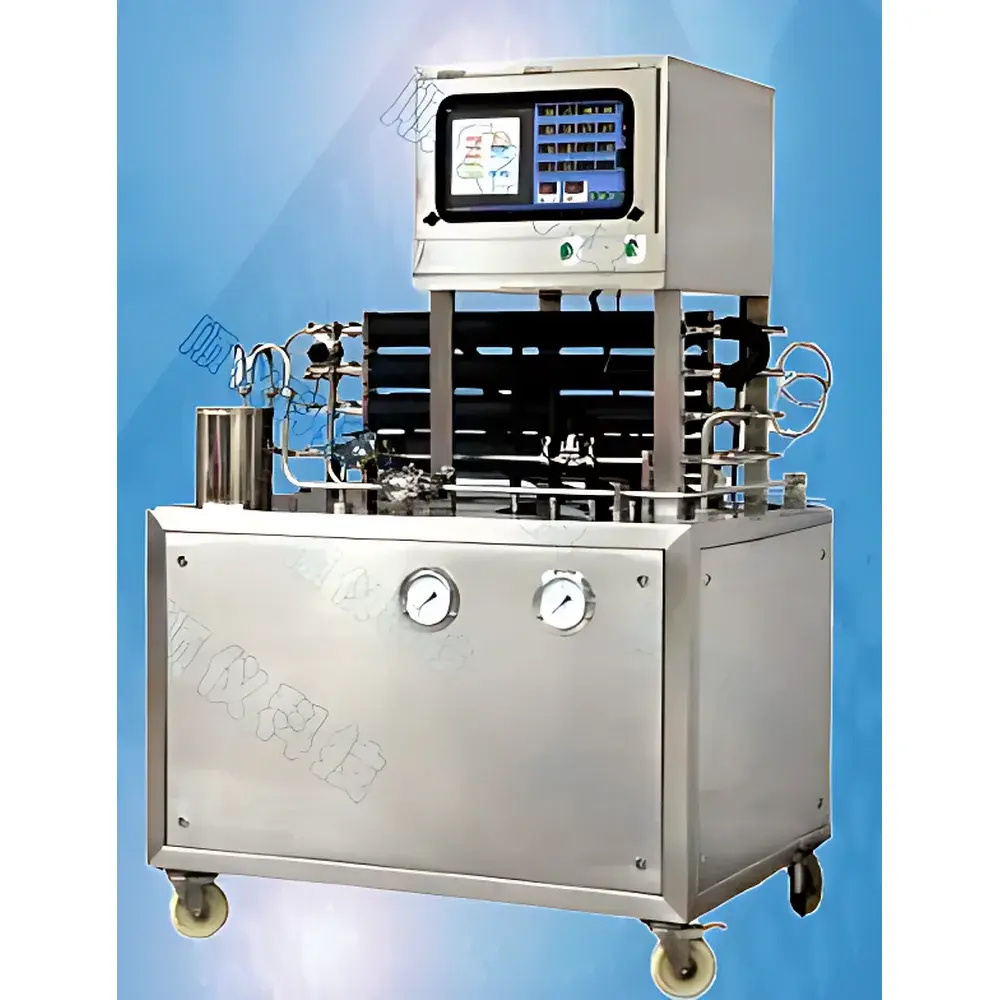
ST-20 Laboratory-Scale Ultra-High Temperature (UHT) Sterilization System
| Origin | Shanghai, China |
|---|---|
| Manufacturer Type | Authorized Distributor |
| Origin Category | Domestic (China) |
| Model | ST-20 |
| Pricing | Available Upon Request |
| Standard Throughput | 20 L/h (adjustable 5–40 L/h) |
| Minimum Batch Volume | 3–5 L |
| Max Sterilization Temp | 150 °C |
| Holding Time Options | 5 s, 15 s, 30 s (at 20 L/h) |
| Fill Temp Range | 20–90 °C |
| SIP Capability | Integrated |
| CIP Flow Rate | 400 L/h |
| Max Operating Pressure | 10 bar |
| Power Supply | 3-phase, 380 V, 10 kW |
| Dimensions (UHT Unit) | 1600 H × 1200 L × 950 W mm |
| CT-20 Aseptic Filling Chamber | HEPA Filtration ≥99.999% @ 0.3 µm, Class 100 (Fed. Std. 209E), 850 × 660 × 2100 mm (L×W×H), 220–240 V / 50 Hz / 0.25 kW |
Overview
The ST-20 Laboratory-Scale Ultra-High Temperature (UHT) Sterilization System is a fully integrated, bench-to-pilot scale thermal processing platform engineered for precise simulation of industrial UHT, HTST (High-Temperature Short-Time), and pasteurization processes. Based on direct steam injection or indirect plate heat exchanger architecture (configurable per application), the system subjects liquid food matrices—including dairy, plant-based beverages, juices, functional drinks, and nutritional emulsions—to controlled thermal profiles defined by temperature, residence time, and pressure. Its core function is to deliver microbiologically stable, shelf-stable samples under rigorously reproducible conditions—enabling formulation scientists, process engineers, and R&D teams to validate sterilization efficacy (e.g., ≥5-log reduction of *Bacillus sporothermodurans* or *Geobacillus stearothermophilus*), assess thermal impact on sensory attributes (color, aroma, viscosity), and generate scalable process parameters compliant with ISO 11133, ISO 7405, and FDA 21 CFR Part 117 requirements.
Key Features
- Compact footprint (≤3 m²) with mobile casters—designed for standard laboratory environments requiring only single-point 380 V/3-phase power and potable water supply.
- PID-controlled thermal management with ±0.5 °C accuracy across the entire operating range (20–150 °C), ensuring repeatable thermal history profiling critical for kinetic modeling (e.g., F0, B* values).
- Modular process train supporting configurable sequences: blending → optional inline homogenization (pre- or post-heat treatment) → thermal hold (5–30 s at 135–150 °C) → cooling → optional aseptic filling via CT-20 chamber.
- Integrated Clean-in-Place (CIP) system rated at 400 L/h and Steam-in-Place (SIP) functionality—validated per ASME BPE and EHEDG Doc. 8 standards for hygienic equipment design.
- Real-time data acquisition via embedded PLC with Ethernet interface; all critical parameters—including inlet/outlet temperatures, pressure differentials, flow rate, holding time, and valve positions—are timestamped and exportable in CSV or PDF format.
- Optional CT-20 Aseptic Filling Module featuring ISO Class 5 (Federal Standard 209E Class 100) laminar airflow, validated HEPA filtration (≥99.999% efficiency at 0.3 µm), and stainless-steel product contact surfaces meeting 3-A Sanitary Standards #37-01.
Sample Compatibility & Compliance
The ST-20 accommodates Newtonian and non-Newtonian fluids with viscosities up to 5,000 mPa·s and particulate content ≤2 mm diameter. It supports low-acid (pH >4.6) and acidified (pH ≤4.6) formulations, including milk, soy/rice/oat beverages, coffee extracts, probiotic suspensions, and protein-fortified shakes. All wetted materials comply with FDA 21 CFR §177.2600 and EU Regulation (EC) No. 1935/2004. The system is designed for GLP-compliant operation: audit trails, user access levels, electronic signatures, and data integrity safeguards align with Annex 11 and ALCOA+ principles. Full validation documentation (DQ/IQ/OQ/PQ templates) is provided to support regulatory submissions under USP , ISO 22000, and China’s GB 12693.
Software & Data Management
The ST-20 operates via a Windows-based HMI with intuitive touchscreen interface and optional remote monitoring via OPC UA. Process recipes—including temperature ramps, dwell times, pump speeds, and valve sequencing—are stored with version control and user-defined metadata (formulation ID, operator, date/time stamp). All sensor data are logged at 1 Hz resolution and archived locally on an encrypted SSD. Export functions support automated generation of summary reports compliant with FDA 21 CFR Part 11 requirements, including electronic records retention, change history, and signature verification. Raw datasets integrate seamlessly with statistical process analysis tools (e.g., JMP, Minitab) for DoE-driven optimization of thermal lethality vs. quality retention trade-offs.
Applications
- Rapid screening of stabilizer systems (e.g., carrageenan, gellan gum, microcrystalline cellulose) under realistic UHT stress conditions.
- Accelerated shelf-life testing (ASLT) through controlled thermal abuse protocols aligned with ISO 11287 and IFT guidelines.
- Validation of sterilization kinetics for novel plant-based matrices where traditional D-value assumptions do not apply.
- Development of cold-fill alternatives by evaluating post-UHT enzymatic stability (e.g., lipase, protease) and microbial recontamination risk during aseptic packaging.
- Training platform for food engineering students and production staff on thermal process validation fundamentals per FDA Food Code Appendix J and Codex Alimentarius CAC/RCP 51-2003.
FAQ
Can the ST-20 be used for low-acid canned food process development?
Yes—the system supports thermal profiles required for low-acid food validation (e.g., 121.1 °C for ≥3 min equivalent F0), though final commercial retort validation must occur in full-scale equipment per USDA-FSIS and FDA guidance.
Is third-party calibration and IQ/OQ support available?
Yes—certified field service engineers provide traceable calibration (NIST-traceable RTDs, pressure transducers), installation qualification, and operational qualification against user requirement specifications (URS).
What level of automation does the CT-20 aseptic chamber offer?
The CT-20 features programmable fill volume, adjustable nozzle height, automatic cap sealing (optional), and real-time particle counter integration for environmental monitoring per ISO 14644-1.
Does the system meet hygiene design standards for dairy applications?
Yes—all product-contact surfaces are electropolished 316L stainless steel (Ra ≤0.4 µm), with zero dead-leg geometry and drainability validated per 3-A SSI Standard 37-01 and EHEDG Guideline Doc. 2.
Can process data be synchronized with enterprise LIMS or MES platforms?
Yes—via OPC UA or Modbus TCP, enabling bidirectional communication with LabVantage, Thermo Fisher SampleManager, or Siemens Opcenter for end-to-end digital batch record generation.



