
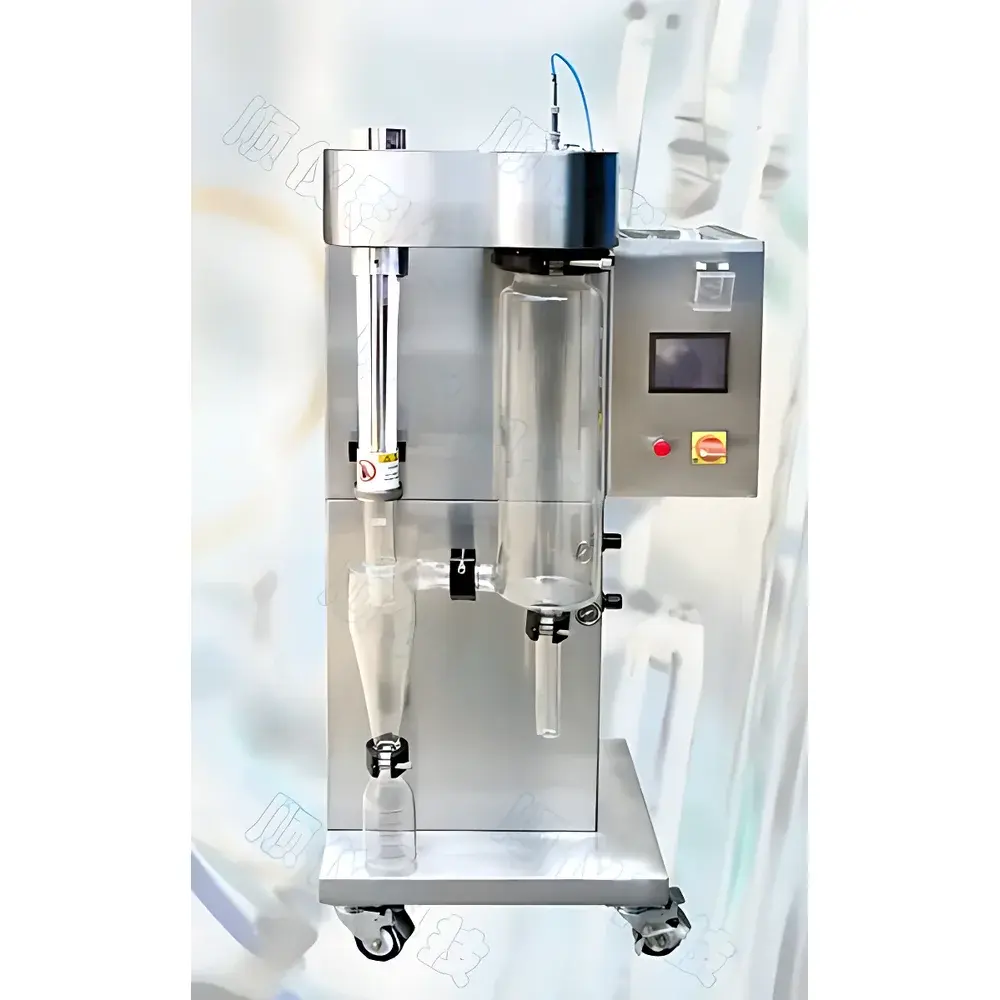
SUNYITECH SP-1500 Benchtop Spray Dryer
| Origin | Shanghai, China |
|---|---|
| Manufacturer Type | Authorized Distributor |
| Origin Category | Domestic (PRC) |
| Model | SP-1500 |
| Price | Upon Request |
| Evaporation Capacity | 1500 mL/h |
| Inlet Air Temperature Range | 30–280 °C |
| Outlet Air Temperature Range | 30–120 °C |
| Temperature Control Accuracy | ±1 °C |
| Drying Residence Time | 1.0–1.5 s |
| Feed Rate (Peristaltic Pump) | 30–2000 mL/h |
| Drying Air Flow Rate | 0–330 m³/h (Max), Max Static Pressure: 686 Pa |
| Compressor Power | 0.2 kW, Air Output: 4.2 m³/h, Operating Pressure: 2–5 bar |
| Jet Cleaner (Needle) Frequency | Adjustable, Pneumatic Supply: 2.3 bar |
| Nozzle Configuration | Dual-Fluid, Standard Orifice: 0.75 mm (Optional: 0.5–2.0 mm) |
| Air/Feed Flow Direction | Co-current, downward |
| Total Power Consumption | 3.5 kW |
| Electrical Supply | AC 220–240 V, 50/60 Hz, 13 A |
| Dimensions (L×W×H) | 650 × 500 × 1550 mm |
| Net Weight | 120 kg |
Overview
The SUNYITECH SP-1500 Benchtop Spray Dryer is a self-contained, compact laboratory-scale system engineered for reproducible, scalable spray drying of heat-sensitive and high-value formulations—including pharmaceutical actives, biopolymers, nanocellulose suspensions, functional food ingredients, and catalyst precursors. It operates on the principle of rapid solvent evaporation via atomization: liquid feed is dispersed into fine droplets using a dual-fluid (air-assisted) nozzle, then exposed to a controlled stream of heated air in a co-current downward configuration. With a nominal evaporation capacity of 1500 mL/h and residence times under 1.5 seconds, the SP-1500 enables gentle thermal processing while preserving structural integrity and bioactivity. Its fully integrated design—featuring an onboard oil-free air compressor, PID-regulated heating system, and borosilicate glass process chamber—eliminates dependency on external utilities, making it suitable for ISO Class 5–7 cleanroom-adjacent labs and GMP-compliant development environments.
Key Features
- Full-color 7-inch capacitive touchscreen interface with bilingual (English/Chinese) navigation and real-time parameter visualization—including inlet/outlet temperatures, feed rate, airflow, and needle purge frequency.
- PID-based temperature control with ±1 °C accuracy across the full 30–280 °C inlet range, ensuring batch-to-batch consistency required for regulatory submissions (e.g., ICH Q5C, USP <1151>).
- Optically transparent high-borosilicate glass drying chamber, cyclone separator, and collection vessel—enabling direct visual monitoring of atomization behavior, particle trajectory, wall deposition, and powder formation dynamics.
- Dual-fluid stainless steel 316 nozzle (standard 0.75 mm orifice, optional 0.5–2.0 mm) delivering narrow particle size distribution (PSD) with high geometric uniformity and improved flowability for downstream handling.
- Automated jet-cleaning mechanism (adjustable impact frequency) powered by internal compressed air (2.3 bar), preventing nozzle clogging during prolonged operation with viscous or particulate-laden feeds.
- Variable-speed peristaltic feed pump supporting precise dosing from 30 mL to 2000 mL/h—ideal for screening minimal sample volumes (≥30 mL) without compromising process fidelity.
- Interlocked safety architecture: heater activation is disabled unless blower is operational; air filtration (HEPA-grade inlet filter) ensures feedstock purity and protects internal components from particulate ingress.
- Integrated oil-free scroll compressor (4.2 m³/h @ 2–5 bar) with acoustic enclosure (<50 dB[A])—meeting occupational noise limits per ISO 11201 and enabling placement in shared lab spaces.
Sample Compatibility & Compliance
The SP-1500 accommodates aqueous, alcoholic, and low-boiling organic solvent-based solutions and colloidal dispersions (e.g., PLGA nanoparticles, protein hydrolysates, chitosan gels). Its inert glass-wetted path and absence of lubricants or elastomeric seals minimize extractables and leachables—supporting compliance with USP <661.1>, ISO 10993-12, and FDA 21 CFR Part 11 requirements when paired with validated SOPs. The system meets CE marking directives (2014/30/EU EMC, 2014/35/EU LVD) and conforms to IEC 61000-6-3 for industrial electromagnetic emissions. Optional IQ/OQ documentation packages are available for GLP and early-phase GMP process development.
Software & Data Management
Equipped with SUNYITECH’s proprietary temperature and process control firmware, the SP-1500 logs timestamped operational data (temperature setpoints, actual readings, feed rate, airflow, and purge events) to internal flash memory. Export is supported via USB 2.0 to CSV format for traceability and statistical analysis (e.g., ANOVA of PSD vs. inlet temp). Audit trails are configurable to record user logins, parameter changes, and alarm acknowledgments—facilitating alignment with ALCOA+ principles and 21 CFR Part 11 electronic record requirements when deployed with role-based access controls and digital signature integration.
Applications
- Pharmaceutical: Production of inhalable dry powders (DPIs), amorphous solid dispersions (ASDs), and lyophilization pre-formulation surrogates.
- Food Science: Encapsulation of probiotics, omega-3 oils, and anthocyanins; production of instant beverage powders with controlled solubility profiles.
- Materials Research: Synthesis of spherical ceramic precursors (e.g., LiFePO₄), metal oxide nanoparticles, and porous silica microspheres.
- Academic & Industrial R&D: Rapid formulation screening, scale-up correlation studies (via dimensionless number matching), and DOE-driven optimization of Tin, feed rate, and atomization pressure.
FAQ
What is the minimum sample volume required for a valid drying run?
The system supports reliable operation with as little as 30 mL of feed solution, provided viscosity remains below 500 cP and solids content does not exceed 25 wt% for aqueous systems.
Can the SP-1500 handle organic solvents such as ethanol or acetone?
Yes—when operated with appropriate ventilation and explosion-proof accessories (e.g., ATEX-rated blower motor, grounded stainless steel ducting), and with outlet temperature maintained below the autoignition point of the solvent.
Is the glassware compliant with DIN/ISO standards for laboratory glass?
All borosilicate glass components meet ISO 3585 specifications (≥95% SiO₂, CTE ≈ 3.3 × 10⁻⁶/K) and are certified for continuous use up to 500 °C for short-term thermal shock resistance.
Does the system support remote monitoring or Ethernet connectivity?
Standard configuration includes USB data export only; optional RS-485 Modbus RTU interface is available for integration into centralized lab automation platforms (e.g., LabArchives, DeltaV).
What maintenance intervals are recommended for long-term reliability?
Compressor desiccant replacement every 6 months; nozzle inspection and ultrasonic cleaning after each 50 hours of cumulative operation; HEPA filter replacement every 200 hours or per particulate load assessment.



