
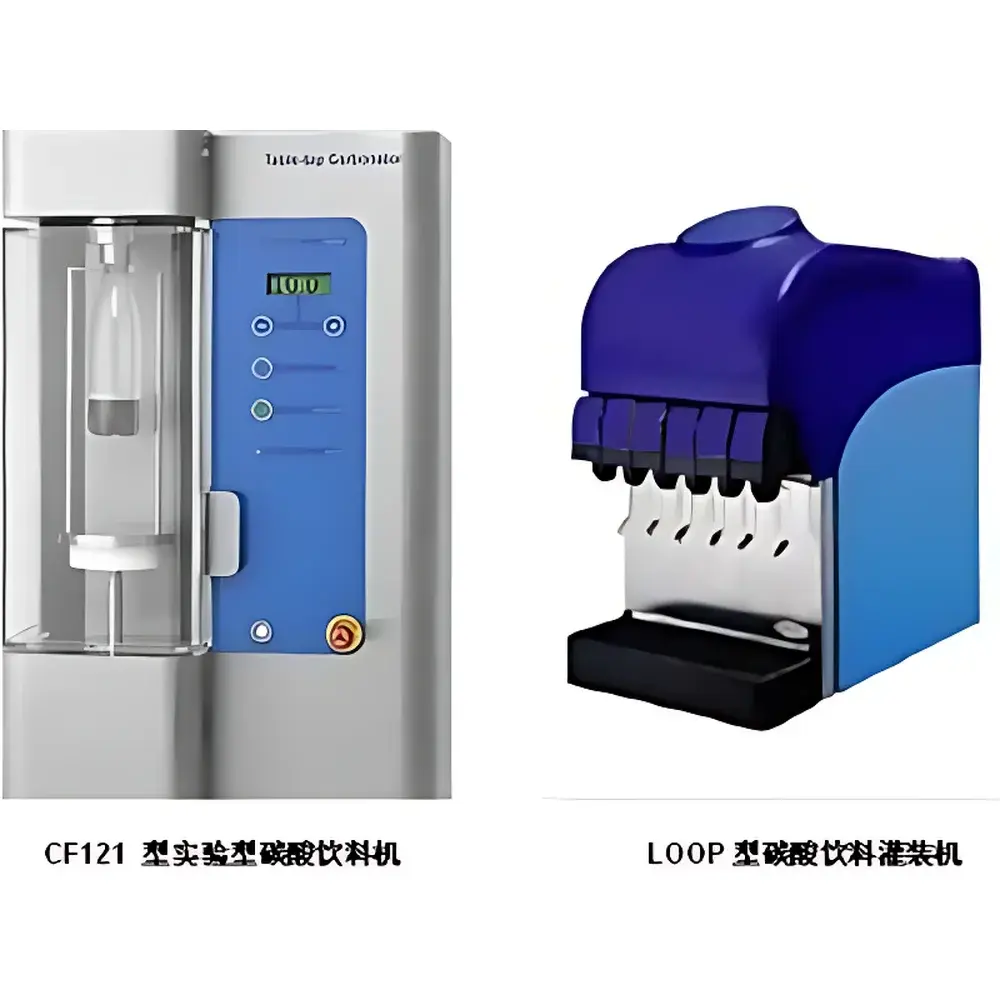
Lab-Scale Carbonated Beverage Filler CF121 by LOOP
| (Manufacturer | LOOP |
|---|---|
| Model | CF121 |
| Type | Benchtop Carbonation & Filling System for R&D) |
| [Origin | Shanghai, China |
| Manufacturer Type | Authorized Distributor |
| Regional Origin | Domestic (PRC) |
| Model | CF121 |
| Quotation | Available Upon Request |
| Capacity | 25 L/h |
| CO₂ Saturation Range | 5.0–10.0 g/L (adjustable in 0.5 g/L increments) |
| Cooling Temperature | 6 °C |
| Operating Pressure | 20–100 PSI |
| Power Supply | 220 V, 50 Hz, 2.5 kW |
| Dimensions | 520 × 580 × 950 mm |
| Weight | 90 kg |
| Bottle Compatibility | Up to 1.5 L, PET/glass, standard neck profiles |
| CO₂ Purge & Pre-pressurization | Yes |
| Fill Method | Continuous, pressure-assisted pre-fill saturation |
| Refrigeration | Integrated single-stage chiller |
| Control | Digital PID-based CO₂ dosing and pressure regulation] |
Overview
The LOOP CF121 Lab-Scale Carbonated Beverage Filler is an integrated benchtop system engineered for precise carbonation, pressure-controlled filling, and process reproducibility in research, quality control, and product development environments. It operates on the principle of counter-pressure (pre-pressurized) filling—where bottles are purged with food-grade CO₂, pressurized to match the saturation pressure of the chilled beverage, and then filled under equilibrium conditions to minimize gas loss and oxygen ingress. This methodology ensures high fidelity in replicating industrial carbonation parameters at sub-pilot scale, enabling formulation scientists and process engineers to validate CO₂ solubility behavior, headspace management, and container integrity under controlled thermal and pressure conditions.
Key Features
- Integrated refrigeration unit maintaining consistent beverage temperature at 6 °C—critical for stable CO₂ solubility per Henry’s Law
- Digital PID-controlled CO₂ dosing system allowing stepless adjustment of carbonation level from 5.0 to 10.0 g/L in 0.5 g/L increments
- Automated bottle conditioning sequence: CO₂ purge → pre-pressurization → fill → pressure release—executed without manual intervention
- Compact footprint (520 × 580 × 950 mm) optimized for fume hoods, lab benches, or QC stations with limited floor space
- Single-stage pressure regulator with calibrated output range (20–100 PSI) supporting both low-carbon waters and high-saturation soft drinks
- Stainless-steel wetted parts compliant with FDA 21 CFR §177.1520 and EC 1935/2004 for food contact materials
- Self-contained operation: requires only single-phase 220 V / 50 Hz power input—no external chillers, compressed air, or CO₂ manifolds needed
Sample Compatibility & Compliance
The CF121 accommodates standard PET and glass bottles with neck diameters conforming to ISO 852 and ASTM D4523 specifications, up to 1.5 L volume. Its CO₂ purge cycle reduces residual O₂ to <0.5 mL/L in headspace—validated via headspace gas chromatography (ASTM D6177). The system meets CE Machinery Directive 2006/42/EC and NSF/ANSI 169 (Food Equipment—R&D Scale), with full documentation traceability for GLP-compliant trials. All pressure vessels comply with PED 2014/68/EU Annex I essential safety requirements, and electrical architecture conforms to IEC 61000-6-2/6-4 immunity and emission standards.
Software & Data Management
While the CF121 operates via a dedicated front-panel HMI with tactile pushbuttons and LED indicators, it supports optional RS-485 Modbus RTU interface for integration into centralized lab data acquisition systems (e.g., LabVIEW, DeltaV, or custom SCADA). All process events—including CO₂ setpoint, actual saturation value, fill time per bottle, cooling status, and pressure transients—are timestamped and stored internally for ≥1,000 cycles. Audit trails comply with ALCOA+ principles and support 21 CFR Part 11 readiness when paired with validated third-party software for electronic signature and role-based access control.
Applications
- R&D validation of CO₂ solubility models across varying sugar content, pH, and temperature gradients
- Accelerated shelf-life studies requiring identical carbonation levels across replicate batches
- QC verification of carbonation stability in reformulated beverages (e.g., reduced-sugar or clean-label variants)
- Process mapping for upstream carbonation units (e.g., contacting columns vs. inline injectors)
- Educational demonstration of gas-liquid mass transfer kinetics in food engineering curricula
- Pre-commercial batch production of sensory evaluation samples under GMP-aligned handling protocols
FAQ
What regulatory certifications does the CF121 hold?
The system carries CE marking per Machinery Directive 2006/42/EC and NSF/ANSI 169 certification for R&D food equipment. Full test reports and EU Declaration of Conformity are supplied with each unit.
Can the CF121 handle viscous or particulate-containing beverages?
It is optimized for clarified aqueous solutions (still/carbonated water, flavored syrups, isotonic bases). Suspensions or >5 cP viscosities are not recommended due to potential nozzle clogging and inconsistent saturation dynamics.
Is calibration of the CO₂ sensor traceable to NIST standards?
The dissolved CO₂ measurement is derived from calibrated pressure/temperature correlation using the modified Setchenow equation; primary calibration is performed against gravimetrically prepared reference standards (±0.1 g/L accuracy) certified by CNAS-accredited labs.
Does the system support automated logging to a network drive?
Yes—via optional Ethernet-to-Modbus gateway, enabling scheduled CSV export to shared storage with configurable retention policies and user-level permissions.
What maintenance intervals are recommended for the chiller and CO₂ delivery path?
Compressor oil and refrigerant charge require inspection every 12 months; stainless-steel CO₂ lines and solenoid valves undergo leak testing and functional validation semiannually per internal SOP-FLD-027.





