
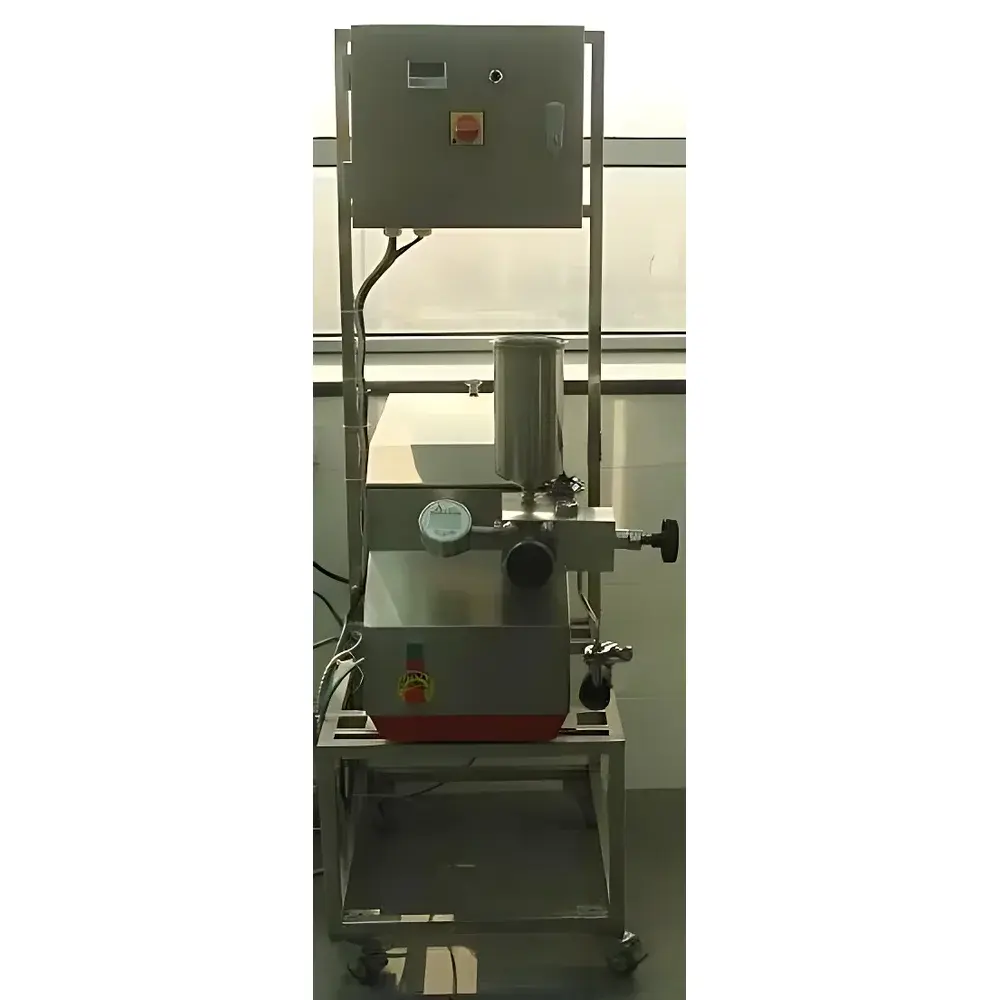
APV APV1000 Laboratory High-Pressure Homogenizer
| Origin | Shanghai, China |
|---|---|
| Manufacturer Type | Authorized Distributor |
| Origin Category | Domestic (PRC) |
| Model | APV1000 |
| Pricing | Upon Request |
| Processing Capacity | 22 L/hr |
| Minimum Sample Volume | 150 mL |
| Maximum Operating Pressure | 1000 bar |
| Plunger Diameter / Material | 14 mm / Ceramic |
| Plunger Seal Material | PVDF/EPDM |
| O-Ring & Gasket Material | EPDM/POM |
| Pump Valve Seat Material | Tungsten Carbide Alloy |
| Pump Valve Material | Cobalt-Based Alloy |
| Homogenizing Valve & Seat Material | Tungsten Carbide Alloy |
| Digital Pressure Display | Yes |
| Overpressure Safety Cut-off | Yes |
| Net Weight | 105 kg |
| Dimensions (W×D×H) | 370 × 818 × 620 mm |
| Motor | TEFC, 3 kW, Three-Phase, 50–60 Hz, Multi-Voltage (200/230/380/400/460/575 V) |
| Temperature Limit for Wetted Parts | 105 °C |
| CIP-Compatible Hygienic Design | Yes |
| CE Marked | Yes |
Overview
The APV APV1000 Laboratory High-Pressure Homogenizer is an engineered solution for scalable, reproducible cell disruption, nanoemulsion formation, liposome extrusion, and particle size reduction in research and early-stage process development. Based on the proven positive-displacement plunger pump architecture and two-stage homogenization principle pioneered by APV (a globally recognized leader in high-pressure fluid processing), this unit operates on the fundamental mechanism of controlled turbulent shear, cavitation, and impact forces generated when a pressurized liquid stream is accelerated through a precisely engineered micro-orifice valve system. Designed for laboratory environments requiring GMP-aligned hygiene, operational flexibility, and compatibility with downstream pilot-scale beverage or biopharmaceutical processing lines, the APV1000 delivers consistent sub-micron particle size distributions (PSD) with high batch-to-batch reproducibility. Its compact footprint and integrated stainless-steel mobile frame support seamless integration into containment hoods, cleanroom workflows, or modular lab setups.
Key Features
- CIP-compatible hygienic design compliant with ASME BPE and EHEDG guidelines for clean-in-place validation in regulated environments
- Two-stage homogenization system featuring replaceable ceramic homogenizing valves optimized for high wear resistance and thermal stability up to 105 °C
- Manually adjustable dual-stage pressure control via precision-machined handwheel mechanism—enabling independent optimization of first-stage (pre-homogenization) and second-stage (final dispersion) pressures
- Stellite-coated ball valves and reversible tungsten carbide valve seats ensure extended service life under abrasive or high-viscosity conditions
- Ceramic plungers paired with PVDF/EPDM dynamic seals provide chemical resistance and thermal stability across pH 2–12 and temperatures up to 105 °C
- Digital pressure transducer with real-time display and programmable overpressure cut-off safeguarding both operator safety and equipment integrity
- Stainless-steel feed hopper and fully enclosed polished 316L stainless-steel housing (CE-marked) meeting IP54 ingress protection requirements
- Integrated lubrication system with sight-level indicators and sealed gear train minimizing maintenance intervals and downtime
- Full internal wiring harness with industrial-grade connectors and EMI shielding for stable operation in shared lab infrastructure
Sample Compatibility & Compliance
The APV1000 accommodates aqueous suspensions, oil-in-water emulsions, protein solutions, microbial lysates, and viscous polymer dispersions with viscosities up to 5,000 cP. All wetted surfaces—including feed hopper, plunger chamber, valve assembly, and discharge manifold—are constructed from electropolished 316L stainless steel or certified food-grade elastomers (EPDM, POM, PVDF). The system meets ISO 13485 design controls principles for medical device manufacturing support and supports audit-ready documentation for GLP/GMP compliance. It is compatible with USP and environmental monitoring protocols when operated within Class II biological safety cabinets. Electrical safety conforms to IEC 61000-6-2/6-4 and EN 60204-1 standards; CE marking confirms conformity with the EU Machinery Directive 2006/42/EC and Low Voltage Directive 2014/35/EU.
Software & Data Management
While the APV1000 operates as a standalone analog-controlled instrument, its digital pressure interface supports optional RS-485 or 4–20 mA analog output for integration into centralized SCADA or LIMS platforms. Pressure logs can be captured externally using third-party data acquisition systems compliant with FDA 21 CFR Part 11 requirements when paired with validated timestamped recording software. Audit trail functionality—including operator ID, pressure setpoints, runtime duration, and safety event triggers—is achievable via external PLC-based controllers configured per Annex 11 and ALCOA+ data integrity principles.
Applications
- Preclinical formulation development of nanosuspensions and lipid nanoparticles (LNPs) for mRNA delivery
- Cell lysis and organelle isolation in molecular biology workflows
- Stabilization of functional beverages containing insoluble phytochemicals or probiotics
- Rheological conditioning of cosmetic emulsions and topical suspensions
- Scale-down modeling for process transfer to APV’s industrial-scale GA series homogenizers (e.g., GA30, GA60)
- Quality-by-Design (QbD) studies supporting DOE-based optimization of particle size distribution and polydispersity index (PDI)
FAQ
What is the minimum sample volume required for reliable operation?
The APV1000 requires a minimum sample volume of 150 mL to ensure stable pump priming, avoid dry-running risks, and maintain laminar flow conditions across the homogenizing valve.
Can the APV1000 be integrated into a continuous small-scale production line?
Yes—the unit features standardized 1/2″ and 3/4″ sanitary clamp connections (ISO 2852) and is routinely deployed upstream of sterile filtration, inline pH adjustment, or filling modules in experimental beverage and nutraceutical pilot lines.
Is validation documentation available for IQ/OQ protocols?
Comprehensive factory-verified installation and operational qualification templates—including calibration certificates for pressure sensors, motor performance curves, and material traceability records—are provided upon request for regulatory submission support.
What maintenance intervals are recommended for routine operation?
Plunger seals and valve components should be inspected every 200 operating hours; full valve reconditioning is advised at 1,000-hour intervals under standard aqueous processing conditions.
Does the system support nitrogen blanketing or inert gas purging?
Yes—optional inlet gas purge ports (N₂ or CO₂) can be installed on the feed hopper to minimize oxidation during processing of oxygen-sensitive actives such as polyphenols or unsaturated lipids.
Related Products



