
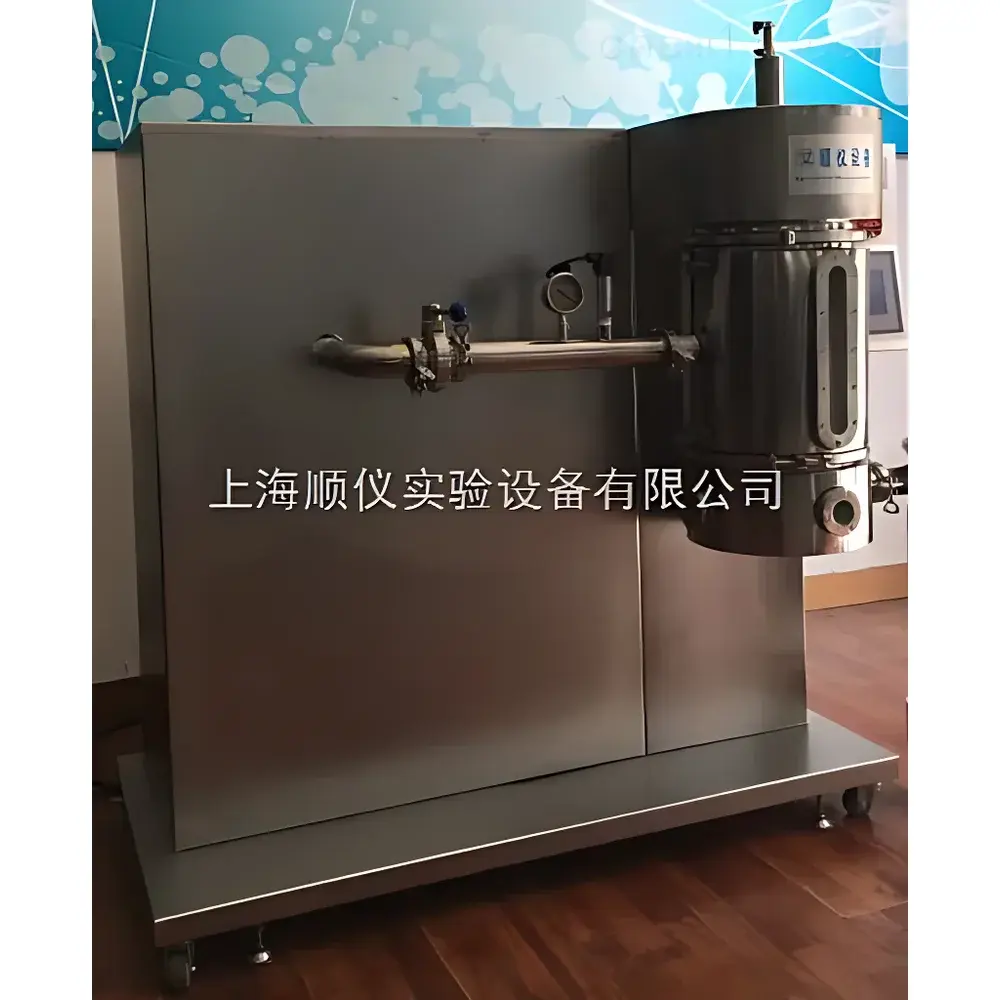
SP-300 Experimental Spray Freeze Dryer
| Origin | Shanghai, China |
|---|---|
| Manufacturer Type | Authorized Distributor |
| Origin Category | Domestic (China) |
| Model | SP-300 |
| Price Range | USD 28,000 – 42,500 |
| Processing Capacity | 30–1000 mL per batch |
| Spray Freezing Temperature | ≤ −15 °C |
| Cold Trap Temperature | ≤ −60 °C |
| Ultimate Vacuum Pressure (empty) | < 20 Pa |
| Spray Pressure Range | 2–5 bar (adjustable) |
| Compressed Air Supply | Built-in oil-free air compressor (4.2 m³/h, 0.2 kW, noise < 50 dB(A)) |
| Drying Air Flow | 0–330 m³/h, max. static pressure 686 Pa |
| Atomization Airflow | 5.5 m³/min |
| Jet Cleaner (Needle) Frequency | Variable, with integrated 2.3 bar compressed air supply |
| Power Input | 9 kW, 380 V, 50 Hz |
| Dimensions (L×W×H) | 1150 × 770 × 1350 mm |
| Control System | Full-color LCD touchscreen interface with real-time digital display of drying chamber temperature, peristaltic pump speed, fan frequency, needle purge frequency, and chamber pressure |
| Dual-mode Capability | Optional conversion to conventional hot-air spray dryer configuration |
Overview
The SP-300 Experimental Spray Freeze Dryer is an integrated bench-scale platform engineered to combine the rapid atomization of spray drying with the low-temperature preservation integrity of vacuum freeze drying. Unlike conventional lyophilizers or thermal spray dryers, this system operates on a hybrid principle: liquid feed is atomized into fine droplets under controlled compressed air, immediately flash-frozen upon contact with a cryogenic environment (≤ −15 °C), and subsequently subjected to primary drying under high vacuum (< 20 Pa) via sublimation-driven water removal. This process preserves thermolabile structures—including proteins, enzymes, polysaccharides, and labile phytochemicals—while yielding free-flowing, spherical microparticles with narrow size distribution and minimal aggregation. Designed for R&D laboratories in pharmaceutical development, nutraceutical research, and advanced biomaterial synthesis, the SP-300 eliminates the need for separate freezing and lyophilization steps, reducing total cycle time by up to 70% compared to standard shelf-based freeze dryers.
Key Features
- Integrated cryogenic spray-freeze-drying architecture with built-in air-cooled hermetic compressor (−60 °C cold trap), enabling continuous ice condensation without external chillers or liquid nitrogen.
- Full-color 7-inch LCD touchscreen interface supporting dual-language (English/Chinese) operation, real-time parameter logging, and programmable multi-stage drying profiles.
- Onboard oil-free air compressor (4.2 m³/h, <50 dB(A)), eliminating external air supply dependencies and ensuring GMP-compatible gas purity for sensitive biologics processing.
- Adjustable nozzle pressure (2–5 bar) and variable-frequency jet cleaner (needle purge) with integrated 2.3 bar air supply to prevent nozzle clogging during viscous or sugar-rich feed processing.
- Dual-mode adaptability: hardware-configurable transition from spray freeze drying to conventional hot-air spray drying (optional retrofit), facilitating comparative process development and scale-up studies.
- Safety interlocks include compressor–heater interlock, vacuum–fan startup sequence control, and overtemperature/overpressure shutdown protocols compliant with IEC 61000-6-2 EMC standards.
Sample Compatibility & Compliance
The SP-300 accommodates aqueous and organic-aqueous solutions, colloidal suspensions, emulsions, and high-viscosity extracts—including herbal decoctions, whey protein isolates, bacterial lysates, viral vector formulations, and polymer nanoparticle dispersions. Its low-temperature freezing kinetics minimize eutectic phase separation and crystalline damage, making it suitable for amorphous solid dispersion development per ICH Q5C guidelines. The system meets mechanical safety requirements per ISO 12100 and electrical safety per UL 61010-1. Vacuum and temperature sensors are NIST-traceable; data acquisition supports 21 CFR Part 11-compliant audit trails when paired with validated software modules. All wetted parts comply with USP Class VI biocompatibility standards.
Software & Data Management
The embedded control firmware records timestamped values for chamber pressure, condenser temperature, inlet/outlet air temperature, peristaltic pump RPM, and needle purge frequency at user-defined intervals (1–60 s). Raw data export is supported via USB 2.0 in CSV format. Optional PC-based software enables remote monitoring, alarm notification (email/SMS), trend analysis, and PDF report generation with digital signature fields. Process parameters are stored in non-volatile memory with cyclic overwrite protection, retaining ≥100 full-cycle logs. Firmware updates are performed via secure OTA protocol with SHA-256 signature verification.
Applications
- Stabilization of monoclonal antibodies, mRNA-LNPs, and recombinant enzymes without excipient-induced conformational stress.
- Rapid prototyping of inhalable dry powder formulations with aerodynamic particle size (MMAD 1–5 µm) and low residual moisture (<1.5%).
- Production of stable probiotic powders from fermented broths while maintaining >90% viable cell count post-reconstitution.
- Preparation of nanostructured food matrices—e.g., encapsulated anthocyanins, curcumin, or omega-3 oils—with enhanced oxidative stability and controlled release profiles.
- Material science applications including synthesis of porous metal–organic frameworks (MOFs) and silica aerogel precursors via solvent-free templating.
FAQ
What types of solvents are compatible with the SP-300?
Aqueous buffers, ethanol–water mixtures, and acetone–water systems are routinely processed. Chlorinated or highly flammable solvents (e.g., chloroform, diethyl ether) require prior risk assessment and optional explosion-proof modification.
Can the SP-300 handle feeds with >40% total solids?
Yes—viscous feeds up to 60% w/w solids can be processed using low-RPM peristaltic pumping and optimized nozzle geometry; however, pre-filtration (≤5 µm) is mandatory to avoid atomizer blockage.
Is GLP-compliant validation documentation available?
IQ/OQ protocols and calibration certificates for all critical sensors (vacuum transducer, PT100 probes, pressure switches) are provided. PQ support requires site-specific installation and operational qualification by certified third-party vendors.
What maintenance intervals are recommended?
Cold trap cleaning every 20 operating hours; compressor oil replacement every 2000 hours; O-ring inspection and replacement every 12 months or after 500 cycles.
Does the system support automated batch reporting for regulatory submissions?
Yes—when used with the optional Data Integrity Module, each batch generates a tamper-evident PDF dossier containing raw sensor traces, operator ID, environmental logs, and electronic signatures aligned with Annex 11 expectations.



