
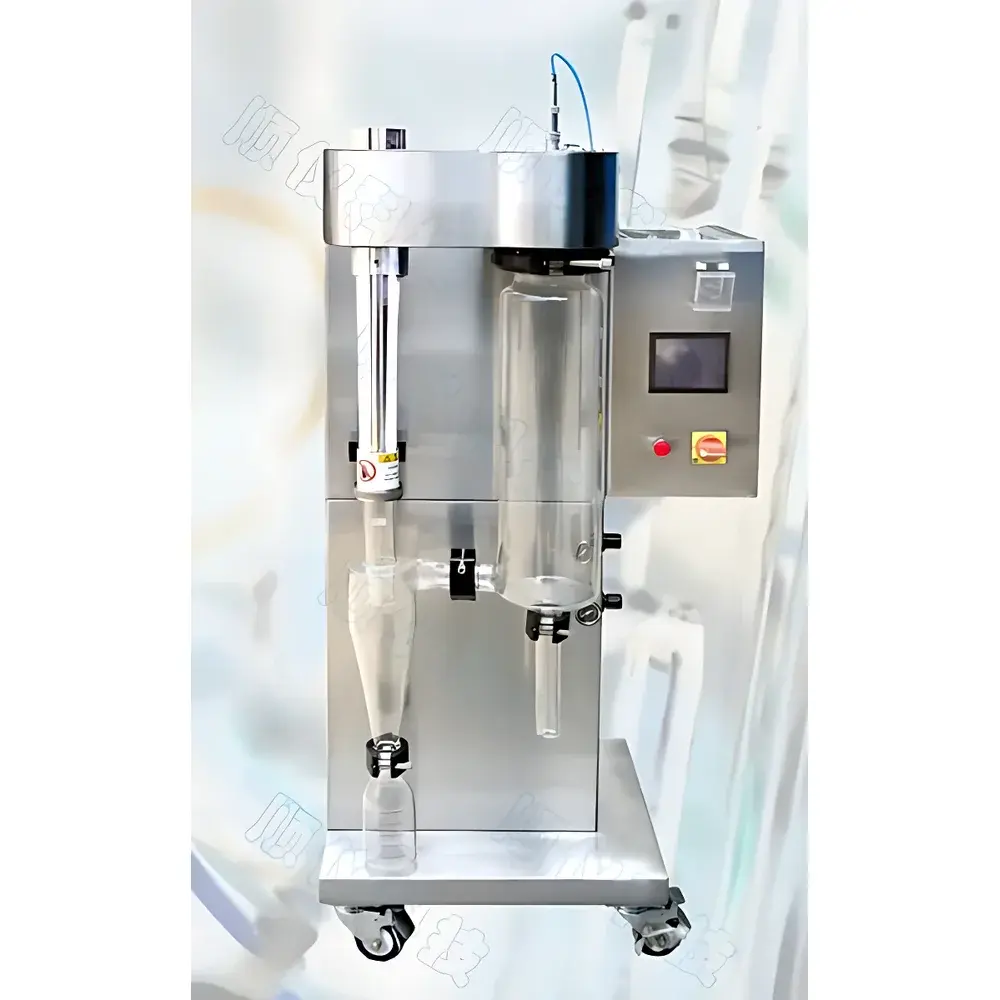
SUNYITECH SP-1500 Benchtop Spray Dryer
| Origin | Shanghai, China |
|---|---|
| Manufacturer Type | Authorized Distributor |
| Origin Category | Domestic (China) |
| Model | SP-1500 |
| Pricing | Upon Request |
| Evaporation Capacity | 1500 mL/h |
| Inlet Air Temperature Range | 30–280 °C |
| Outlet Air Temperature Range | 30–120 °C |
| Temperature Control Accuracy | ±1 °C |
| Drying Residence Time | 1.0–1.5 s |
| Feed Flow Rate (Peristaltic Pump) | 30–2000 mL/h |
| Airflow Volume | 0–330 m³/h |
| Air Pressure | Up to 686 Pa |
| Compressor Power | 0.2 kW |
| Compressed Air Output | 4.2 m³/h at 2–5 bar |
| Jet Cleaner (Needle) Frequency | Adjustable, driven by internal 2.3 bar compressed air supply |
| Nozzle Configuration | Standard dual-fluid nozzle (0.75 mm orifice), optional orifices 0.5–2.0 mm |
| Spray & Hot Air Flow Direction | Co-current, downward |
| Total Power Consumption | 3.5 kW |
| Electrical Supply | 220/240 V AC, 50/60 Hz, 13 A |
| Dimensions (L×W×H) | 650×500×1550 mm |
| Net Weight | 120 kg |
Overview
The SUNYITECH SP-1500 Benchtop Spray Dryer is an integrated, self-contained laboratory-scale spray drying system engineered for precision, reproducibility, and operational transparency in R&D environments. It operates on the principle of rapid solvent evaporation via atomization—where liquid feed is dispersed into fine droplets using a dual-fluid (air-assisted) nozzle, then exposed to a controlled stream of heated air in a co-current downward flow configuration. This thermodynamic process enables continuous conversion of solutions, suspensions, or emulsions into free-flowing, spherical dry powders within a residence time of 1.0–1.5 seconds. Designed for laboratories requiring scalable process development—from formulation screening to pilot-scale parameter mapping—the SP-1500 delivers consistent particle morphology and narrow size distribution without external utilities such as external air compressors or chillers.
Key Features
- Full-color 7-inch capacitive touchscreen interface with bilingual (English/Chinese) menu navigation and real-time parameter visualization—including inlet/outlet temperature, airflow rate, feed rate, and needle cleaning cycle status.
- PID-based closed-loop temperature control ensures stable thermal conditions; inlet air temperature is regulated with ±1 °C accuracy across the full 30–280 °C range.
- All critical process zones—including the drying chamber, cyclone separator, and collection vessel—are constructed from borosilicate glass (Schott Duran®-grade equivalent), enabling full visual monitoring of atomization behavior, droplet trajectory, and powder deposition dynamics.
- Dual-fluid nozzle assembly fabricated from electropolished ASTM A276 316 stainless steel; standard 0.75 mm orifice delivers monomodal droplet distribution, supporting high powder yield (>95% collection efficiency) and uniform particle sizing.
- Automated jet cleaner (‘needle’) system with adjustable frequency and integrated 2.3 bar compressed air supply prevents nozzle clogging during extended operation with viscous or particulate-laden feeds.
- Variable-speed peristaltic feed pump supports precise dosing from 30 mL/h (ideal for high-value APIs or nanomaterial precursors) up to 2000 mL/h, facilitating both micro-scale feasibility studies and larger batch optimization.
- Interlocked safety architecture: heater activation is physically inhibited until blower reaches nominal speed, preventing thermal runaway or chamber overheating under no-airflow conditions.
- Integrated oil-free scroll-type air compressor (0.2 kW) delivers clean, dry instrument-grade air (<5 µm particulate, ISO Class 3) at ≤50 dB(A) sound pressure level—suitable for shared lab environments.
- HEPA-class inlet air filtration (EN 1822 H13) minimizes environmental contamination, ensuring product purity compliance for pharmaceutical, nutraceutical, and functional food applications.
Sample Compatibility & Compliance
The SP-1500 accommodates aqueous and organic solvent-based feeds—including aqueous polymer dispersions, protein solutions (e.g., insulin, albumin), colloidal silica, nanoemulsions, and ceramic precursors—provided flash points exceed operational inlet temperatures. Its all-glass wetted path eliminates metal leaching risks, supporting USP and ICH Q5C stability study requirements. The system conforms to CE machinery directive 2006/42/EC and electromagnetic compatibility standard EN 61326-1. While not certified for GMP production, its design supports GLP-compliant documentation through audit-trail-capable data logging (via optional USB export) and operator-accessible calibration records—aligning with FDA 21 CFR Part 11 expectations when paired with validated SOPs.
Software & Data Management
The embedded SUNYITECH Temperature & Process Control System (v4.2) logs timestamped operational parameters at 1-second intervals to internal flash memory (16 GB). Data export is supported via USB 2.0 port in CSV format for post-processing in MATLAB®, Python (Pandas), or statistical analysis platforms. Optional Ethernet connectivity enables remote monitoring via Modbus TCP protocol for integration into centralized lab infrastructure. All setpoints, alarm thresholds, and user permissions are configurable and password-protected. Calibration certificates for temperature sensors (PT100 Class A) and airflow transducers (capacitance-based) are provided with each unit and traceable to NIM (National Institute of Metrology, China).
Applications
- Pharmaceutical R&D: Preparation of inhalable dry powders, amorphous solid dispersions (ASDs), and nanoparticle carriers with controlled residual moisture (<2.5% w/w).
- Food Science: Encapsulation of heat-sensitive actives (vitamins, probiotics, omega-3 oils) using maltodextrin or gum arabic matrices.
- Materials Engineering: Synthesis of spherical LiFePO₄ cathode precursors, SiO₂ aerogel particles, and metal-organic framework (MOF) microspheres.
- Academic Research: Kinetic modeling of droplet drying, investigation of crust formation mechanisms, and comparative evaluation of nozzle geometries on particle sphericity (measured via SEM + ImageJ).
- Quality Control Labs: Rapid moisture content verification, batch-to-batch consistency assessment, and excipient compatibility screening.
FAQ
What is the minimum sample volume required for a valid drying run?
The system supports feed volumes as low as 30 mL using the calibrated peristaltic pump—ideal for precious biologics or early-stage compound libraries.
Can the SP-1500 handle organic solvents such as ethanol or acetone?
Yes, provided the inlet temperature remains below the solvent’s autoignition point and appropriate explosion-proof modifications (e.g., nitrogen inerting kit, static-dissipative tubing) are implemented per local safety regulations.
Is the glass drying chamber resistant to thermal shock during rapid temperature ramping?
The borosilicate glass components are rated for continuous service up to 300 °C and withstand ΔT ≥120 °C/min without fracture when preheated according to the manufacturer’s startup protocol.
How is particle size distribution influenced by nozzle selection?
Orifice diameter directly governs primary droplet size: 0.5 mm nozzles yield median diameters (D50) of ~10–15 µm; 2.0 mm nozzles produce D50 ≈ 40–60 µm—verified by laser diffraction (Malvern Mastersizer) across >50 validation batches.
Does the system support 21 CFR Part 11 compliance out-of-the-box?
No—electronic signature, role-based access control, and audit trail encryption require supplemental software licensing and IQ/OQ documentation, available under SUNYITECH’s Validation Support Package (VSP-SP1500).



