
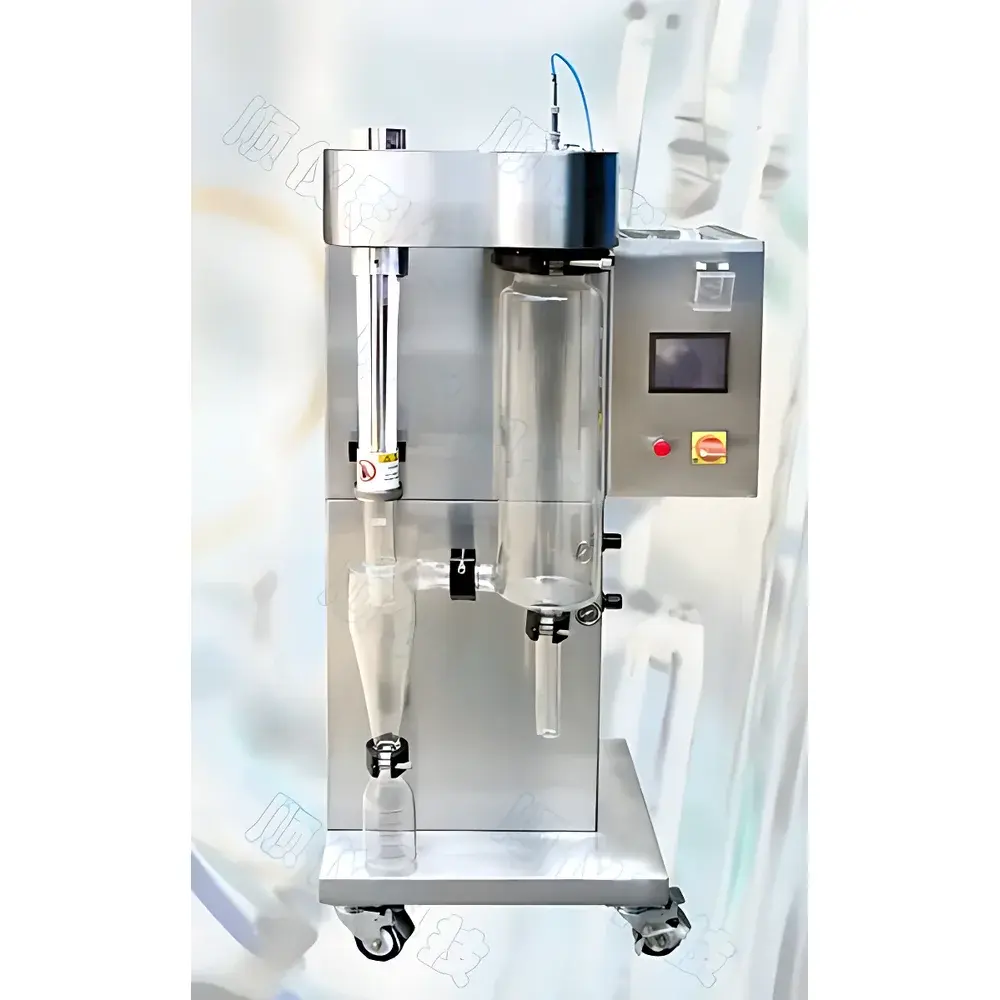
Sunyitech SP-1500 Benchtop Spray Dryer
| Origin | Shanghai, China |
|---|---|
| Manufacturer Type | Authorized Distributor |
| Origin Category | Domestic (PRC) |
| Model | SP-1500 |
| Pricing | Available Upon Request |
| Evaporation Capacity | 1500 mL/h |
| Inlet Air Temperature Range | 30–280 °C |
| Outlet Air Temperature Range | 30–120 °C |
| Temperature Control Accuracy | ±1 °C |
| Drying Residence Time | 1.0–1.5 s |
| Feed Rate (Peristaltic Pump) | 30–2000 mL/h |
| Air Flow Rate | 0–330 m³/h (Max), Max Static Pressure: 686 Pa |
| Compressor Power | 0.2 kW, Air Output: 4.2 m³/h, Operating Pressure: 2–5 bar |
| Nozzle Type | Two-Fluid, Standard Orifice: 0.75 mm (Optional: 0.5–2.0 mm) |
| Atomization Direction | Co-current, Downward |
| Heating System Power | 3.5 kW |
| Electrical Supply | AC 220–240 V, 50/60 Hz, 13 A |
| Dimensions (L×W×H) | 650 × 500 × 1550 mm |
| Net Weight | 120 kg |
| Integrated Oil-Free Air Compressor | Noise Level < 50 dB(A) |
| Air Intake Filter | HEPA-Class Pre-Filter Included |
| Collection Efficiency | >95% of dried powder within a single particle size distribution band |
Overview
The Sunyitech SP-1500 is a fully integrated benchtop spray dryer engineered for reproducible, scalable laboratory-scale drying of heat-sensitive and high-value formulations—including pharmaceutical actives, biopolymers, nanocellulose suspensions, functional food ingredients, and catalyst precursors. It operates on the principle of rapid solvent evaporation via concurrent two-fluid atomization: liquid feed is pneumatically dispersed into fine droplets using compressed air or nitrogen, then exposed to a controlled stream of heated drying gas. With a nominal evaporation capacity of 1500 mL/h and sub-second residence time (1.0–1.5 s), the system enables gentle thermal processing while preserving structural integrity and bioactivity. Its all-in-one architecture eliminates dependency on external air compressors, chillers, or exhaust ducting—making it suitable for ISO Class 7 clean benches, fume hoods, and regulated QC laboratories.
Key Features
- Full-color 7-inch capacitive touchscreen interface with bilingual (English/Chinese) menu navigation and real-time parameter visualization—including inlet/outlet temperatures, feed rate, airflow, and compressor status.
- PID-based closed-loop temperature control ensures ±1 °C accuracy across the full inlet temperature range (30–280 °C), critical for thermolabile compound processing per ICH Q5C stability guidelines.
- Optically transparent borosilicate glass drying chamber, cyclone separator, and collection vessel allow continuous visual monitoring of atomization behavior, particle trajectory, and wall deposition—supporting method development and troubleshooting without process interruption.
- Two-fluid nozzle assembly fabricated from ASTM A276 Grade 316 stainless steel; standard 0.75 mm orifice (0.5–2.0 mm optional) delivers narrow, normally distributed droplet size (Dv50 ≈ 20–40 µm), directly influencing final powder morphology and flowability.
- Automated needle-clearing mechanism (‘jet-clean’ function) with adjustable frequency (0.5–5 Hz) and internal 2.3 bar compressed air supply prevents nozzle clogging during viscous or particulate-laden feed applications.
- Calibrated peristaltic pump with linear 30–2000 mL/h flow range supports minimal sample consumption (as low as 30 mL total feed volume), essential for early-stage API screening and formulation optimization.
- Safety interlock logic: heater activation is physically inhibited until blower reaches operational RPM; dual thermal cutoffs protect against overheating under no-flow or low-airflow conditions.
- Integrated oil-free scroll compressor (<50 dB[A] acoustic emission) eliminates hydrocarbon contamination risk—compliant with USP environmental monitoring requirements for sterile process simulation.
Sample Compatibility & Compliance
The SP-1500 accommodates aqueous, alcoholic, and organic solvent-based solutions, emulsions, and colloidal dispersions with viscosities up to 500 cP. Its inert glass-wetted path and HEPA-class intake filtration ensure compatibility with GMP-aligned workflows. The system meets mechanical safety standards per IEC 61000-6-2 (EMC immunity) and IEC 61000-6-4 (EMC emissions). While not certified for explosion-proof operation, optional nitrogen inerting kits are available for Class I, Division 1 solvent handling per NFPA 497. Data logging functionality supports ALCOA+ principles when paired with validated software extensions.
Software & Data Management
The embedded Sunyitech temperature and process controller records timestamped values for all critical parameters at 1 Hz resolution. Exportable CSV files include inlet/outlet temperatures, feed rate, airflow, and compressor duty cycle—enabling post-run statistical analysis (e.g., Cp/Cpk, ANOVA) and batch traceability. Optional Ethernet-enabled firmware upgrade adds remote monitoring, user-level access control, and audit trail generation compliant with FDA 21 CFR Part 11 Annex 11 requirements.
Applications
- Pharmaceutical: Production of inhalable dry powders (DPIs), amorphous solid dispersions (ASDs), and nanoparticle-loaded microparticles for oral delivery.
- Food Science: Encapsulation of probiotics, omega-3 oils, and anthocyanins; production of instant beverage powders with controlled hygroscopicity.
- Materials Research: Synthesis of spherical metal oxide precursors (e.g., LiCoO₂, SiO₂), porous silica microspheres, and polymer-coated magnetic nanoparticles.
- Academic & Method Development: Rapid screening of excipient compatibility, drying kinetics modeling, and scale-up correlation studies (0.1–5 kg/h equivalent).
FAQ
What is the minimum feed volume required for a valid drying run?
Minimum recommended feed volume is 30 mL to ensure stable atomization and representative particle formation. Lower volumes may yield incomplete drying or non-reproducible morphology.
Can the SP-1500 operate with nitrogen instead of compressed air?
Yes—the system accepts external nitrogen supply via the same inlet port used for compressed air; pressure regulation and flow metering must be externally managed.
Is the glassware autoclavable?
All borosilicate components are rated for autoclaving at 121 °C/15 psi; however, repeated thermal cycling may reduce long-term transparency due to alkali leaching—regular inspection is advised.
Does the unit support GLP-compliant data archiving?
Raw process logs meet GLP documentation requirements; for full electronic signature and audit trail compliance, the optional Sunyitech DataVault module must be installed and qualified.
What maintenance intervals are recommended for the compressor and filters?
Compressor service (oil-free bearing inspection) every 2000 operating hours; intake filter replacement every 3 months or after 500 h of continuous use in dusty environments.



