
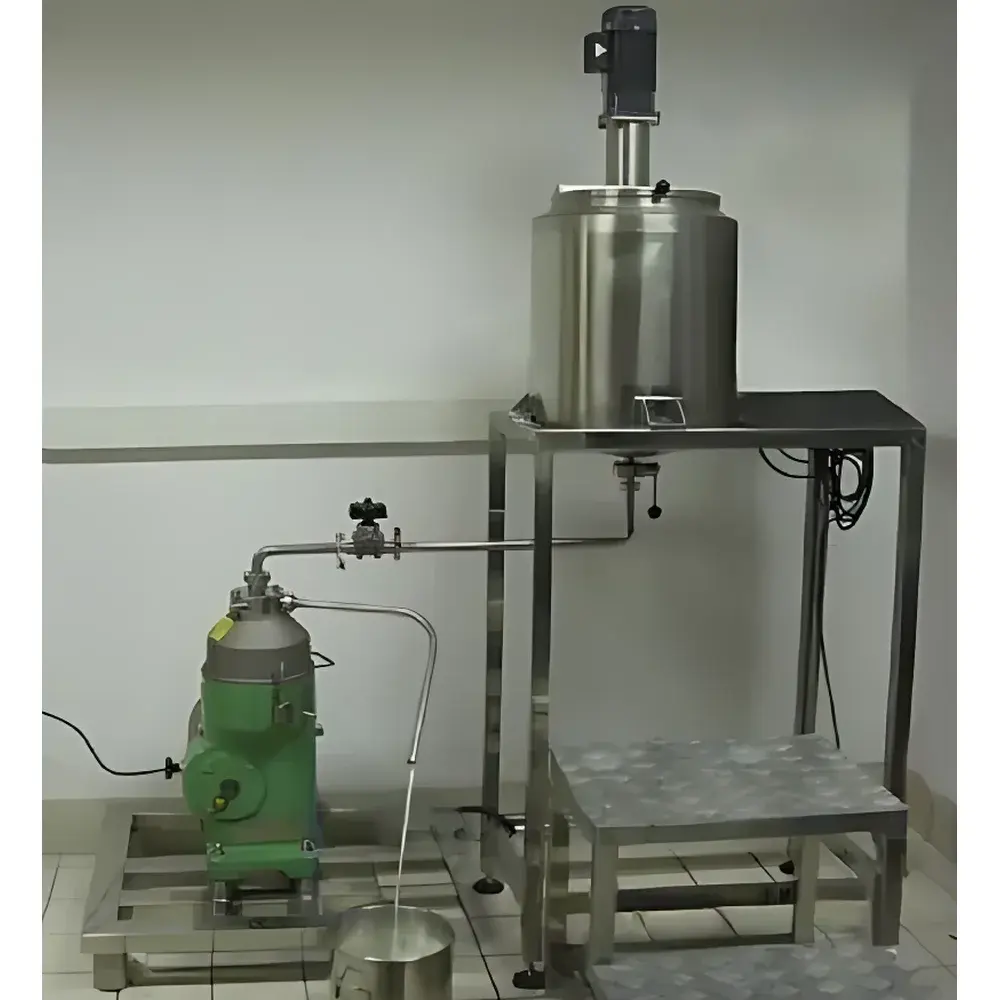
Italian-Made SE03.0V Benchtop Disc Stack Centrifuge for Continuous Liquid-Liquid-Solid Separation
| Origin | Italy |
|---|---|
| Manufacturer Type | Authorized Distributor |
| Import Status | Fully Imported |
| Model | SE03.0V |
| Instrument Type | Floor-Standing Centrifuge |
| Speed Range | 10,000–30,000 rpm (Rated Max: 11,000 rpm) |
| Max RCF | 11,000 × g |
| Max Capacity | 5 L (per batch, with optional 10–1000 L/h continuous operation) |
| Dimensions (W×D×H) | 670 × 455 × 880 mm |
| Power Supply | 3-phase, 380 V, 50 Hz, 1.5 kW |
| Motor Protection | IP55, Class F Insulation, Thermal Overload Protection |
| Drum Material | High-Strength Stainless Steel (AISI 431 shaft, precision-machined disc stack in AISI 304), Dynamic Balance Grade G2.5 |
| Feed/Discharge | Sanitary 304 SS inlet tubing, pressure gauge, micro-controlled discharge valves |
| Compliance | CE-marked, designed per ISO 13485 principles for pharmaceutical process validation support |
| Typical Configuration | Horizontal-axis disc stack centrifuge with integrated 25/50 L feed & clarified product tanks |
Overview
The Italian-engineered SE03.0V Disc Stack Centrifuge is a floor-standing, continuous-feed laboratory-scale separation system designed to replicate industrial-scale disc centrifugation under controlled R&D conditions. Unlike conventional batch centrifuges, it operates on the principle of high-speed sedimentation within a rotating stack of conical discs—increasing effective settling area by up to 500× compared to tubular geometry. This enables simultaneous three-phase (liquid-liquid-solid) or two-phase (liquid-solid or immiscible liquid-liquid) separation with high throughput and reproducible partitioning efficiency. Its core architecture supports process development from early-stage formulation screening through pilot-scale validation, particularly where regulatory traceability, scalability, and shear-sensitive material handling are critical—such as in dairy standardization, biopharmaceutical clarification, edible oil degumming, and fermentation broth harvesting.
Key Features
- Continuous-feed capability with adjustable throughput from 50 to 1000 L/h—enabling direct scale-up correlation from lab to production without re-optimization
- High-precision AISI 431 stainless steel rotor shaft and dynamically balanced disc stack (G2.5 grade), minimizing vibration and acoustic emission during operation at 11,000 rpm
- Integrated dual-tank system: 25 L or 50 L sanitary-grade AISI 304 feed reservoir and clarified effluent collection tank—eliminating external pumping infrastructure
- Modular, freestanding stainless steel frame with horizontal leveling adjustment; no anchoring, concrete foundation, or seismic retrofitting required
- Sanitary fluid path components—including inlet piping, pressure monitoring, and micro-controlled discharge valves—all constructed from electropolished AISI 304 stainless steel meeting EHEDG and 3-A standards
- IEC 60034-compliant motor with IP55 ingress protection, Class F insulation, and embedded thermal cut-off for sustained duty-cycle reliability
Sample Compatibility & Compliance
The SE03.0V accommodates a broad range of low-to-medium viscosity Newtonian and non-Newtonian suspensions and emulsions—including raw milk, fruit juice concentrates, microbial cell lysates, vegetable oil mixtures, and aqueous polymer solutions. Its disc geometry allows efficient separation of particles ≥0.5 µm and dispersed phase droplets ≥2 µm under optimized residence time and flow rate. The unit complies with CE Directive 2006/42/EC (Machinery Safety) and carries EMC conformity per EN 61326-1. While not certified as GMP equipment per se, its construction, documentation package (including FAT/SAT protocols), and audit-ready operational logs align with GLP and pre-GMP process development requirements. It supports validation activities compliant with FDA 21 CFR Part 11 when paired with validated data acquisition software.
Software & Data Management
The centrifuge operates via a programmable logic controller (PLC) interface with real-time display of rotational speed, feed pressure, temperature (optional sensor port), and elapsed run time. All operational parameters—including start/stop timestamps, speed ramp profiles, and manual intervention events—are logged internally with UTC timestamping and exportable via USB to CSV format. When integrated with third-party SCADA or LIMS platforms (e.g., LabWare, DeltaV), the system supports electronic signature capture, audit trail generation, and role-based access control—facilitating compliance with ISO/IEC 17025 and USP analytical instrument qualification frameworks.
Applications
- Dairy processing: Skim milk production with residual fat ≤0.05% w/w, standardized cream separation, whey protein concentration
- Beverage industry: Juice and wine clarification, removal of pectin haze and yeast cells without enzymatic treatment
- Biopharmaceuticals: Harvest of mammalian or microbial cells, removal of host cell debris post-lysis, intermediate purification of viral vectors
- Edible oils: Degumming of crude soybean or sunflower oil, phosphatide separation, soapstock recovery
- Chemical synthesis: Catalyst recovery from homogeneous reaction mixtures, solvent extraction phase splitting, polymer latex fractionation
FAQ
What is the minimum batch volume required for method development?
The system supports discrete batch operation down to 10 L per cycle, allowing full characterization of separation kinetics, phase distribution, and solids retention without continuous feed constraints.
Can the disc stack be cleaned-in-place (CIP)?
Yes—the entire fluid path is designed for CIP using caustic soda (NaOH) and nitric acid (HNO₃) solutions at temperatures up to 85°C, with validated flow velocity >1.5 m/s and Reynolds number >4,000.
Is rotor balancing performed at the factory?
Each rotor assembly undergoes dynamic balancing per ISO 1940-1 at 1.2× maximum operating speed (13,200 rpm) and is supplied with balance certificate and serial-matched disc set.
Does the unit support variable-frequency drive (VFD) speed control?
Yes—speed is continuously adjustable from 3,000 to 11,000 rpm via built-in VFD with 0.1 rpm resolution and ±0.5% speed stability under load.
What documentation is included for regulatory submission?
Standard delivery includes Factory Acceptance Test report, Material Certificates (EN 10204 3.1), Electrical Safety Certificate (EN 61000-6-2/3), and Operation & Maintenance Manual with preventive maintenance schedule and spare parts list.



