
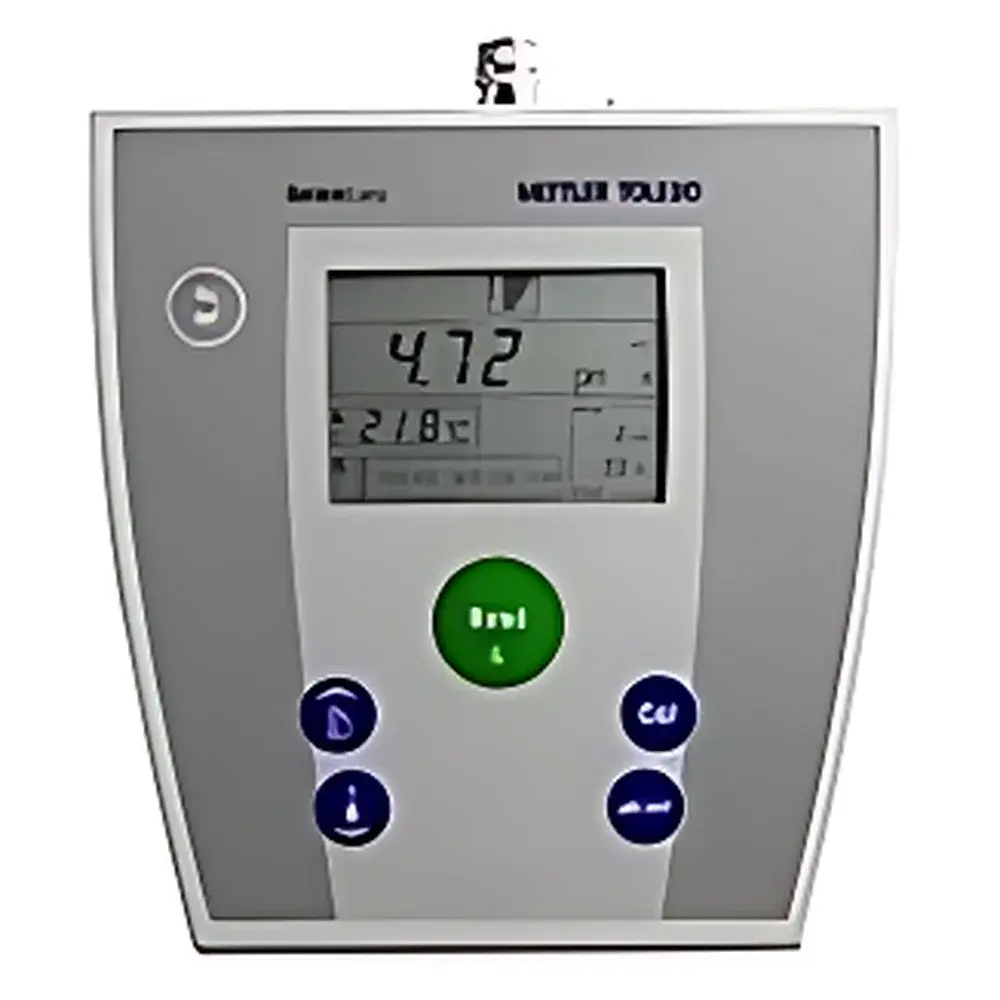
METTLER TOLEDO S30 SevenEasy™ Conductivity Meter
| Brand | METTLER TOLEDO |
|---|---|
| Origin | Switzerland |
| Model | S30 |
| Temperature Range | –5.0 to 105.0 °C |
| Temperature Resolution | 0.1 °C |
| Temperature Accuracy | ±0.2 °C |
| Conductivity Range | 0.01 µS/cm to 500 mS/cm (auto-ranging) |
| Conductivity Accuracy | ±0.5% of reading |
| Salinity Range | 0.00–80.00 ppt |
| TDS Range | 0.1 mg/L to 500 g/L |
| TDS Factor | User-definable (0.40–1.00) |
| Resistivity Range | 0.000 Ω·cm to 100.0 MΩ·cm |
| Electrode Constant Input | User-configurable |
| Display | Backlit LCD with simultaneous parameter + temperature readout |
| Power Supply | AC adapter (included) or 4× AA (LR6) batteries |
| Interface | RS232 for data export |
| Compliance | Designed for GLP-compliant workflows |
Overview
The METTLER TOLEDO S30 SevenEasy™ Conductivity Meter is a benchtop electrochemical instrument engineered for routine, high-reproducibility measurement of conductivity, salinity, total dissolved solids (TDS), and resistivity across diverse aqueous samples. It operates on the principle of two-electrode or four-electrode conductometric sensing—where an alternating current is applied across a defined electrode geometry, and the resulting voltage drop is used to calculate solution conductance, corrected for cell geometry via user-entered or auto-recognized electrode constant. Designed in accordance with ISO 7888 and ASTM D1125 standards for conductivity measurement, the S30 delivers traceable, temperature-compensated results suitable for QC laboratories in pharmaceutical, food & beverage, environmental monitoring, and academic research settings. Its modular architecture supports both standalone operation and integration into structured data management protocols.
Key Features
- Automatic Temperature Compensation (ATC): Real-time correction using integrated Pt1000 sensor (±0.2 °C accuracy) ensures compliance with standard temperature references (e.g., 25 °C) per ISO 7888.
- Auto-Endpoint Detection: Intelligent signal stabilization algorithm locks measurement once drift falls below 0.1 %/sec for ≥2 seconds—minimizing operator dependency and enhancing inter-user reproducibility.
- Buffer Recognition During Calibration: Supports pre-programmed IUPAC and DIN buffer sets (e.g., KCl 0.01 mol/kg, 0.1 mol/kg); automatic identification eliminates manual entry errors and accelerates multi-point calibration.
- Configurable Electrode Constant Entry: Enables precise adaptation to a wide range of conductivity cells—including InLab® 731 (k = 0.1 cm⁻¹), InLab® 741 (k = 1.0 cm⁻¹), and custom probes—ensuring metrological traceability.
- Dual-Power Operation: Operates continuously via included AC adapter or up to 2,000 hours on four AA alkaline batteries—ideal for field deployment or backup during power outages.
- Backlit LCD Display: Simultaneously shows primary parameter (e.g., conductivity), temperature, unit, stability indicator, and electrode status—optimized for rapid visual verification under varied ambient lighting.
Sample Compatibility & Compliance
The S30 accommodates low-conductivity ultrapure water (≥18.2 MΩ·cm), process brines (up to 500 mS/cm), and intermediate matrices such as drinking water, wastewater effluents, and cell culture media. Its IP20-rated enclosure meets IEC 61010-1 safety requirements for laboratory instruments. All measurements adhere to Good Laboratory Practice (GLP) principles: timestamps, operator ID (via optional keypad login), calibration history, and measurement metadata are retained internally and exportable. While the S30 itself does not provide full 21 CFR Part 11 compliance (e.g., electronic signatures), its RS232 output enables integration with validated LIMS or ELN systems supporting audit trails, electronic records, and role-based access control.
Software & Data Management
Raw measurement data—including conductivity, temperature, date/time stamp, electrode constant, and calibration points—is stored in non-volatile memory (up to 200 entries). Export occurs via RS232 serial interface to PC-based software (e.g., METTLER TOLEDO LabX® Light or third-party CSV-compatible applications). No proprietary drivers required; ASCII-formatted output includes delimiter-separated fields for direct import into Excel, MATLAB, or statistical analysis platforms. Calibration logs retain slope, offset, and R² values for each session—supporting internal QA reviews and external audits per ISO/IEC 17025.
Applications
- Pharmaceutical Water Systems: USP compliant resistivity monitoring of Purified Water (PW) and Water for Injection (WFI).
- F&B Quality Control: Batch verification of brine concentration in canned vegetables, sugar content estimation via TDS in syrups, and conductivity-based cleaning validation (CIP rinse water).
- Environmental Labs: Field-deployable salinity profiling in estuarine studies and TDS screening of groundwater per EPA Method 120.1.
- Academic Teaching: Demonstrating Kohlrausch’s law, ion mobility trends, and temperature dependence of electrolyte conduction in physical chemistry labs.
- Industrial Process Support: Monitoring boiler feedwater purity, electroplating bath composition, and desalination plant permeate quality.
FAQ
Does the S30 support four-electrode conductivity measurement?
No—the S30 is a two-electrode system optimized for general-purpose applications. For high-accuracy, high-conductivity, or polarizable sample measurement (e.g., aggressive acids/bases), METTLER TOLEDO recommends the SevenCompact™ series with optional four-electrode cells.
Can calibration data be edited after completion?
Calibration parameters are write-protected post-execution to preserve data integrity. Recalibration is required to update electrode constant or buffer assignments.
Is the InLab® 731 electrode included with all configurations?
Only the S30K bundle (order code 51302806) includes the InLab® 731 conductivity electrode. The base S30 (51302805) requires separate electrode procurement.
What is the maximum allowable sample temperature during measurement?
The instrument supports continuous measurement up to 105.0 °C; however, electrode compatibility must be verified separately—InLab® 731 is rated to 80 °C.
How frequently should the instrument be recalibrated?
Recalibration frequency depends on usage intensity and regulatory context. Daily calibration is recommended for GLP-regulated environments; weekly verification suffices for stable, low-risk processes—always following documented SOPs.





