
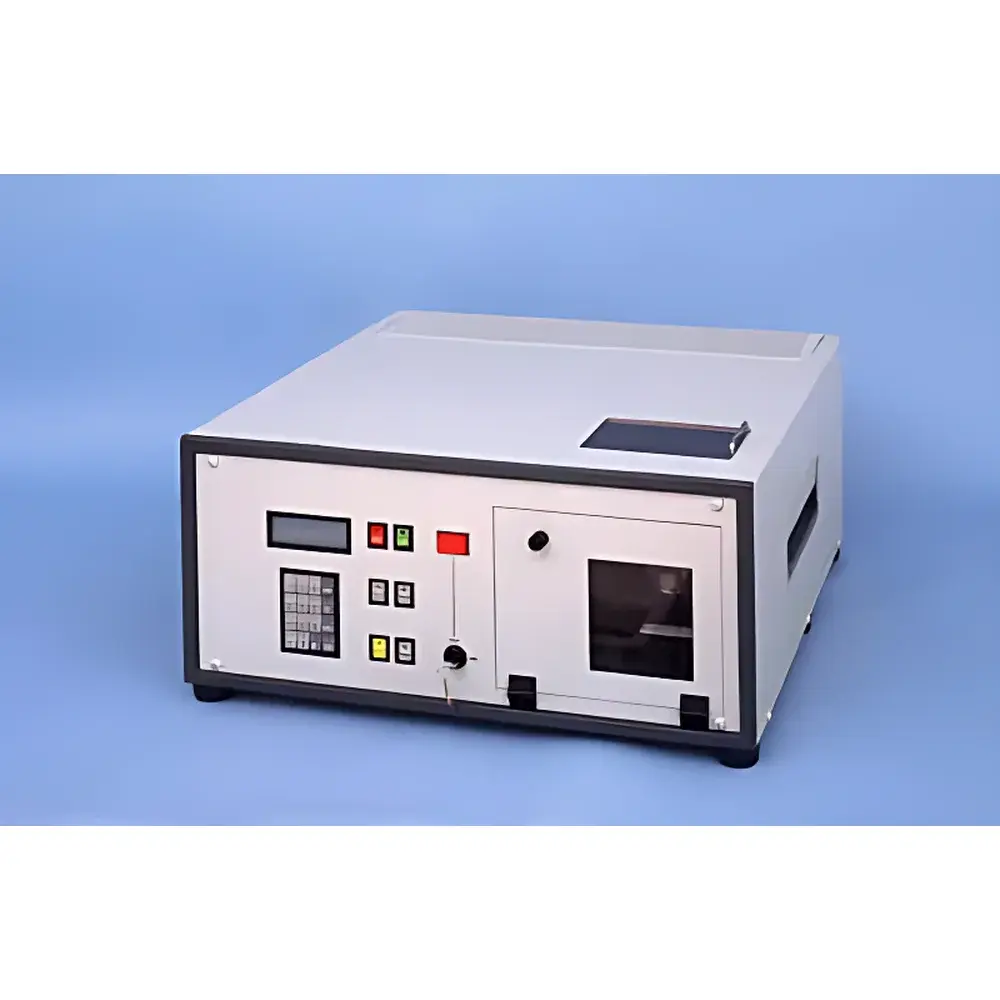
Brookhaven BI-DCP / BI-XDC Disc Centrifuge Sedimentation Particle Size Analyzer
| Brand | Brookhaven Instruments |
|---|---|
| Origin | USA |
| Model | BI-DCP / BI-XDC |
| Measurement Principle | Centrifugal & Gravitational Sedimentation |
| Repeatability | 1% |
| Accuracy | ±2% |
| Particle Size Range (BI-DCP) | 0.01–45 µm |
| Particle Size Range (BI-XDC) | 0.01–100 µm |
| Detection Method | Visible Light (BI-DCP) / X-ray (BI-XDC) |
| Sample Introduction | Layered (LIST mode) or Homogeneous (HOST mode) |
| Rotational Speed Range | 500–15,000 rpm (BI-DCP) |
| Speed Stability | ±0.01% |
| Disk Material | Standard PMMA or Corrosion-Resistant Alternative |
| Data Storage | Built-in extinction curve database (BI-DCP) |
Overview
The Brookhaven BI-DCP and BI-XDC Disc Centrifuge Sedimentation Particle Size Analyzers are precision-engineered instruments based on the fundamental hydrodynamic principle of sedimentation under controlled centrifugal or gravitational fields. These analyzers implement Stokes’ law—relating particle terminal velocity to size, density difference, and fluid viscosity—to resolve particle size distributions with exceptional resolution and statistical robustness. Unlike ensemble-averaging techniques such as laser diffraction, disc centrifugation provides true single-particle detection via time-resolved optical (BI-DCP) or X-ray (BI-XDC) transmission monitoring as particles sequentially sediment through a thin, rotating liquid layer. This method delivers high-resolution, mass-based size distributions across a broad dynamic range (0.01–100 µm), making it uniquely suited for polydisperse, dense, or optically challenging colloidal and powder systems where accurate quantification of minor modal populations is critical.
Key Features
- Two platform configurations: BI-DCP employs visible-light transmission detection with integrated extinction curve database for automatic refractive index compensation; BI-XDC utilizes X-ray absorption detection, eliminating dependence on optical properties and enabling direct analysis of opaque, highly absorbing, or metallic samples without calibration.
- Dual operational modes: Centrifugal sedimentation (for rapid, high-resolution analysis of submicron to micron particles) and gravitational sedimentation (for gentle, low-shear characterization of fragile aggregates or large particles up to 100 µm).
- High-precision digital motor control with speed stability of ±0.01% and programmable rotational profiles (500–15,000 rpm for BI-DCP; 500–10,000 rpm optional for BI-XDC), ensuring reproducible hydrodynamic conditions across repeated runs.
- Flexible sample introduction: HOST mode enables homogeneous suspension analysis; LIST mode supports layered injection for improved resolution of multimodal distributions by minimizing initial dispersion artifacts.
- Robust disk architecture: Standard polymethyl methacrylate (PMMA) rotor disks are available, with chemically resistant alternatives (e.g., quartz-coated or fluoropolymer-lined) for aggressive solvents or corrosive suspensions.
- Validated repeatability of ≤1% RSD (relative standard deviation) and accuracy of ±2% against NIST-traceable reference materials—meeting requirements for routine QC in regulated environments.
Sample Compatibility & Compliance
The BI-DCP and BI-XDC accommodate a wide spectrum of industrial and research-grade particulate systems—including latex emulsions, carbon black, metal oxides (e.g., TiO₂, Al₂O₃), ceramic precursors, pharmaceutical excipients, pigment dispersions, and nanoscale catalysts. Both instruments support aqueous and organic media (e.g., toluene, xylene, alcohols), provided viscosity and density parameters fall within operational limits defined by Stokes’ regime validity. The platforms are routinely deployed in GLP-compliant laboratories and support full audit trails, electronic signatures, and data integrity features aligned with FDA 21 CFR Part 11 requirements when used with validated software configurations. Method protocols conform to ASTM D4467 (Standard Test Method for Particle Size Distribution of Carbon Black by Disc Centrifuge) and ISO 13321 (Particle size analysis — Photon correlation spectroscopy), with documented traceability to international reference standards.
Software & Data Management
Acquisition and analysis are managed via Brookhaven’s proprietary WinDCP software suite, designed for both routine operator use and advanced method development. The interface supports automated method sequencing, real-time sedimentation curve visualization, multi-peak deconvolution using constrained non-negative least squares (NNLS), and export of distribution metrics (D10, D50, D90, span, modal widths) in CSV, XML, or PDF formats. All raw transmission/time datasets are stored with full metadata (temperature, rotor speed, medium viscosity, density, disk ID), enabling retrospective reprocessing and inter-laboratory comparison. Software validation packages—including IQ/OQ documentation, change control logs, and backup/recovery procedures—are available to support GMP and ISO 17025 accreditation.
Applications
These analyzers serve as primary tools for formulation optimization and process control across multiple sectors. In polymer latex manufacturing, they identify batch-to-batch variability in particle nucleation and growth kinetics—enabling correction of reactor fouling or surfactant imbalance before downstream coating defects occur. Carbon black producers rely on BI-DCP for tire compound qualification, where deviations >0.5% in the 20–50 nm mode directly correlate with changes in vulcanization kinetics and tread wear resistance. In pharmaceutical dry powder inhalers, BI-XDC quantifies agglomerate breakage during micronization and blending, supporting QbD-based control strategies per ICH Q5A and Q8(R2). Additional applications include quality release testing of battery cathode powders (LiCoO₂, NMC), rheological modifier characterization in architectural coatings, and nanoparticle stability assessment in cosmetic emulsions.
FAQ
How does disc centrifugation differ from laser diffraction in terms of resolution?
Disc centrifugation resolves individual particle populations based on sedimentation velocity, delivering true mass-weighted distributions with resolution down to 1.2× between adjacent modes—significantly higher than ensemble optical methods limited by Mie scattering assumptions and signal averaging.
Can the BI-XDC analyze metallic powders without sample preparation?
Yes. X-ray detection enables direct measurement of conductive or opaque particles (e.g., Fe, Cu, Ni powders) in carrier fluids without surface modification, sonication, or dispersant addition—provided sedimentation remains stable and non-aggregating.
Is method transfer between BI-DCP and BI-XDC straightforward?
While both platforms report equivalent size metrics under Stokes conditions, method transfer requires verification due to differences in detection physics (absorption vs. extinction) and hydrodynamic boundary effects. Cross-platform validation using common reference materials is recommended per ISO/IEC 17025 clause 7.2.2.
What maintenance is required to sustain ±0.01% speed accuracy?
Annual calibration of the motor encoder and tachometer system is recommended; rotor balance verification should be performed before each high-speed run (>10,000 rpm). Brookhaven-certified service includes torque calibration, bearing inspection, and firmware validation.
Does the system support 21 CFR Part 11 compliance out-of-the-box?
The base software includes user access controls and electronic signature prompts; full Part 11 compliance requires implementation of a validated IT infrastructure, documented SOPs, and periodic security audits—services available through Brookhaven’s Regulatory Support Program.



