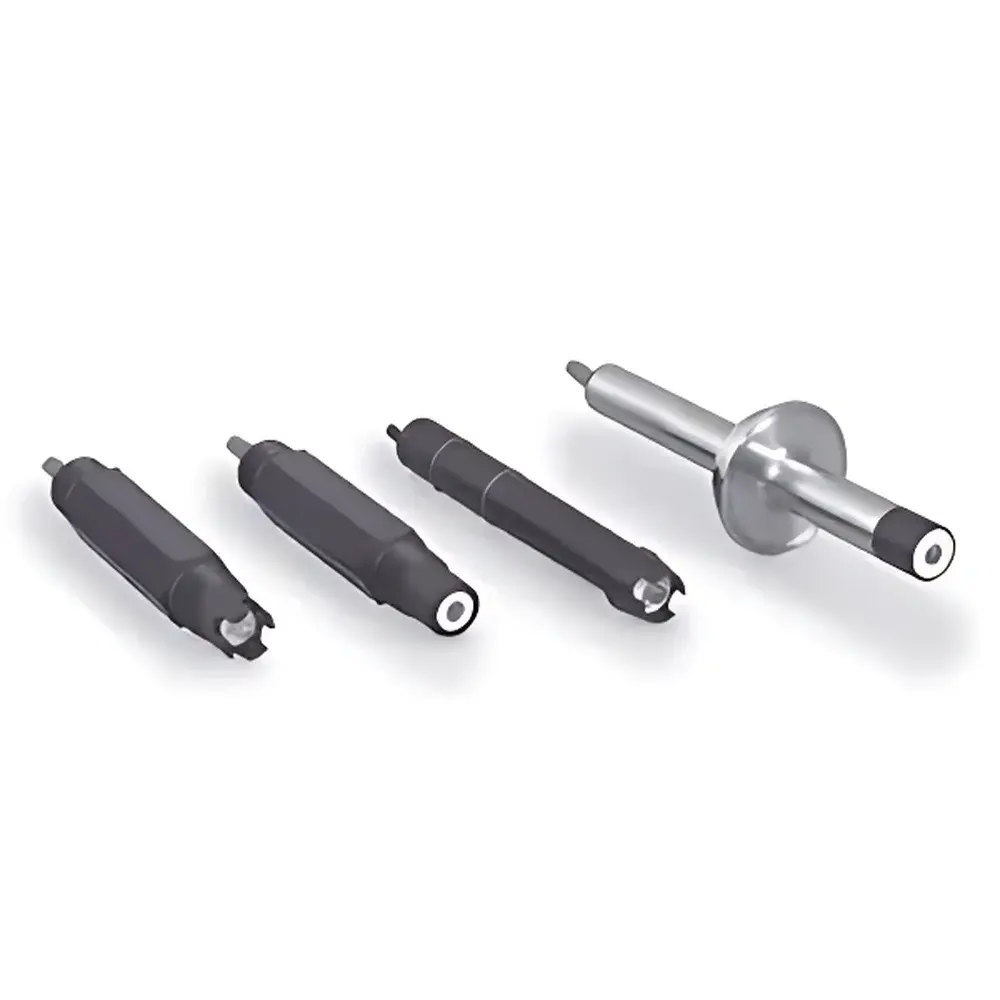
Hach GLI 3/4-inch Composite pH/ORP Electrode for Online Process Monitoring
| Brand | Hach |
|---|---|
| Origin | USA |
| Model | GLI 3/4-inch |
| Body Material | Ryton® (general-purpose) / PVDF (insertion-type) / PVDF with 316SS liner (sanitary-type) |
| pH Range | 0–14 |
| ORP Range | −2000 to +2000 mV |
| Temp. Range | 0–105 °C |
| Max. Pressure | 6.9 bar at 100 °C |
| Flow Rate Limit | ≤2 m/s (non-abrasive fluids) |
| pH Accuracy | <0.1 pH |
| ORP Accuracy | ±20 mV (in standard solutions) |
| Temperature Compensation | Built-in Pt1000 |
| Reference System | Dual-salt-bridge |
| Grounding | Integrated ground connection |
| Thread | 3/4″ NPT (general-purpose) |
| Flange | 2″ sanitary clamp (sanitary-type) |
| Cable Length | 4.5 m (standard) |
Overview
The Hach GLI 3/4-inch Composite pH/ORP Electrode is an industrial-grade, process-integrated sensing solution engineered for continuous, reliable measurement of hydrogen ion activity (pH) and oxidation-reduction potential (ORP) in demanding aqueous environments. Based on potentiometric principle—measuring the voltage difference between a pH-sensitive glass membrane (or inert platinum surface for ORP) and a stable reference electrode—the sensor delivers real-time electrochemical data essential for process control, effluent compliance, and chemical dosing optimization. Its modular mechanical architecture supports three primary installation configurations—flow-through (threaded), insertion (retractable), and sanitary (clamp-mounted)—enabling seamless integration into municipal wastewater treatment plants, chemical manufacturing lines, pulp & paper digesters, and pharmaceutical water systems. Designed to operate continuously under elevated temperature (up to 105 °C) and pressure (up to 6.9 bar at 100 °C), the electrode meets long-term stability requirements in corrosive, fouling-prone, or high-flow applications where sensor longevity and calibration integrity are critical.
Key Features
- Triple-platform mechanical design: General-purpose (3/4″ NPT Ryton® body), insertion-type (PVDF body with Viton® O-rings), and sanitary (PVDF body with 316 stainless steel liner and 2″ tri-clamp flange)
- Dual-salt-bridge reference system minimizes electrolyte contamination and extends service life in high-chloride, sulfide-rich, or heavy-metal-laden streams
- Integrated Pt1000 temperature sensor enables automatic, algorithmic temperature compensation per NIST-traceable thermistor response curves
- Chemically resistant wetted materials: Ryton® (polyphenylene sulfide) for broad acid/base resistance; PVDF (polyvinylidene fluoride) for HF compatibility and UV stability; 316SS liner for enhanced mechanical rigidity in hygienic applications
- Built-in grounding connection reduces electromagnetic interference (EMI) and improves signal integrity in electrically noisy plant environments
- Retractable insertion design allows hot-tap maintenance—electrode removal and replacement without process shutdown or line isolation
Sample Compatibility & Compliance
The GLI 3/4-inch electrode demonstrates robust performance across heterogeneous liquid matrices including activated sludge, anaerobic digester supernatant, caustic cleaning solutions, chlorine-dosed cooling water, and USP Purified Water (PW) and Water for Injection (WFI) loops when configured with sanitary hardware. It complies with ISO 7027 (for turbidity-coupled validation protocols), ASTM D1293 (Standard Test Method for pH of Water), and EN 27888 (Water quality — Guidance on pH measurement). While not intrinsically rated for hazardous locations, its construction supports use in Zone 2/Class I, Division 2 areas when paired with appropriate barrier-protected transmitters. The dual-salt-bridge reference and low-drift glass formulation ensure conformance with GLP/GMP documentation requirements—including audit-ready calibration logs and drift verification per USP and when integrated with Hach SC1000 or HQ40d platforms supporting 21 CFR Part 11-compliant data handling.
Software & Data Management
When connected to Hach’s SC1000 Multi-Parameter Controller or HQ Series portable/online analyzers, the GLI electrode leverages embedded firmware for automated calibration sequence execution (single- or two-point), slope monitoring, and asymmetric offset diagnostics. All measurements are timestamped and stored with metadata (temperature, calibration history, sensor ID, operator tag) in non-volatile memory. Data export via Modbus RTU/ASCII or Ethernet/IP enables direct ingestion into DeltaV, PI System, or Ignition SCADA platforms. Audit trails include user-initiated actions, calibration events, and sensor health flags—fully compliant with FDA 21 CFR Part 11 for electronic records and signatures when deployed with validated configuration and access controls.
Applications
- Municipal wastewater: Aeration basin pH control, final effluent compliance monitoring, anaerobic digester alkalinity tracking
- Industrial pretreatment: Neutralization tank feedback control, rinse water pH verification in metal finishing lines
- Power generation: Condensate polishing loop pH surveillance, boiler feedwater amine treatment optimization
- Food & beverage: CIP solution concentration verification, fermentation broth pH profiling
- Pharmaceutical utilities: PW/WFI distribution loop trending, clean-in-place (CIP) cycle endpoint detection
- Chemical manufacturing: Batch reactor pH titration endpoints, scrubber liquor redox monitoring
FAQ
What installation options does the GLI 3/4-inch electrode support?
It offers three mechanically distinct configurations: general-purpose (3/4″ NPT threaded for tee fittings), insertion-type (slip-fit PVDF body with Viton® seals for retractable mounting), and sanitary (2″ tri-clamp with 316SS-lined PVDF body for ASME BPE-compliant vessels).
Is the electrode compatible with non-Hach transmitters?
Yes—its analog mV output (pH: −450 to +450 mV; ORP: −2000 to +2000 mV) and Pt1000 RTD interface conform to industry-standard signal protocols, enabling interoperability with Emerson Rosemount, Endress+Hauser, and Siemens process analyzers.
How often does the electrode require recalibration?
Field calibration interval depends on application severity; typical recommendation is weekly for wastewater, bi-weekly for stable chemical processes, and per-batch for pharmaceutical CIP cycles—validated against NIST-traceable buffer standards (pH 4.01, 7.00, 10.01) and quinhydrone or Zobell’s solution for ORP.
Can the electrode measure in hydrofluoric acid (HF) environments?
Only the PC1R3A variant—equipped with HF-resistant glass and optimized junction geometry—is rated for continuous exposure to dilute HF solutions up to 2% w/w; standard versions are not HF-compatible.
What is the expected service life under continuous operation?
Under typical municipal wastewater conditions (pH 6–9, 20–35 °C, moderate suspended solids), mean time between failures exceeds 18 months; dual-salt-bridge design extends reference electrode life by ≥40% versus single-junction alternatives.
Related Products