
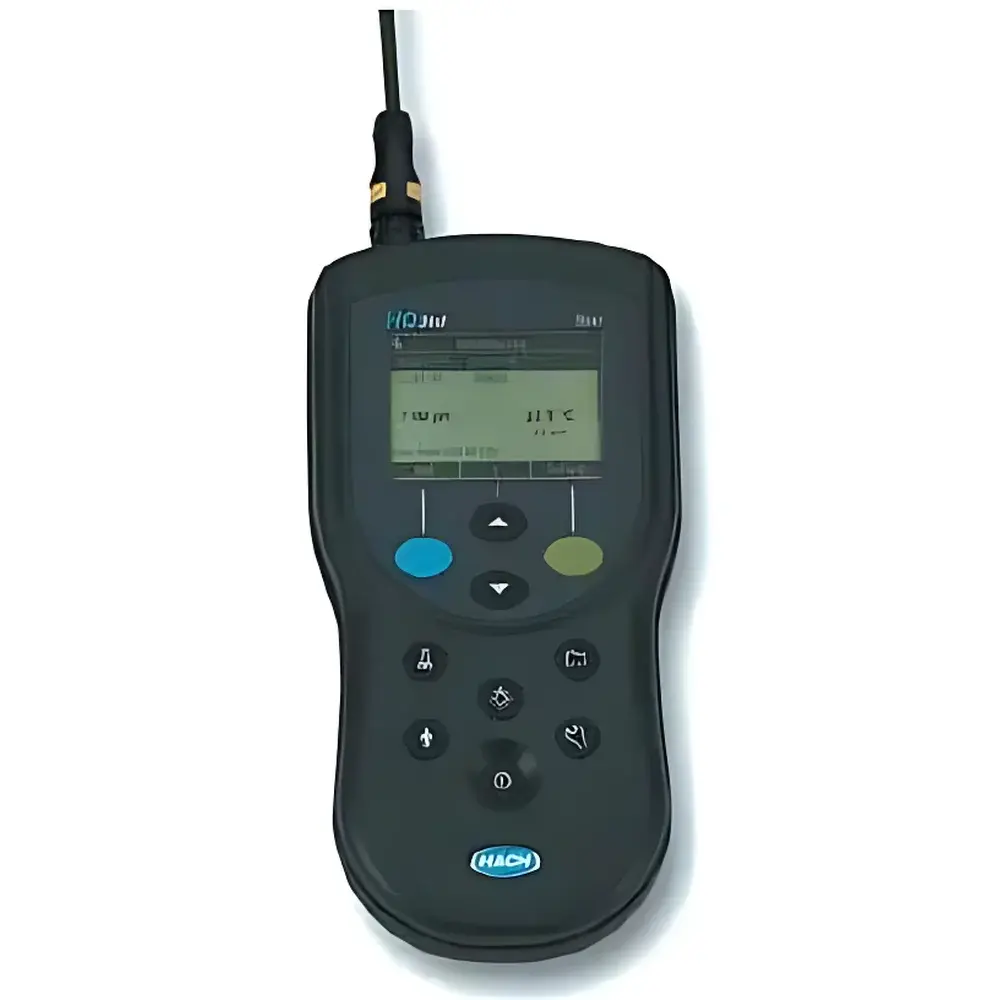
Hach HQ30d Portable Luminescent Dissolved Oxygen Meter
| Brand | Hach |
|---|---|
| Origin | USA |
| Model | HQ30d with LDO Sensor |
| Measurement Range | 0–20 mg/L (ppm) and 0–200% saturation |
| Resolution | 0.01 mg/L |
| Sensor Type | Optical (Luminescence-based) |
| Cable Options | 1 m, 3 m, 5 m, 10 m, 15 m, 30 m (standard & rugged variants) |
| Compliance | Designed for ASTM D888, ISO 5814, and EPA Method 4500-O G |
Overview
The Hach HQ30d Portable Luminescent Dissolved Oxygen Meter is an optical, field-deployable instrument engineered for high-accuracy, maintenance-free dissolved oxygen (DO) measurement in environmental monitoring, wastewater treatment, drinking water distribution, and limnological research. Unlike electrochemical sensors relying on Clark-type amperometry or galvanic cells, the HQ30d employs a solid-state luminescent sensing principle—specifically, phase-fluorometric detection of oxygen quenching. The LDO (Luminescent Dissolved Oxygen) sensor features a proprietary ruthenium-based fluorophore immobilized on a stable polymer matrix. When excited by blue LED light (470 nm), the fluorophore emits red luminescence (~600 nm); molecular oxygen in the sample modulates the decay lifetime of this emission. The instrument precisely measures the phase shift or lifetime decay (in nanoseconds) between excitation and emission—a parameter inversely proportional to dissolved oxygen partial pressure. This physics-based calibration eliminates drift from electrolyte depletion, membrane fouling, or cathode polarization, delivering inherently stable measurements across variable temperature, salinity, and flow conditions.
Key Features
- Zero-polarization operation: No warm-up or stabilization delay required—measurements begin immediately upon immersion.
- Factory-calibrated sensor: Pre-characterized against NIST-traceable standards; no user calibration needed under routine field conditions.
- Membrane-free design: Eliminates consumables such as replacement membranes, electrolyte refills, or cathode cleaning—reducing total cost of ownership and operational downtime.
- Chemical interference resistance: Immune to sulfide, chlorine, hydrogen sulfide, heavy metals, and other common interferents that degrade electrochemical DO sensors.
- Ruggedized optical cap options: Standard and impact-resistant LDO probes rated for repeated handling, sediment contact, and partial surface contamination without loss of accuracy.
- Integrated temperature compensation: Automatic correction using built-in thermistor (±0.1 °C accuracy) per ASTM D888 and ISO 5814 protocols.
Sample Compatibility & Compliance
The HQ30d LDO system is validated for use in freshwater, seawater, wastewater effluents, activated sludge, groundwater, and surface runoff. It meets method requirements for EPA Method 4500-O G (luminescence-based DO determination), ASTM D888-22 (Standard Test Methods for Dissolved Oxygen in Water), and ISO 5814:2012 (Water quality — Determination of dissolved oxygen — Electrochemical probe method). While the optical principle does not require compliance with USP or FDA 21 CFR Part 11 for pharmaceutical applications, its audit-ready data logging (with timestamped events, operator ID, and sensor diagnostics) supports GLP-aligned field documentation workflows. All firmware and calibration records are stored internally with tamper-evident metadata.
Software & Data Management
Data acquisition and reporting are managed via Hach’s portable HQd platform firmware (v3.2+), supporting real-time display, manual/automatic logging (up to 500,000 points), and CSV export via USB or Bluetooth. Each measurement includes dissolved oxygen concentration (mg/L and % saturation), temperature (°C), atmospheric pressure (mbar), salinity (ppt), and sensor health status (e.g., fluorophore intensity, signal-to-noise ratio). Field technicians may configure measurement intervals, alarm thresholds, and unit preferences directly on-device. For centralized QA/QC, data files integrate seamlessly with Hach’s LabStation software and third-party LIMS platforms via standardized .csv or .xlsx templates compliant with ISO/IEC 17025 documentation requirements.
Applications
- Wastewater treatment plant process control: Aeration basin optimization, return activated sludge (RAS) monitoring, and final effluent compliance verification.
- Drinking water distribution system integrity assessment: Detection of stagnation zones, biofilm activity, and disinfectant residual interactions.
- Environmental site assessment: Stream/river DO profiling, wetland health evaluation, and sediment-water interface flux studies.
- Regulatory field sampling: EPA Region-specific ambient water quality surveys requiring traceable, non-destructive DO quantification.
- Academic and research fieldwork: Long-term deployment in remote locations where battery life (>100 hours), low maintenance, and thermal stability are critical.
FAQ
Does the LDO sensor require recalibration during routine use?
No—factory calibration remains valid for the sensor’s service life under normal operating conditions. Recalibration is only recommended after physical damage to the optical cap, exposure to solvents, or when verifying traceability for regulatory audits.
Can the HQ30d measure DO in high-salinity seawater?
Yes—the instrument applies automatic salinity compensation using user-entered ppt values or integrated conductivity readings (when paired with a compatible HQd conductivity probe), ensuring accuracy up to 45 ppt per ISO 5814 Annex B.
How does temperature affect LDO measurement accuracy?
Temperature influences oxygen solubility and fluorophore kinetics. The HQ30d incorporates a high-precision thermistor and applies dual-parameter correction (temperature + salinity) in real time, maintaining ±0.1 mg/L accuracy across 0–50 °C.
Is the LDO probe suitable for continuous submerged deployment?
Standard LDO probes are designed for spot measurements and short-term immersion (<24 h). For long-term monitoring, Hach offers dedicated LDO submersible housings (e.g., LDO-Sub10 series) with IP68-rated enclosures and anti-fouling coatings.
What cable length options are available for extended reach applications?
Ruggedized LDO probes support cable lengths of 1 m, 3 m, 5 m, 10 m, 15 m, and 30 m—each certified for mechanical durability, signal integrity, and EMI resistance in industrial field environments.







