
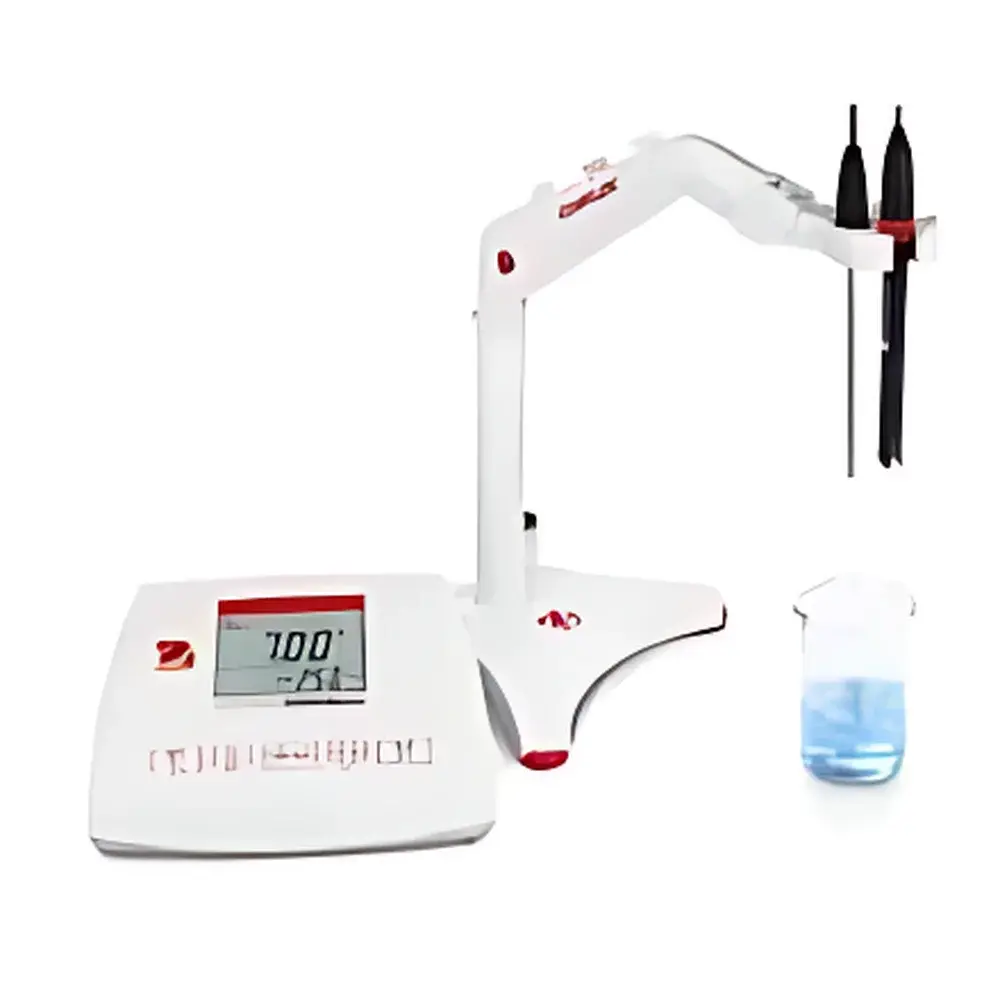
OHAUS STARTER 2100/3C Pro Benchtop pH Meter
| Brand | OHAUS |
|---|---|
| Origin | USA |
| Model | STARTER 2100/3C Pro |
| pH Range | 0.00–14.00 |
| mV Range | −1999 to +1999 mV |
| Temperature Range | 0.0–100.0 °C |
| Resolution | 0.01 pH / 1 mV / 0.1 °C |
| Accuracy | ±0.01 pH / ±1 mV / ±0.5 °C |
| Calibration | Up to 3-point with auto-buffer recognition |
| Temperature Compensation | Automatic or manual (NTC 30 kΩ sensor) |
| Input Impedance | >10¹² Ω (BNC pH input) |
| Power | AC 110–240 V, 50 Hz / DC 12 V |
| Dimensions | 220 × 175 × 78 mm |
| Weight | 0.75 kg |
| Display | LCD |
| Housing Material | ABS |
| Compliance | CE, ISO 9001, CMC certified |
Overview
The OHAUS STARTER 2100/3C Pro is a benchtop pH meter engineered for routine laboratory applications requiring reliable, repeatable electrochemical measurements in academic, quality control, and industrial testing environments. Based on potentiometric measurement principles, the instrument determines hydrogen ion activity via a glass electrode coupled with a reference electrode, delivering stable voltage signals converted into pH values using Nernst equation-based algorithms. Its design emphasizes operational robustness, intuitive workflow integration, and long-term calibration stability—critical attributes for laboratories performing daily pH verification of buffers, aqueous solutions, culture media, wastewater effluents, and food extracts. The device operates within standard ambient temperature conditions (15–30 °C) and supports full-range aqueous pH assessment from strongly acidic (pH 0.00) to highly alkaline (pH 14.00) matrices, with simultaneous mV mode enabling redox potential evaluation and electrode diagnostics.
Key Features
- Auto-buffer recognition across standard IUPAC and NIST-traceable calibration points (e.g., pH 4.01, 7.00, 10.01), reducing operator error during multi-point calibration sequences.
- Dual-mode temperature compensation: automatic compensation using integrated NTC 30 kΩ thermistor (Cinch connector) or manual entry—ensuring accuracy across thermal gradients from 0.0 to 100.0 °C.
- High-input-impedance (>10¹² Ω) BNC pH input minimizes signal drift and leakage current, preserving measurement fidelity especially with high-resistance electrodes or low-conductivity samples.
- Compact ABS housing provides chemical resistance and mechanical durability while maintaining ergonomic footprint (220 × 175 × 78 mm) for benchtop flexibility—compatible with standard electrode stands and modular lab setups.
- Real-time clock functionality enables timestamped calibration records, supporting GLP-compliant documentation practices without external software dependency.
- On-device storage retains last calibration metadata—including date, time, slope (%), offset (mV), and buffer IDs—facilitating internal audit readiness and traceability.
Sample Compatibility & Compliance
The STARTER 2100/3C Pro is validated for use with standard combination pH electrodes (e.g., refillable gel-filled or double-junction types) and compatible with common aqueous and mildly buffered matrices. It is not intended for non-aqueous solvents, viscous suspensions, or high-salinity brines without electrode-specific conditioning. Regulatory alignment includes CE marking per Directive 2014/30/EU (EMC) and 2014/35/EU (LVD), ISO 9001:2015-certified manufacturing, and China Metrology Certification (CMC) for domestic metrological traceability. While the instrument itself does not enforce 21 CFR Part 11 compliance, its timestamped calibration logs and immutable device-stored records serve as foundational elements for laboratories implementing supplementary procedural controls under GMP/GLP frameworks.
Software & Data Management
This model operates as a standalone instrument with no proprietary PC software or cloud connectivity. All data handling occurs locally: calibration parameters, timestamps, and mV/pH readings are retained exclusively in volatile memory until overwritten by subsequent calibration events. No export capability (USB, Bluetooth, or RS-232) is provided; therefore, manual transcription or external logging via camera/photo documentation remains the primary method for record retention. For labs requiring electronic data capture, integration with third-party LIMS or ELN systems must occur at the procedural level—not through native instrument interface.
Applications
- Academic teaching labs: Demonstrating acid-base equilibria, titration endpoint detection, and electrode response kinetics.
- Pharmaceutical QC: Monitoring pH of dissolution media, buffer preparations, and purified water (PW) per USP guidelines.
- Food & beverage: Verifying acidity in dairy products, fruit juices, and fermentation broths prior to microbial challenge testing.
- Environmental testing: Field-deployable validation of portable meters via benchtop reference checks in wastewater treatment facilities.
- Chemical manufacturing: In-process control of neutralization reactions and catalyst slurry pH stabilization.
FAQ
Does the STARTER 2100/3C Pro support electrode diagnostics or slope calculation?
Yes—it automatically calculates and displays electrode slope (% deviation from theoretical 59.16 mV/pH at 25 °C) and asymmetry potential (offset in mV) after each calibration event.
Can it be used with non-OHAUS electrodes?
Yes, provided the electrode uses standard BNC connectors and meets minimum impedance specifications (>10¹² Ω at DC); compatibility with double-junction or low-noise electrodes is confirmed.
Is temperature compensation mandatory during pH measurement?
No—manual temperature entry is supported, but automatic compensation is recommended for improved accuracy when sample temperature deviates significantly from 25 °C.
What is the expected service life of the internal power supply components?
Under normal operating conditions (≤8 hrs/day, ambient humidity 5 years mean time between failures (MTBF) based on OHAUS reliability testing protocols.
How frequently should calibration be performed?
Calibration frequency follows risk-based laboratory SOPs; for routine QC use, daily 2-point calibration (pH 4.01 and 7.00) is typical, with 3-point verification required after electrode replacement or extended storage.
Related Products



